Buying creative tools
AI Image Subscription vs. Pay As You Go: Find Your Break-Even

An occasional maker and a daily production team can make opposite buying decisions from the same prices. Count the attempts you will use, the images you accept and the allowance you might leave idle.
This guide creates a fictional purchasing worksheet in Ciyo. Its $24 subscription, 120-attempt allowance, $0.30 attempt rate and 50% acceptance assumption are illustrative. They are not competitor prices or measured results.
Compare equivalent work
Choose one deliverable, such as a monthly set of promotional pictures. Compare plans only when they offer the model, references, resolution, editing and export access the task needs.
Write down any overage rule, rollover limit and renewal terms from the plan you are considering. If a key term is unknown, leave it unknown rather than filling the gap with a favorable assumption.
Calculate break-even inside the allowance
In the example, subscription cost S is $24 and pay-as-you-go attempt cost p is $0.30. For n attempts within the 120-attempt allowance, compare S with n×p. Equality occurs at S÷p = 80 attempts.
At 20 attempts, the example consumption is $6; at 60 it is $18; at 80 it is $24; at 120 it is $36. Above 120, the subscription’s overage terms are unknown, so this comparison stops.
Build a worksheet in Ciyo
Ask the design agent to make the inputs, formula and boundary visible. Include a separate section for cash paid up front and credits consumed, because those are different purchasing questions.
The live workflow creates a code-rendered planning worksheet on the canvas. It does not generate test photographs or measure acceptance. Keep the illustrative label visible on every cost comparison.
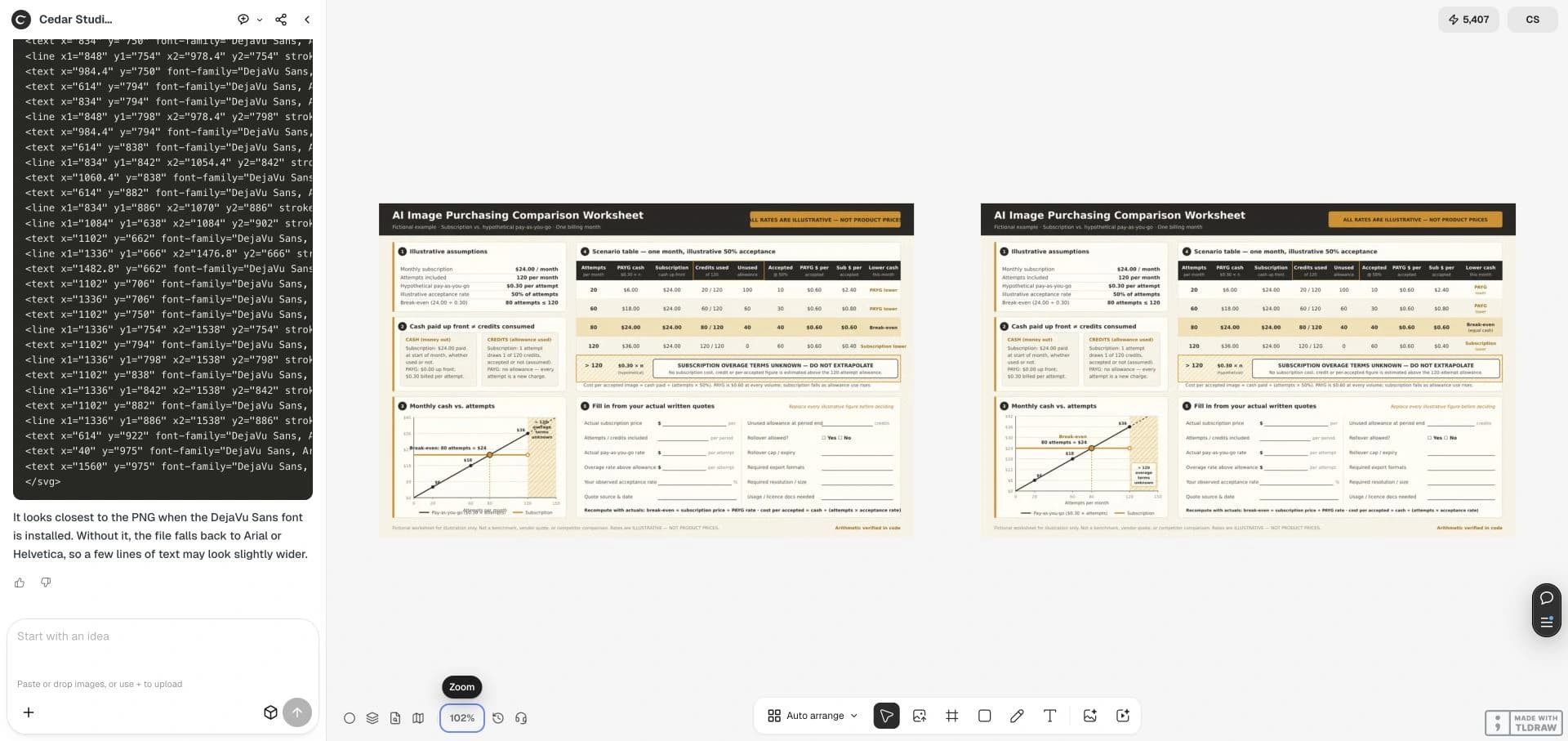
Use code only for a 1600×1000 fictional purchasing worksheet. Label all rates ILLUSTRATIVE — NOT PRODUCT PRICES. Subscription $24 with 120 attempts; pay-as-you-go $0.30 per attempt. Show 20=$6, 60=$18, 80=$24, 120=$36; break-even 80. At illustrative 50% acceptance show 10/30/40/60 accepted, $0.60 each for pay-as-you-go and $2.40/$0.80/$0.60/$0.40 for subscription. Stop subscription beyond 120: overage unknown. Separate upfront cash from consumption; leave blanks for actual quotes, unused allowance, rollover and exports. Verify arithmetic and layout, place PNG on canvas and print SVG source. No image/video calls or measured benchmark.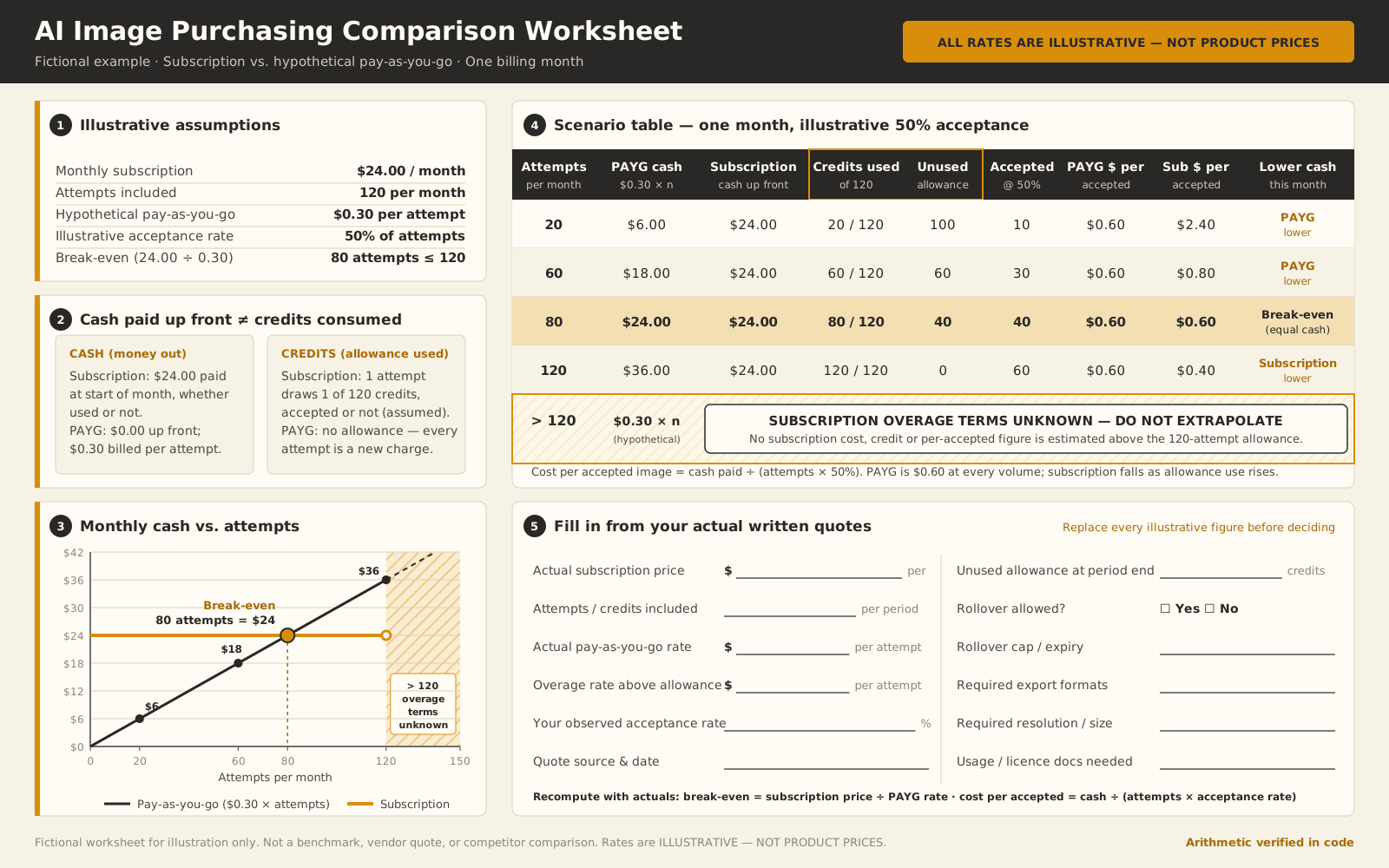
Compare cost per accepted image
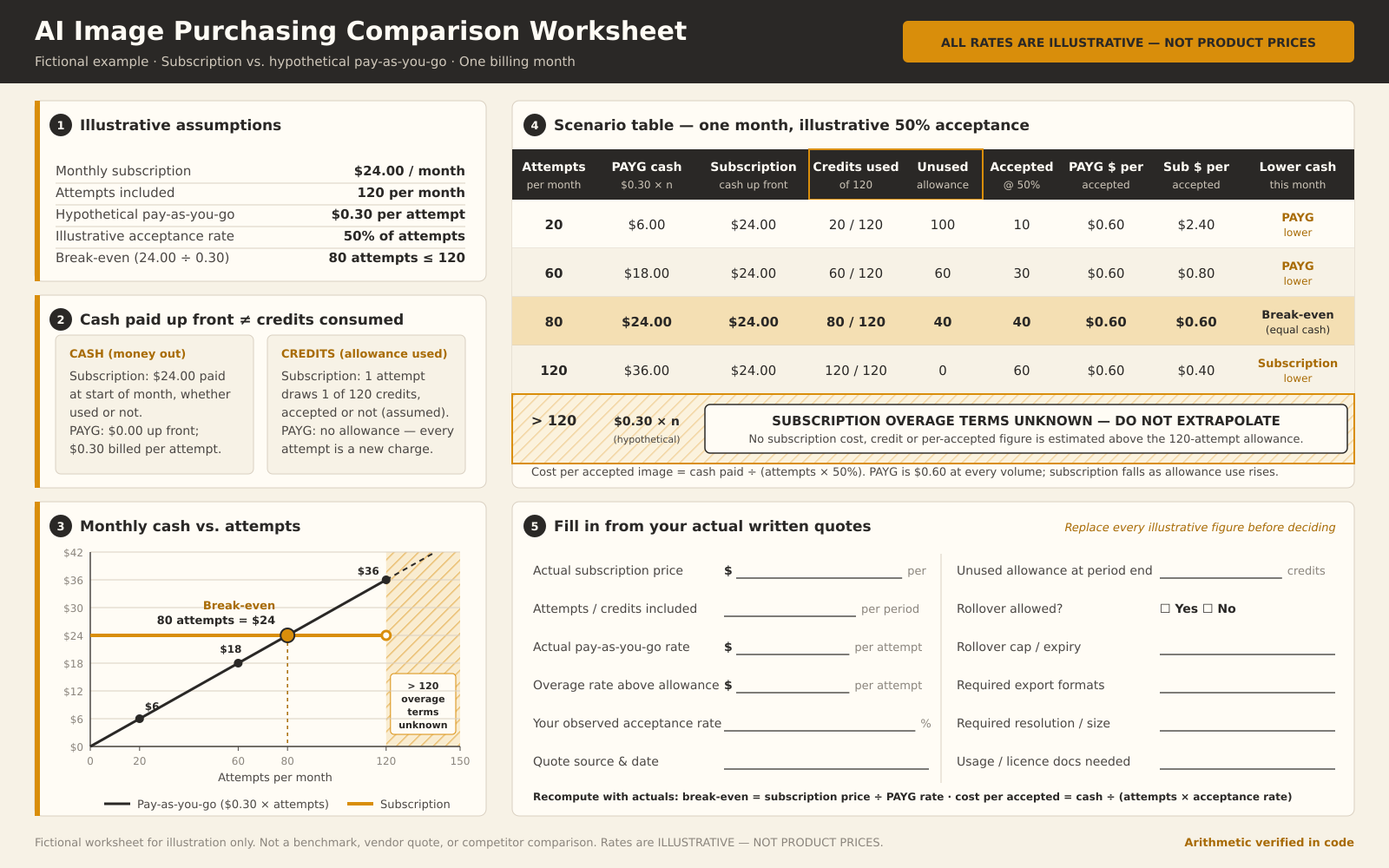
At the invented 50% acceptance assumption, 20, 60, 80 and 120 attempts produce 10, 30, 40 and 60 accepted images. Pay-as-you-go cost per accepted image is $0.60 throughout this example.
Allocating the $24 subscription across those accepted counts gives $2.40, $0.80, $0.60 and $0.40. Replace the assumed acceptance with your own pilot results. If the plans have different acceptance rates, using the same rate can conceal the real difference.
| Attempts | Accepted images | Pay-as-you-go consumption | Subscription cost per accepted image |
|---|---|---|---|
| 20 | 10 | $6 | $2.40 |
| 60 | 30 | $18 | $0.80 |
| 80 | 40 | $24 | $0.60 |
| 120 | 60 | $36 | $0.40 |
Separate consumption from the checkout
Ciyo’s published pricing is pay-as-you-go, with a $10 pack containing 1,000 non-expiring credits. That is a cash purchase; a project may consume only part of it. Read current operation quotes before applying the worksheet to Ciyo.
A recent Reddit post by Artem of Writingmate argues for task-specific tests before choosing a subscription and promotes that company’s platform. Our break-even worksheet is an original adaptation; the poster did not use or endorse Ciyo, and we do not adopt its model rankings or price table.
Original Reddit post by Artem of Writingmate, promoting that platform. It informs the idea of testing a specific task before buying; this worksheet is our own adaptation, not a Ciyo endorsement.
Buy for the next realistic production period
Use a conservative workload estimate for the next month or project, including rejected attempts and expected revisions. Repeat the calculation when settings or workflow change; last month’s quote may no longer apply.
If use is intermittent, unused subscription allowance matters. If work is steady and the plan fits the task, included capacity may be valuable. Make the decision from actual terms and a representative pilot rather than a promise that either billing model always wins.
Practical questions
Is 80 attempts Ciyo’s break-even point?
No. It comes from fictional comparison inputs. Replace them with the actual plans and quotes you are evaluating.
What if I exceed the included allowance?
Read the overage terms and calculate a new comparison. This example does not extrapolate past 120 attempts.
Is a $6 consumption estimate a $6 checkout?
Not necessarily. Prepaid credit packs can require a larger upfront purchase, leaving a balance for later use.
Compare one realistic month
Enter the actual plan terms and your expected workload. Keep the sample assumptions visible until you replace them with evidence.