GPT-6 Astra · Practical Ciyo workflows
GPT-6 Astra Ad Creatives with GPT Image 2.5 and Seedance 2.5

“Make ten ads” is a production request. “Find out whether a product close-up communicates better than a lifestyle scene” is a learning question. The second gives your creative work a purpose and makes the results easier to interpret.
Use GPT-6 Astra to turn that question into a test matrix, GPT Image 2.5 to create the still candidates, and Seedance 2.5 when the experiment needs motion. Ciyo prepares the creative assets; your ad platform controls delivery and reporting. The example below is a fictional product test, with clearly illustrative results.
A practitioner’s variation workflow: change the opening, keep the base
In r/PPC, u/Expert_Coffee_203 describes duplicating a base CapCut edit and changing the opening three seconds or captions. The question is how to keep scaling variations without rebuilding the same work. It is a practical production discussion, not a reported experiment proving that one creative wins.
Bring that distinction into the Ciyo brief: identify the reusable base and the one deliberate variation before generating. The source uses CapCut; the Astra, GPT Image 2.5 and Seedance 2.5 workflow below is our adaptation. Matching the brief is only the first step—compare the actual assets for unintended differences before testing them.
Practitioner discussion about a CapCut workflow. Our Ciyo test matrix is an original adaptation; the post supplies no performance result.
Choose the decision the experiment should inform
Suppose a fictional desk-light brand wants to know whether showing the lamp alone or in a workspace makes its offer clearer. Keep the offer, landing page and headline the same for the first comparison. Write the expected mechanism: the workspace may communicate use, while the close-up may make the product easier to recognize.
Astra can help expose uncontrolled differences in the brief. Ask it to identify which elements must remain fixed and which one may change. Its preference is creative feedback, not a forecast of which ad will sell more. Real results still depend on the audience, delivery and measurement setup.
Make a small matrix you can audit visually
Start with two cells. Expanding to a two-by-two layout can help organize a second experiment, but it introduces another factor. If you test both image treatment and headline, be explicit that the four assets answer a broader question. Do not call a completely redesigned ad a controlled variation.
Use the canvas to compare the actual files against the matrix. Check that the product crop did not accidentally change between headline variants. A labeled plan is valuable only when the exported assets still match it.
| Asset | Image treatment | Headline |
|---|---|---|
| A1 | Product close-up | Meet your evening light |
| A2 | Product close-up | A calmer corner starts here |
| B1 | Desk scene | Meet your evening light |
| B2 | Desk scene | A calmer corner starts here |
Brief the assets with explicit invariants
Ask Astra for a production plan using your product reference, approved claim and destination. Select GPT Image 2.5 and generate the two treatments from the same identity reference. Keep the headline as editable text in the destination layout tool so a spelling change does not require regenerating the product.
Reject creative drift before launch. A close-up with a huge discount badge and a lifestyle scene with no offer do not isolate image treatment. If you intentionally change several things, call it a concept comparison and document the changes instead of pretending the result identifies one cause.
For a video test, first approve both GPT Image 2.5 stills. Send each to Seedance 2.5 with the same requested duration, camera move and audio choice. If the experiment tests the opening composition, a change in music or motion introduces another explanation for the result. Review the actual generated clips for those accidental differences before uploading them.
Help me plan an ad creative experiment for [product] and [audience]. Hypothesis: [one specific visual choice changes how the offer is understood]. Use my attached product image as the identity reference. Create a two-cell matrix first. Keep product facts, offer, headline, CTA and destination fixed; vary only [image treatment]. List accidental differences to check before export. Plan the work before generating. Do not predict CTR, sales or a winning asset. After the matrix is approved, use GPT Image 2.5 for the still candidates. If I choose a video test, animate the approved stills with Seedance 2.5 using matched motion, duration and audio settings. Wait for approval at each media stage.Read a results chart without inventing a winner
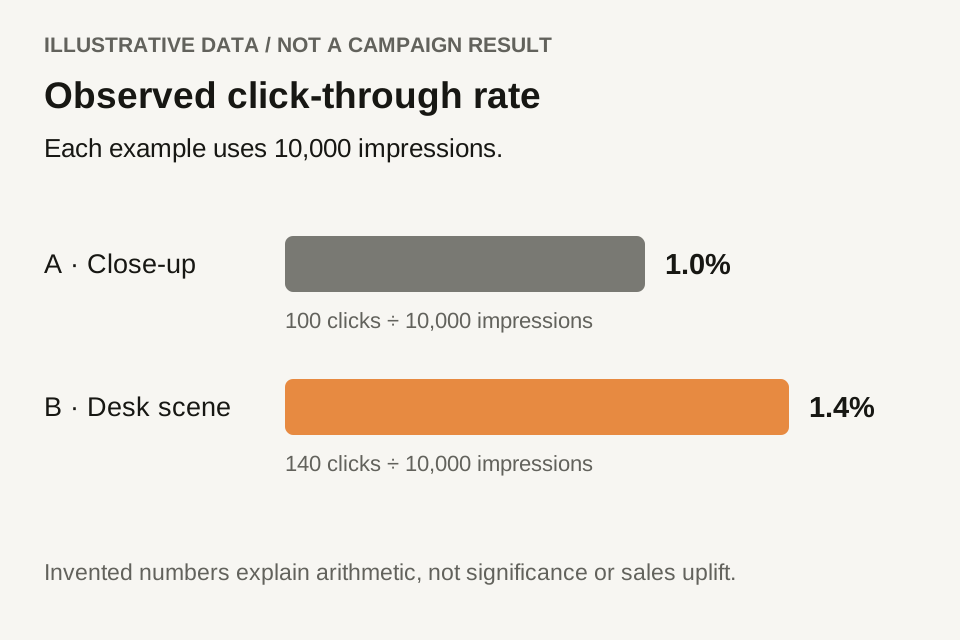
Imagine A receives 10,000 impressions and 100 clicks, while B receives 10,000 impressions and 140 clicks. The observed click-through rates are 1.0% and 1.4%. That arithmetic describes the sample; it does not prove that B causes more sales, nor that the result will repeat.
Use the platform’s experiment method and examine the outcome you chose in advance. Unequal delivery, audience differences or a changed landing page can complicate interpretation. A high click rate with poor downstream performance may indicate that the ad attracts curiosity rather than suitable buyers.
| Variant | Impressions | Clicks | Observed CTR |
|---|---|---|---|
| A: close-up | 10,000 | 100 | 1.0% |
| B: desk scene | 10,000 | 140 | 1.4% |
Turn the observation into the next creative decision
Record what you tested, what was delivered and what remains uncertain. “The desk scene had a higher observed CTR in this sample” is a defensible note. “Astra increases conversions by 40%” is not supported by those numbers. Keep your asset IDs connected to the reports exported from the ad platform.
Bring the finding back to Ciyo for the next iteration. If the scene appears promising, preserve it while testing one new element. Save unsuccessful assets too: they document what the experiment actually compared and prevent a future team from unknowingly repeating the same test.
Frequently asked questions
Does Ciyo run my advertising experiment?
This workflow creates and reviews the creative assets in Ciyo. Configure delivery, conversion tracking and experiment analysis in your advertising platform.
Can Astra choose the winning ad before launch?
It can critique an ad against your brief, but that is not measured audience response. Use real experiment results for performance claims.
Put this workflow on your canvas
Use the “Try GPT-6 Astra in Ciyo” link to open an editable starter. Add your own references and constraints before sending. Choose the image or video model and supported settings for the asset you want to create.