Industrial design review · Production guide
Present hardware colorways with a part-by-part finish matrix
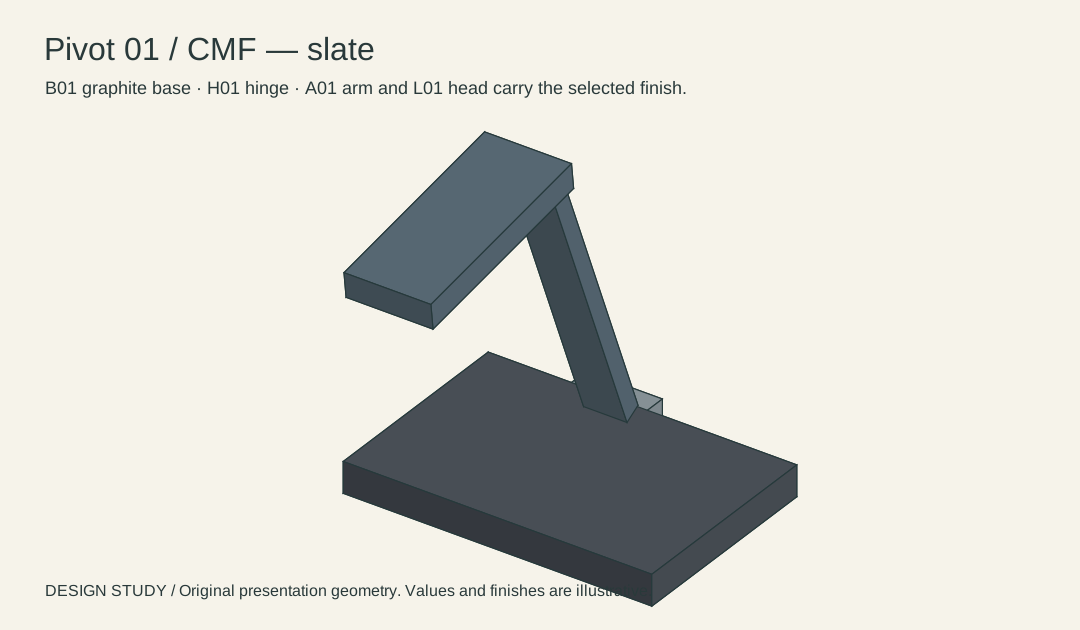
B01 and H01 stay fixed in all three variants. A01 and L01 share the finish selection. Use the stable part IDs as columns instead of describing components by their position on the sheet.
Input and decision
Label each variant by part ID rather than by page number. In this example B01 is the base, H01 the hinge, A01 the arm and L01 the head. Pivot 01 is an original presentation model. Material and mechanical approval require their own evidence.
Set up the comparison
Change the finish for the arm and head together to create a second option. Highlight any cell whose finish differs from the source rules.
Make the comparison
Introduce a deliberate mismatch in a working copy: set the CW02 head to chalk and leave its arm oxide. The part matrix should expose the mismatch.
Worked record
The downloadable worksheet includes the records below and a blank row for your own project.
| Colorway | B01 | H01 | A01 | L01 |
|---|---|---|---|---|
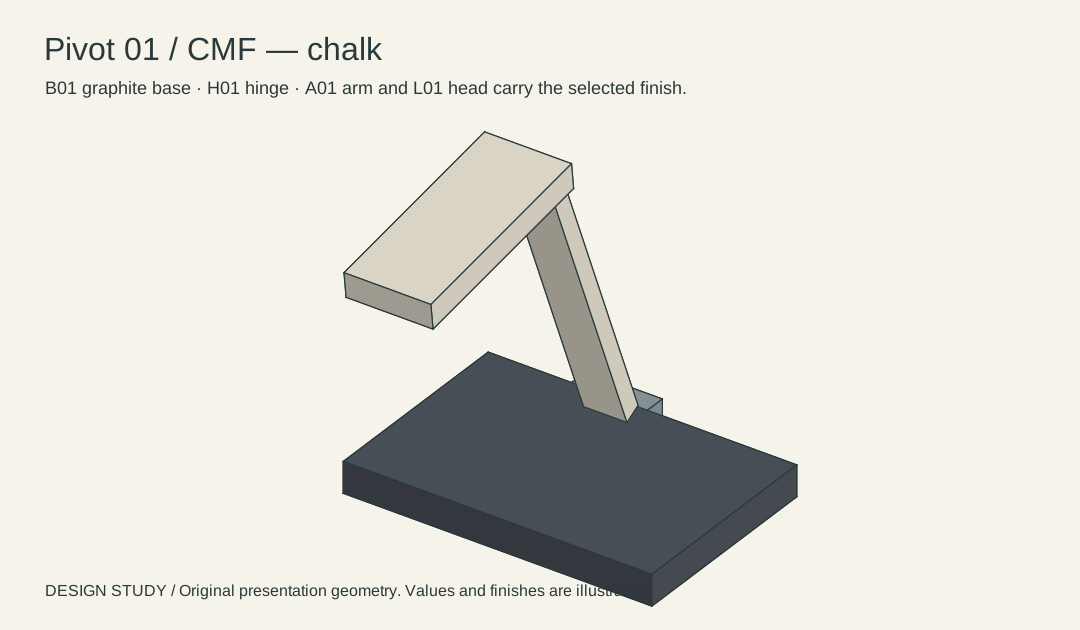
| CW01 | Graphite | Neutral metal | Chalk | Chalk |
| CW02 | Graphite | Neutral metal | Oxide | Oxide |
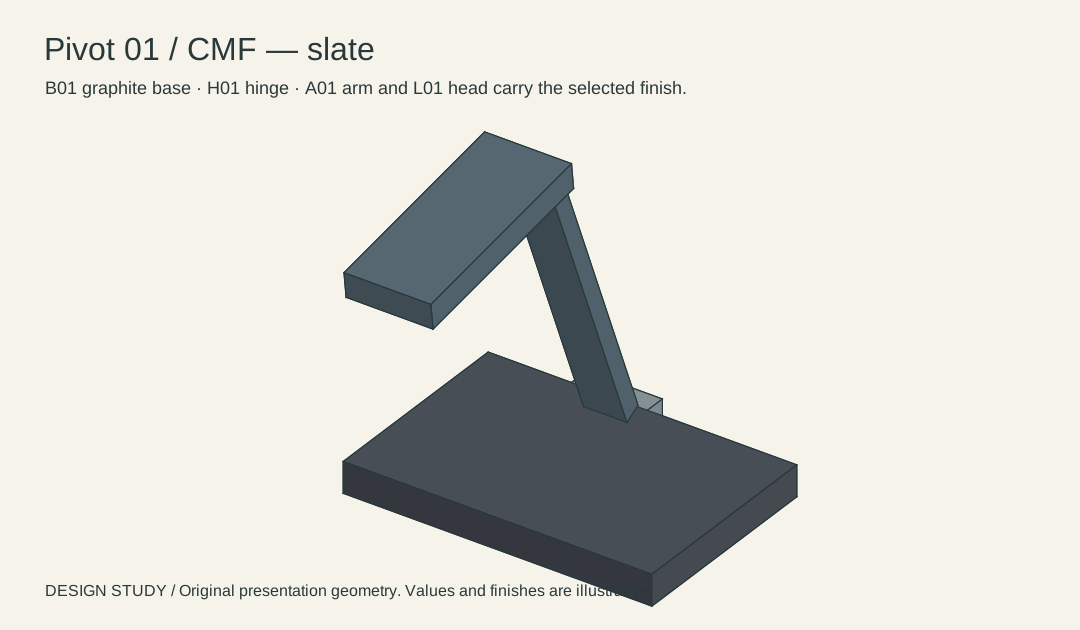
| CW03 | Graphite | Neutral metal | Slate | Slate |
Check the result
Deliberately give the head a different finish in one draft. The matrix should reveal the disagreement before anyone approves an entire colorway.
Hand off the revision
Keep one row per colorway and one column per part. Add the supplier code only after a physical match.
Review question
Do CW01, CW02 and CW03 specify purchasable coatings?
CW01, CW02 and CW03 label chalk, oxide and slate appearance proposals. Obtain supplier coating codes from the material owner after checking physical samples.
Use the task on your own brief
Use a copy of the worksheet to keep the project’s source files, reviewed options and decisions together.