Event print templates
How to Make a Name Badge Template That Fits a Long Name
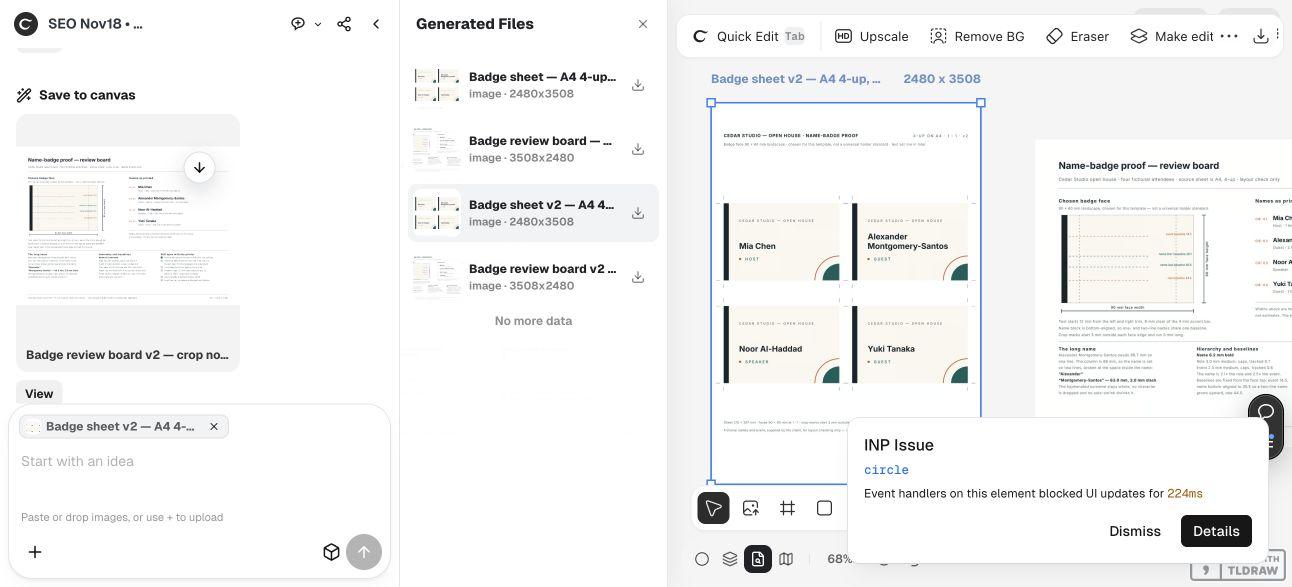
A badge template that works for a short name can fail on the longest entry in the roster. Shrinking every name to fit that one entry makes the whole set harder to scan; dropping part of the name changes the attendee’s information.
We used four fictional attendees for a Cedar Studio open house in a live Ciyo project. The delivered source keeps every full name, breaks Alexander Montgomery-Santos deliberately across two lines and retains editable text. We checked the source against the roster and corrected a crop-mark note before saving the final proof. No badges were printed or tested in a real holder.
Quick answer: test the longest name before accepting the template
Start from an exact roster, give the name more emphasis than the role or event, and decide how a long entry can wrap without losing characters. Compare that decision across the whole set, then check the actual source and a physical proof.
The five steps below use four chosen 90 × 60 mm badge faces on an A4 page. The dimensions describe this example; measure your own holder before adapting it.
| Step | Action | Keep for review |
|---|---|---|
| 1 | Prepare exact names and roles | An authoritative roster |
| 2 | Brief the hierarchy and longest entry | A layout that preserves every name |
| 3 | Compare the line-break decision | Consistent name size and baseline logic |
| 4 | Check the source, roster and final version | Editable text and accurate geometry notes |
| 5 | Measure the holder and a paper proof | A real fit and readability decision |
1. Use the roster as the source of truth
Keep names and roles in separate fields. Review spelling, punctuation and spaces before layout, and preserve the original full name alongside any display-line decisions. A line break is a layout choice; it should not silently become a different roster entry.
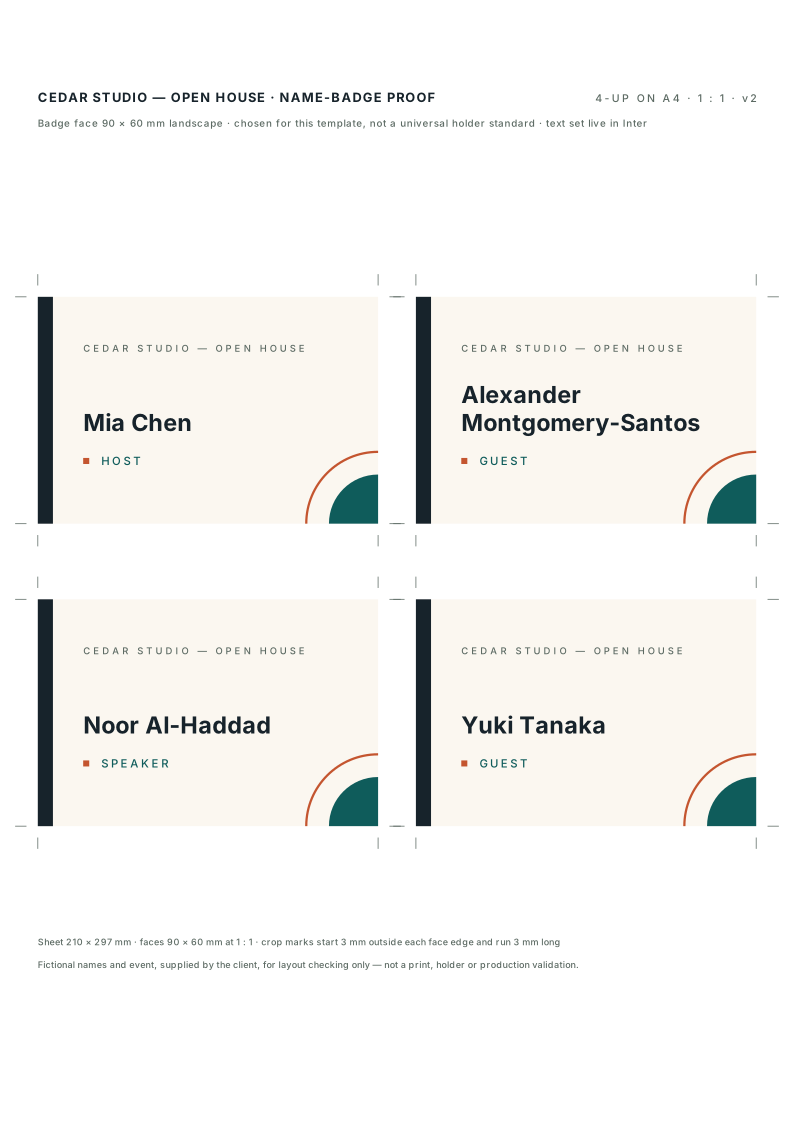
Our four fictional records are Mia Chen, Host; Alexander Montgomery-Santos, Guest; Noor Al-Haddad, Speaker; and Yuki Tanaka, Guest. The longest entry supplies a useful stress case, while the others show whether the same system still works for shorter names.
For a real event, use only the attendee information needed for the badge and obtain the correct spelling from the event’s approved roster. This demonstration contains fictional names and no attendee photographs or contact details.
| Full name | Display lines | Role |
|---|---|---|
| Mia Chen | Mia Chen | Host |
| Alexander Montgomery-Santos | Alexander / Montgomery-Santos | Guest |
| Noor Al-Haddad | Noor Al-Haddad | Speaker |
| Yuki Tanaka | Yuki Tanaka | Guest |
2. Brief a name-first hierarchy with an explicit long-name case
Give Ciyo the roster, chosen face dimensions and hierarchy in one request. State that full names must remain intact and that a deliberate second line is acceptable. Ask for editable text and a separate review board so the print faces stay clear of measurement annotations.
The live Design agent used vector geometry and measured type in its rendering environment. It delivered a four-up sheet and a review board, then returned the complete SVG and roster CSV in the conversation. We saved those sources separately; the canvas outputs were raster previews.
This method suits an organizer who needs to review a small roster before making a larger set. It does not demonstrate an automatic attendee import or a bulk printing service. The Design agent’s reasoning is billable usage even when the artwork is built as vectors.
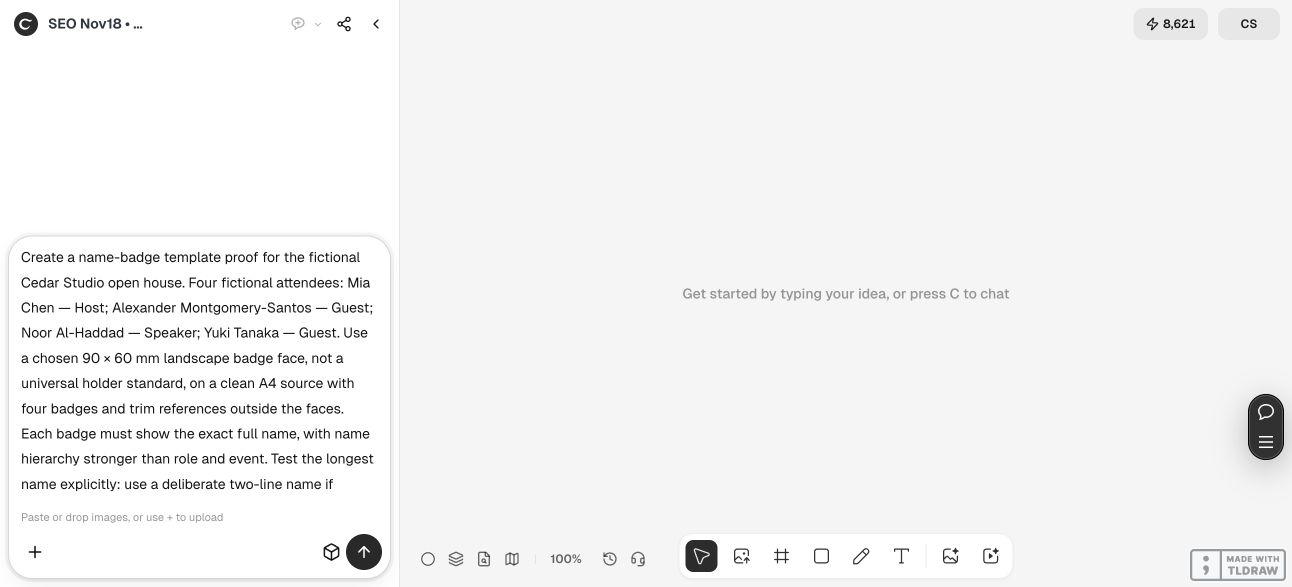
Create a name-badge template for [event] using this exact roster: [full name and role for each attendee]. Use [chosen face dimensions] after checking the intended holder. Give the name stronger hierarchy than role and event. Test [longest full name] explicitly: use a deliberate two-line break if needed, preserve every character and avoid squeezing every name smaller. Keep consistent name size, baseline logic and internal margins. Return complete editable SVG and a roster CSV with the full name preserved separately from display lines. Put a clean sheet and separate line-break review on the Ciyo canvas. Identify remaining font, printer and holder checks. Do not print, order, publish or contact attendees.3. Compare the two-line name with the rest of the set
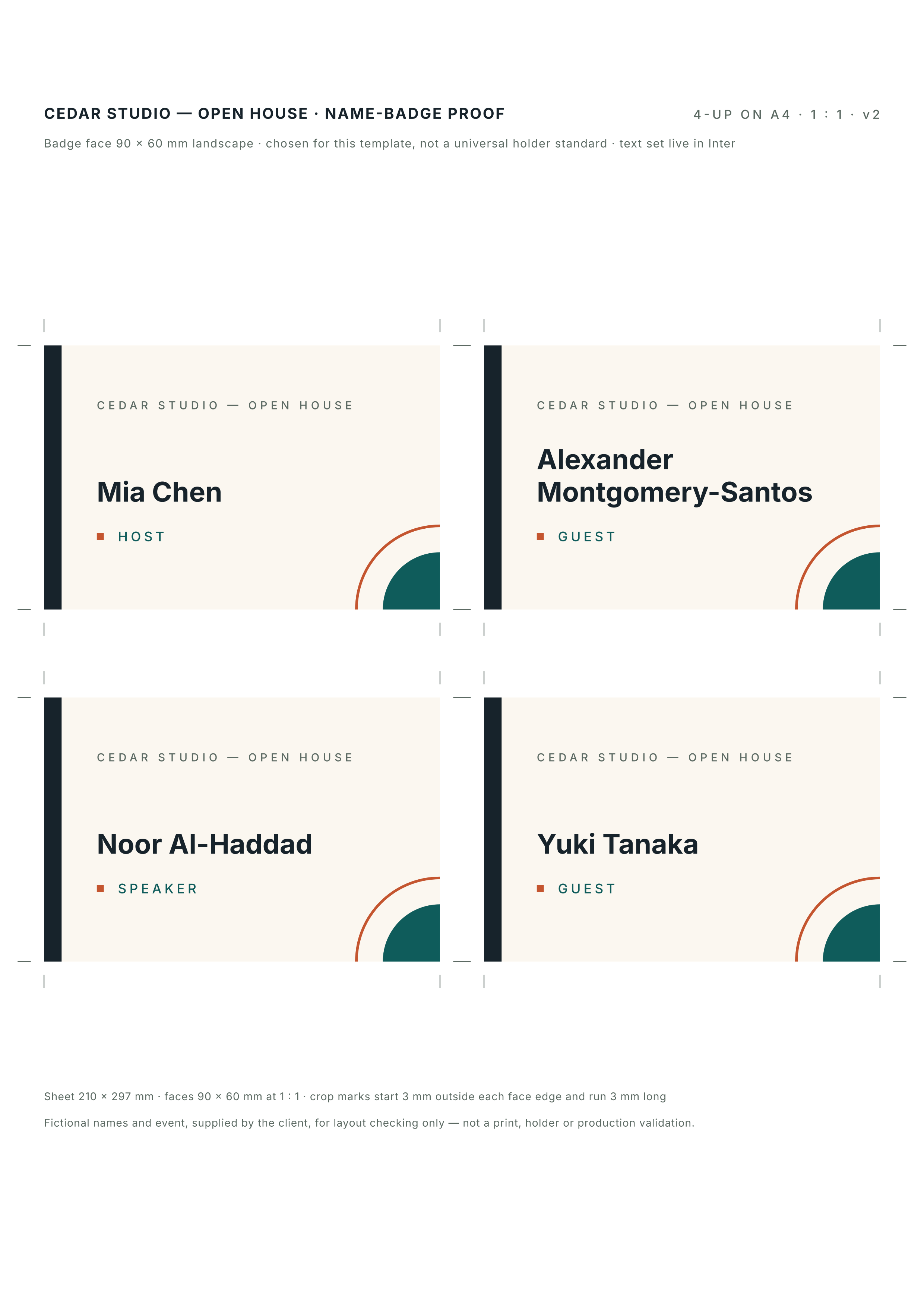
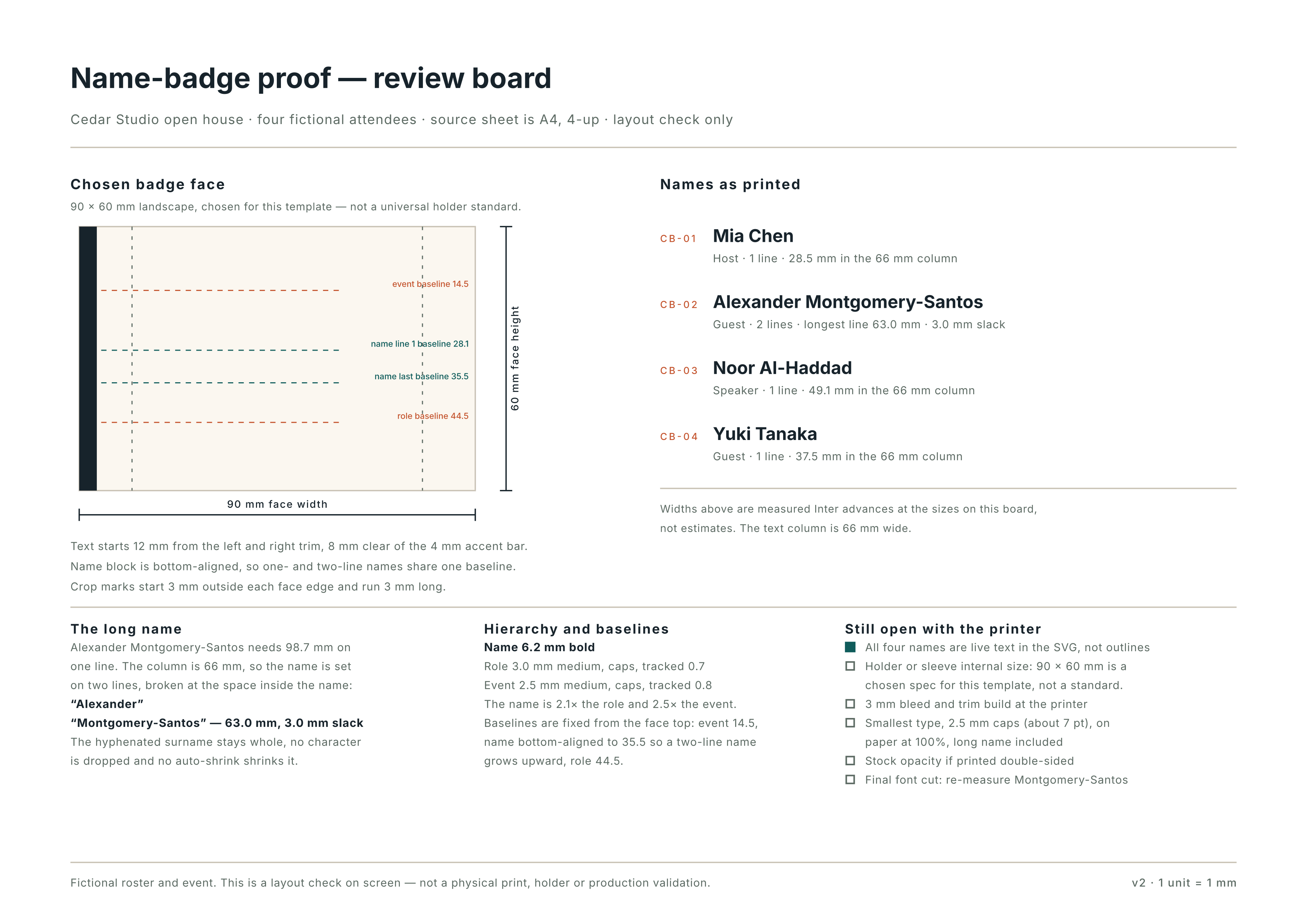
The example places “Alexander” above “Montgomery-Santos,” keeping the hyphenated surname together. The other three names stay on one line. All name text uses the same 6.2 mm size in the source, so the longest record does not force a smaller name size across the set.
The final name line shares a baseline 35.5 mm below each face’s top edge. The two-line block grows upward from that baseline, while the role remains below it. That gives the reviewer a concrete alignment rule rather than four independently positioned text blocks.
Inspect both the longest line and the surrounding hierarchy. The event sits above the name at a smaller size; the role sits below. A readable full name is the main task, so decorative geometry should not compete with it or cover part of a long surname.
These are layout observations on the supplied sample, not a universal rule for every writing system or name. A different roster may need different break points or a wider face. Preserve full-name data and review each exceptional display explicitly.
4. Check the exact names, source geometry and final version
We parsed the SVG and compared each badge’s name text with the roster CSV. All four full names matched when the intended display lines were joined with a space. The four face rectangles measured 90 × 60 mm in the source, on a page declared as 210 × 297 mm.
A separate source inspection caught a note that did not match the geometry: the first footer called the crop marks 1.5 mm offset, while the marks started 3 mm outside each face and ran for 3 mm. We asked for a focused correction that kept names and geometry unchanged. The v2 footer now describes the marks as drawn.
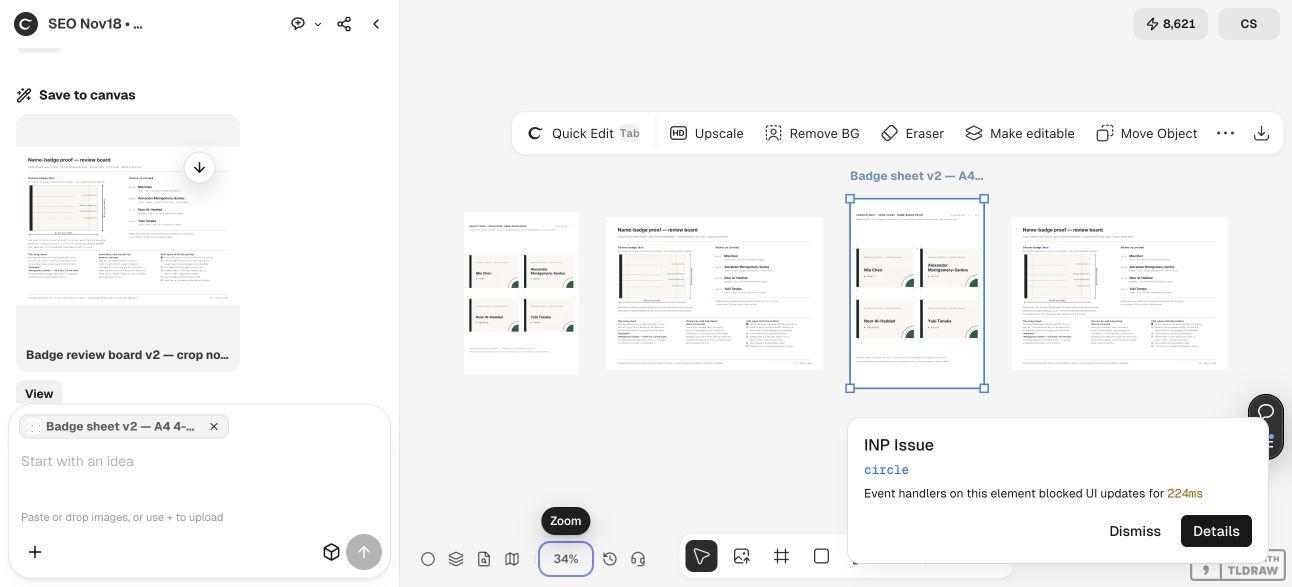
Use the corrected v2 sheet and review image. The earlier version remains in the project, so select by the explicit version name rather than choosing the first file. The crop-mark gap is a chosen layout detail; it does not establish bleed, printer acceptance or holder clearance.
The SVG keeps live text and specifies Inter with fallback fonts. The supplied PNG records the actual Ciyo rendering. If your editor substitutes a font, recheck the long line before exporting a new proof; the original rendering’s text widths do not automatically transfer to another font.
5. Check one real holder and one physical proof before producing the set
Measure the actual holder or sleeve’s usable space and visible opening. Our 90 × 60 mm face is only a chosen example. A holder lip or window can hide text that fits comfortably within the digital rectangle.
Make a paper proof at the intended size and compare the shortest and longest names at the distance where people will read them. Check the role and event too, especially their smaller text. Confirm paper, trim and any bleed requirements with the actual print workflow before preparing the full set.
For a small event, review each attendee directly against the roster. For a larger job, preserve the roster and line-break decisions together so a later update does not restore an unsuitable one-line name. Recheck changed names rather than assuming a previously accepted template covers every new record.
The demonstration did not include physical printing, a holder test or a real check-in. The package supports the digital layout review; production approval still depends on your actual files, font, materials and equipment.
Name-badge template questions
Should every name become smaller to fit the longest one?
This example keeps one name size and gives the longest entry a deliberate second line. That worked for the four supplied names; inspect your own roster before deciding whether the same approach fits.
Does the CSV preserve the full name?
Yes. It keeps full_name separately from name_line_1 and name_line_2. We checked that joining the display lines preserves each fictional full name.
Are the crop marks a bleed specification?
No. The corrected source documents a 3 mm gap and 3 mm mark length outside each face. Your printer’s bleed, trim and paper requirements remain separate checks.
Will the SVG look identical with another font?
Not necessarily. It uses editable text with an Inter-first font stack. Recheck the longest line and export a new proof if the editor substitutes a font or you change the type.
Is the badge ready for any holder?
No. The 90 × 60 mm face is a demonstration choice. Measure the actual holder and visible opening, then check a physical proof before producing the set.
Make the longest name part of the first proof
Give Ciyo an exact roster and a clear hierarchy. Review full names, line breaks and the actual export before moving to a measured holder and paper proof.