Buying creative tools
AI Design Revision Cost: Keep One Change to One Change

“Just change the button” becomes expensive when the tool also changes the event date, layout and illustration. Before buying a revision round, describe both the edit and the parts that must stay fixed.
We created a fictional Cedar Workshop poster in Ciyo and then requested one CTA change. The example tests controlled source revision and review. It does not establish a freelance market rate or a typical AI editing charge.
Name the approved version
Save a source and a proof of the accepted draft. Our starting poster is 1200×800 with Pottery taster; Saturday 17 October; Book a seat; FICTIONAL DEMO.
Use a visible version name in the project and file names. A link to an old screenshot without its source is a weak basis for a precise edit, especially when several alternatives share the same canvas.
Separate the change from the protected content
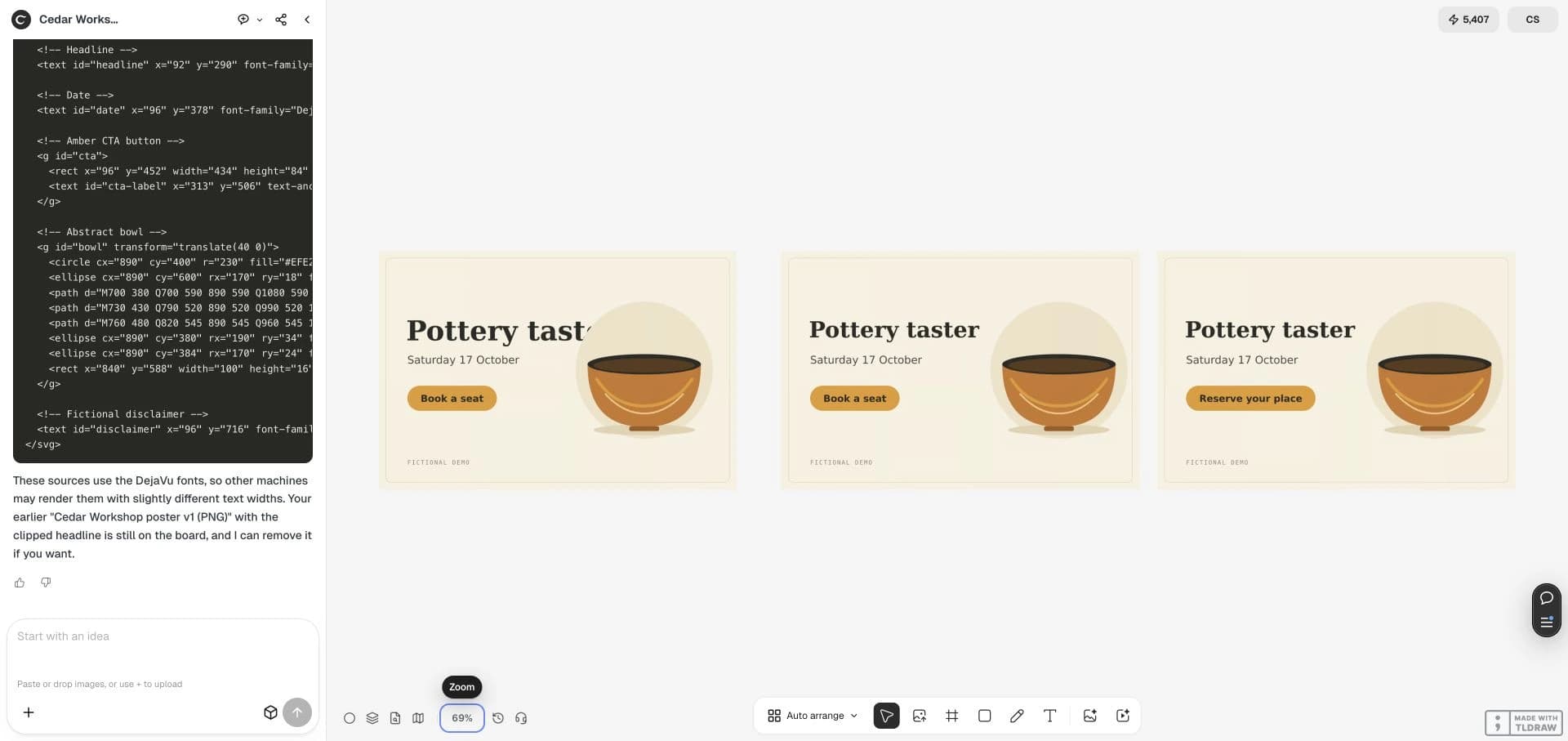
The change request replaces Book a seat with Reserve your place. The heading, date, demo label, illustration, colors and canvas dimensions remain fixed.
If feedback also asks for a new concept or a new format, price and approve that scope separately. One text substitution and a reworked creative direction have different acceptance criteria, even if both are described as revisions.
| Item | Instruction | Acceptance |
|---|---|---|
| CTA | Book a seat → Reserve your place | Exact new phrase |
| Heading and date | Keep fixed | Same source strings |
| Artwork and colors | Keep fixed | Compare geometry and fills |
| Size | 1200×800 | Same output dimensions |
| Extra scope | Ask before changing | Visible approval |
Revise the source in Ciyo
Give the design agent the exact substitution and ask it to reuse the existing source. Ask for a new SVG and PNG with a new version name, plus a comparison of what changed.
The walkthrough uses a code-created poster. It demonstrates retained-source editing rather than a generative edit of a photograph. For a flat picture, Ciyo’s editing tools follow a different process and need their own quote and visual review.
Create a code-only fictional Cedar Workshop poster, 1200×800 PNG and SVG. Exact English copy: Pottery taster; Saturday 17 October; Book a seat; FICTIONAL DEMO. Ivory background, charcoal headline, amber button and bowl. Inspect the proof and fix any overlap before retaining an approved v1. Next replace only Book a seat with Reserve your place, preserving everything else. Save v2, compare source and pixels, and flag any needed button adjustment for review. Keep both versions and print complete SVG sources. No paid image/video generator or real event claim.

Review the unchanged parts as carefully as the edit
Read the heading, date and label in the new export. Compare dimensions and retained artwork with the approved version. The word “only” in a prompt is a request; verification establishes whether it was followed.
A source comparison can find changed text or geometry, while a visual comparison catches wrapping and spacing problems. A longer CTA may require an approved spacing adjustment; record that exception rather than treating it as invisible.
In our run the agent widened the button and moved its label without asking first. We accepted that spacing exception after inspecting the proof; this was not a strict text-only result. The retained sources show the adjustment, while the other content and artwork stay fixed. For a real client, obtain approval before accepting such extra scope.

Calculate the revision budget from real work
Record any quoted operation charges and the actual review time. Do not equate the number of chat messages with the number of paid image edits, or assume a fixed per-message price.
For client work, agree on the included rounds, who consolidates feedback and what triggers a new estimate. This article shows a review method, not a contract template or a claim that source edits are always free. Check current billing in the environment you use.
Approve the export and keep the change note
Send the final reviewer the new proof with a short note: CTA changed from Book a seat to Reserve your place; approved exceptions, if any; file version. Keep the previous source for traceability.
Inspect the downloaded result once more before delivery. The fictional date and demo label must never be repurposed as a real event announcement without replacing and reapproving that content.
Practical questions
Does one request mean one fixed editing price?
No. The workflow and billing may differ; check actual quotes and charge records.
Can a source diff replace visual review?
No. It can find changed content, but the rendered export may still wrap or clip.
What if the new CTA does not fit?
Approve a specific spacing or type-size adjustment, then repeat the content and export checks.
Scope one precise revision
Bring the approved source, the exact replacement and a list of protected elements. Review the export before approving the next round.