Artist presentation documents
Artist Portfolio PDF: Give Each Artwork a Clear Case Study
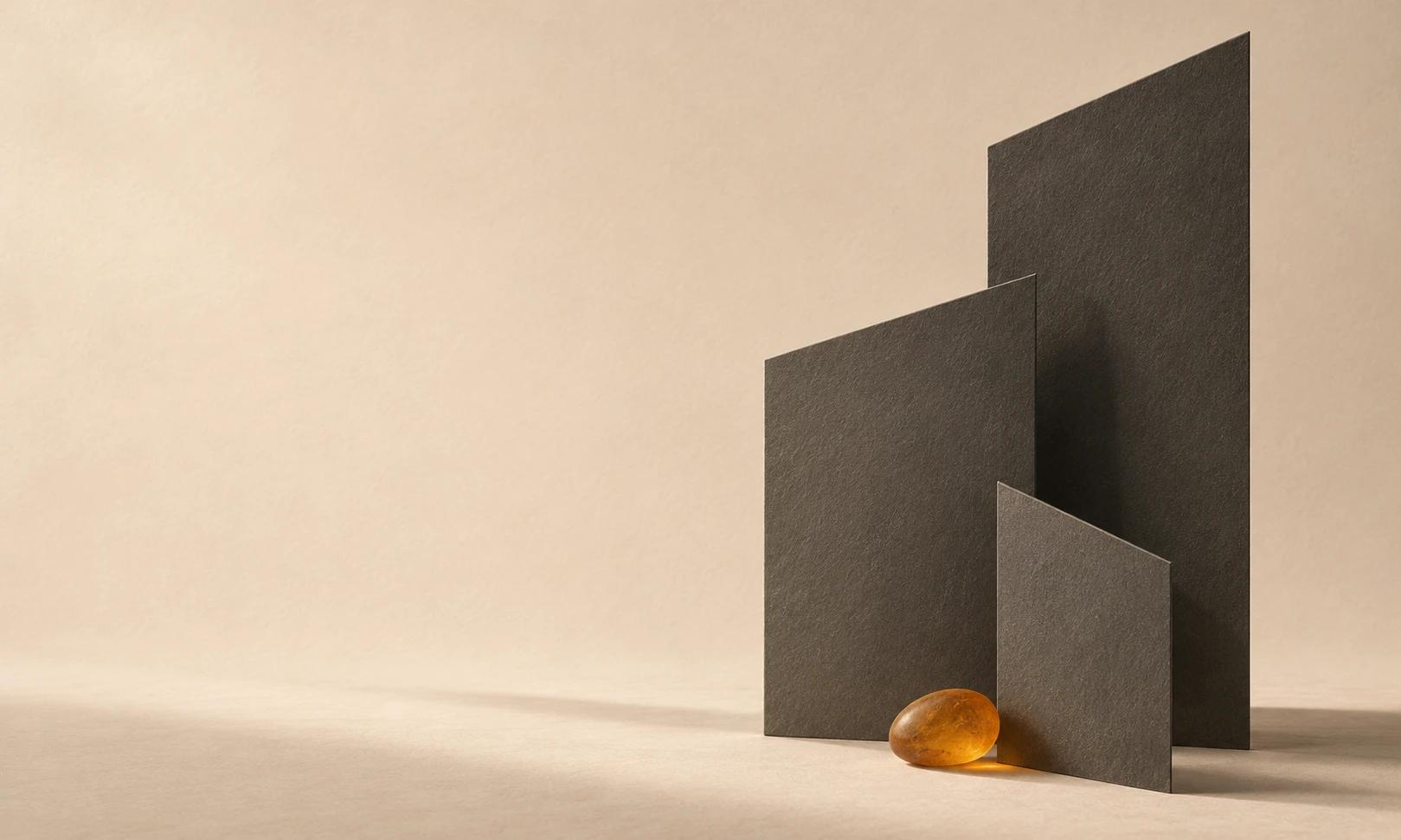
A portfolio can contain attractive images and still leave a reviewer unsure what they are looking at. A title without a medium, an unexplained process image or an invented client name makes the work harder to assess. Start with one clearly identified piece before expanding the document.
On November 21, 2026, we generated an original abstract image in a Ciyo development workspace for the fictional Juniper Paper Studio. That run returned artwork and explicitly declined to save the requested HTML and PDF. We assembled those document companions separately, then checked the supplied PDF's two pages, extracted text and rendered appearance. This tutorial keeps the image-generation step and document-production step visible. It represents no real artist, commission or exhibition.
Quick answer: identify the work before explaining the process
Pair the artwork with its title, year and accurate medium. Add a short brief, a process description based on what actually happened, and a reflection that helps the reader understand a design choice. Then export a document whose page count, image display and text can be checked independently.
Follow five steps: choose the recipient's requirements, prepare the artwork and caption, write a compact case study, assemble the document, and inspect the exported file. The two-page English example below is a teaching sample with one AI-generated digital image, not a substitute for an artist's own body of work.
| Step | Decision | Output |
|---|---|---|
| 1 | What does this recipient request? | A page, file-size and format brief |
| 2 | What exactly is the artwork? | An approved image and accurate caption |
| 3 | What should the case study explain? | Brief, process and reflection text |
| 4 | How will the information stay editable? | A source document separate from the raster art |
| 5 | Does the final file preserve it? | Checked pages, text and image appearance |
1. Start with the recipient's actual requirements
An application, gallery inquiry and client introduction can ask for different evidence. Read the current submission instructions before choosing page size or adding process pages. Keep any required file limit, naming convention, number of works and deadline in a short checklist. There is no universal portfolio page count that this fictional example can establish.
For Juniper Paper Studio, the teaching brief is deliberately small: two portrait pages, one original digital image, its caption, a short explanation and a fictional contact. Canva's portfolio presentation catalog provides another example of this document category, but a presentation template does not establish the requirements of your particular recipient.
Use a lookbook when the reader needs to browse a collection or product range. A portfolio case study instead explains a selected piece and the decisions behind it. Keep that difference clear so the document answers the right question.
2. Generate or select artwork and preserve its identity
Use work you have permission to present. Record whether an image is an original photograph, a scan, a digital composition, a mockup or AI-generated artwork. Do not describe a generated paper-like image as a physically fabricated paper sculpture or invent a client commission to explain it.
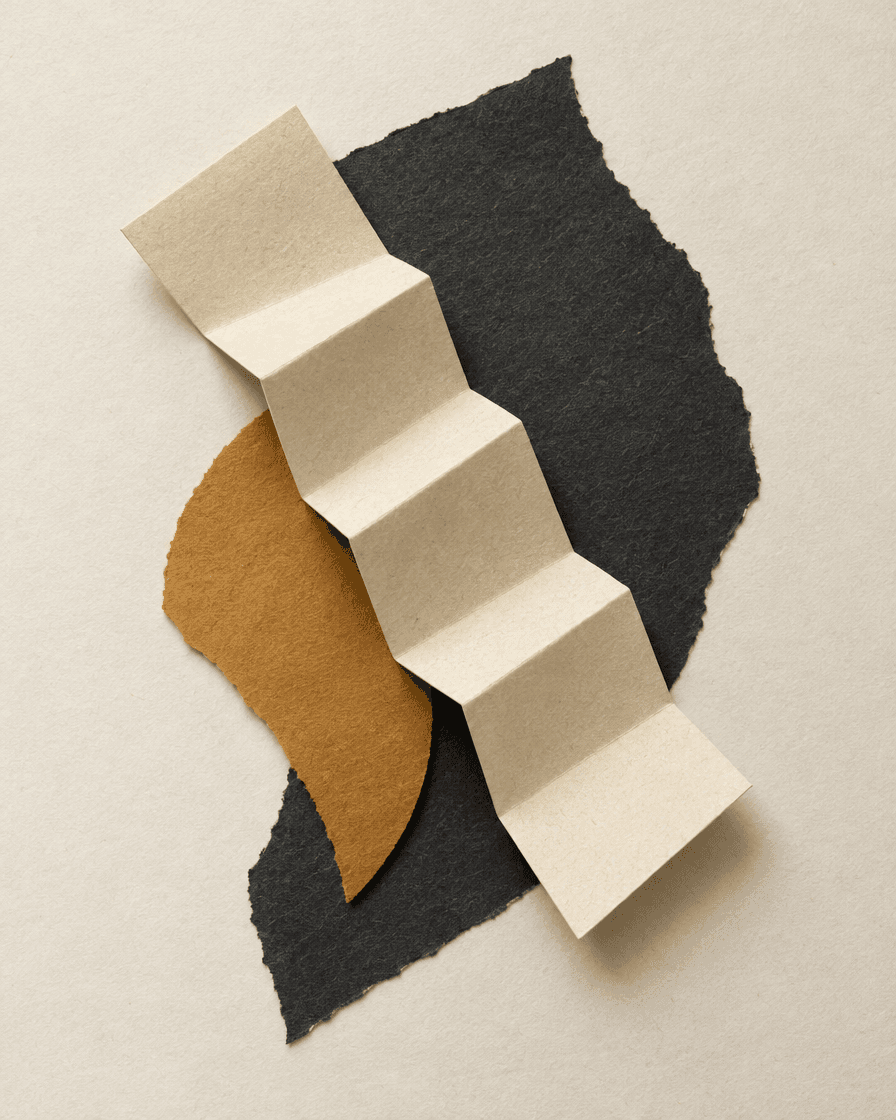
Our Ciyo request combined an art brief with a request for document files. The run produced Quiet Fold artwork using GPT Image 2.5 Flare and said it could not save the requested document formats in that project. We downloaded the resulting PNG and independently confirmed its 896 × 1120 pixel dimensions. The image contains ivory folded forms, a torn charcoal shape and muted amber, with no lettering.
Keep the original image separate from the portfolio layout. That lets you adjust a caption or replace sample text without regenerating the artwork. The narrower prompt below describes the image step that actually succeeded.
Generate one original text-free abstract [medium or visual style] image for [approved project or fictional example]. Explore [specific forms and composition] using [palette]. Keep it free of lettering, logos and invented client references. Save the image and report its actual dimensions. Describe it accurately as a digital image; do not claim physical fabrication, an exhibition or a document export.3. Write a short case study from observable facts
Begin with the caption: Quiet Fold, 2026, AI-generated digital paper-collage study. The year belongs to this example's creation record. It does not imply that a physical artwork was made or exhibited. For your own work, preserve the title and medium approved by its creator.
Use Brief to explain the intended task, Process to describe the tools and actions actually used, and Reflection to discuss a visible decision. In this example, the folded ivory strip creates a focal path across the charcoal form while the amber curve provides a second point of emphasis. That is a visual reading of the image, not evidence of commercial success.
Keep process claims narrow. We can say an image was generated in Ciyo and that the PDF was assembled outside it. We cannot turn that into a story about hand-cut paper, a paying client, multiple research interviews or measured audience response. Replace fictional biographical material before presenting your own portfolio.
4. Assemble editable text around the image
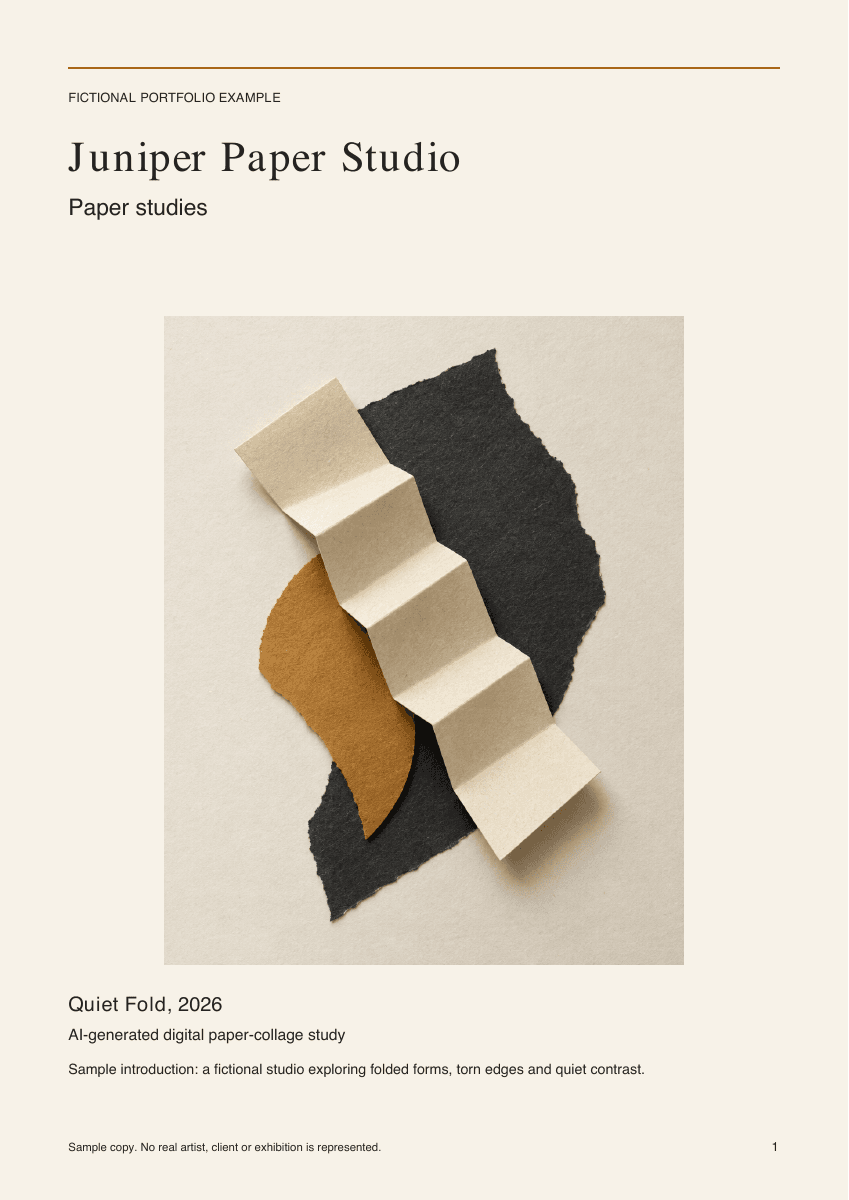
The supplied PDF was independently typeset for this article. Page one introduces the fictional studio, shows the artwork and keeps its caption nearby. Page two contains the brief, process, reflection and sharing check. Its text is an extractable text layer rather than a picture of an entire page.
The English HTML companion contains the same text and links to the original public artwork. It uses a separate layout, so a browser export is a new file that needs its own pagination check. To work offline, save the artwork too and update the image path in your local HTML copy. Editing an HTML file means changing source text; it is not a demonstrated in-canvas document editor.
Keep the artwork's proportions when placing it. Our source is 4:5; stretching it to fill a different rectangle would change the composition. If a recipient requires a different format, make that adjustment in the source document and inspect the result before sending.
5. Inspect the exported pages and the information they preserve
We reopened the supplied PDF, confirmed two A4 pages and extracted its text, including the fictional disclosure, artwork title and case-study headings. We then rendered both pages and inspected their spacing, caption placement and legibility. This establishes the supplied file's checked state; it does not validate every later browser export or modified copy.
Repeat the check after editing. Review the first and last lines on every page, inspect the artwork without accidental cropping, and confirm that the contact and filename belong to the current sharing copy. Try text search or selection in the viewer you will use. Extractable text alone does not establish complete document accessibility or correct reading order.
A physical print introduces another check. This example has not been printed, and its image resolution does not guarantee every desired print size. Use the recipient's instructions and inspect an actual proof when paper delivery matters.
Adapt the document to your stage of practice
A beginner can explain a self-initiated study honestly without inventing clients. A practicing artist can add approved installation views, captions and exhibition history where relevant. A designer can show a real brief and distinguish personal contribution from collaborators' work.
Expand only when another piece contributes useful evidence. A longer PDF is not automatically a stronger portfolio. Keep the recipient's requested scope and the clarity of each work ahead of decorative page count.
Artist portfolio PDF questions
Did Ciyo export the supplied PDF?
No. The demonstrated run generated the abstract artwork and declined to save HTML or PDF in the project. The article's PDF and HTML companions were assembled and checked separately.
Does a portfolio need a fixed number of pages?
Follow the recipient's current instructions. Our two-page document demonstrates one artwork and a compact case study; it is not a universal submission standard.
Can I edit the supplied PDF's artwork text?
The caption and case-study text are separate from the image and can be extracted from the PDF. For changes, use the HTML companion or your own source document, then export and inspect a new file. The artwork itself is raster content.
Can I present this as a physical paper artwork?
No. Quiet Fold is an AI-generated digital paper-collage study in a fictional example. Its visual texture does not establish physical materials, fabrication or exhibition history.
Give one piece a clear explanation
Bring an approved artwork brief to Ciyo, preserve the original result and write an accurate caption. Assemble the portfolio in an editable document and check the final PDF.