Personal library labels
Bookplate Template: Leave Room for a Handwritten Owner Name

A bookplate needs to leave room for the owner's name. A detailed border can look pleasing on screen while reducing the useful writing area to a narrow line. Decide how the name will be added before choosing the decoration.
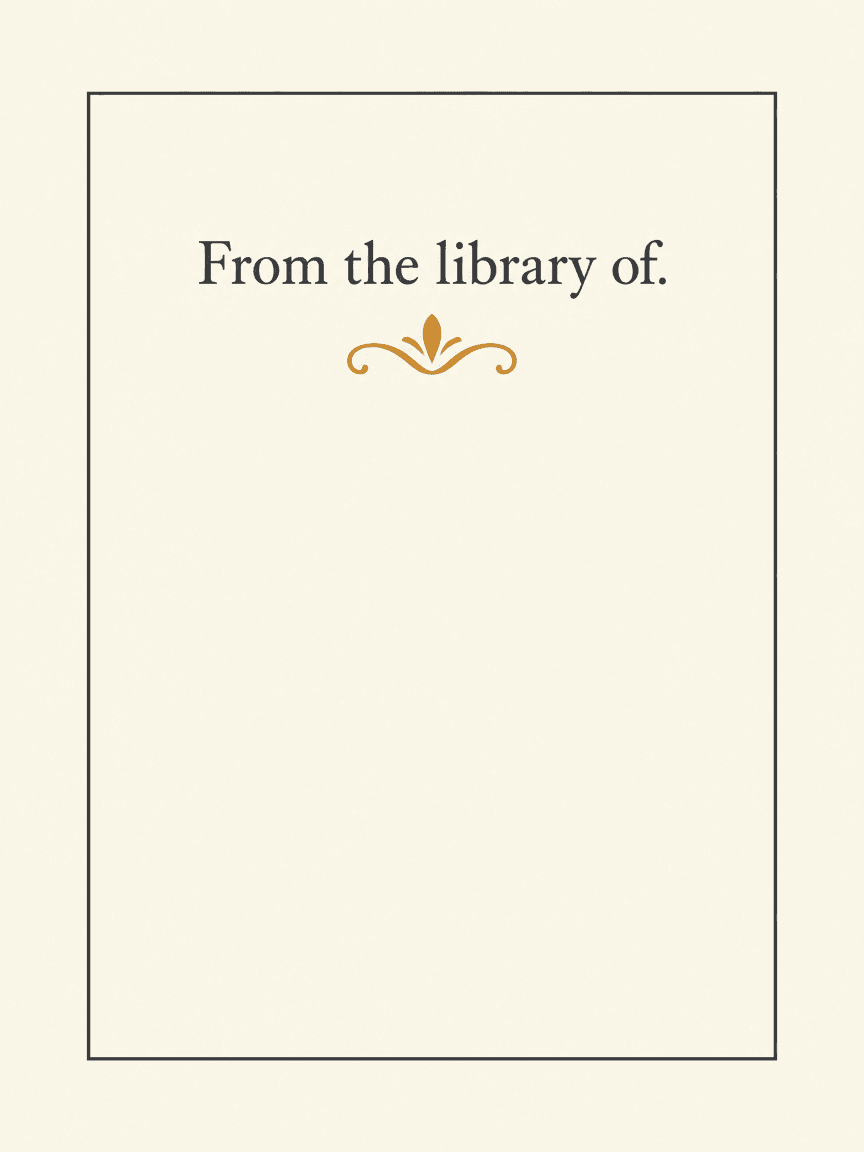
We generated a bookplate composition proof in Ciyo on November 22, 2026. It keeps the owner area blank but adds a period to the ownership phrase and uses a portrait border rather than a measured landscape label. The separately assembled SVG and PDF define an original 80 by 50 mm label with a 60 by 12 mm handwriting area. No physical print, adhesive or book-surface test was performed.
Quick answer: a source you can check, then a visual proof
Choose handwritten or typed ownership text, reserve its area and keep decoration outside it. Use Ciyo for a visual proof, then set exact dimensions in a separate source. Print at the intended scale and measure a sample before choosing paper or adhesive.
Follow five steps: define the task, prepare the source, request a visual proof, inspect the actual output and prepare a separately reviewed working file.
1. Choose the ownership message
Our simple label says From the library of and leaves the owner's name blank. It belongs inside a personal book and identifies ownership; it is not a bookmark, a return deadline or a borrowing record. Keep the job clear so extra fields do not crowd out the name.
Avery's bookplate guidance describes labels used to identify a book's owner. Our template is an original illustration of that purpose. It makes no claim that a particular adhesive is safe for a valuable book or that the supplied dimensions fit an Avery product.
2. Reserve a measured handwriting area
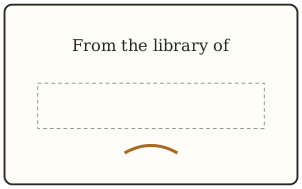
The SVG defines an 80 by 50 mm overall size. Inside it, the dashed name area is 60 by 12 mm. These are explicit source dimensions, unlike a visual model's approximate idea of a small label. A longer handwritten name may need a wider or taller area.
Try your intended name and pen on a plain paper sample before making a sheet. The dashed area is a guide, not a required cutting line. If you want a typed name, put the correct spelling into the editable SVG source and check it again after exporting.
| Part | Example size | Limit |
|---|---|---|
| Overall label | 80 x 50 mm | Original design; no stock compatibility claimed |
| Handwriting area | 60 x 12 mm | Check with your actual name and pen |
| PDF proof | One label on an A4 page | Print scaling can change the measured size |
3. Brief a restrained bookplate proof in Ciyo
Create a separate project and request one flat bookplate proof with the words From the library of, a generous blank name area and a small original decorative accent. Avoid asking for handwriting unless you are intentionally exploring that appearance; generated handwriting is not your actual signature. For the run shown, we used Image Generator with GPT Image 2.5 Flare, portrait 3:4, 1K and one image. Check the displayed credit quote before starting your own run.
Keep the image request focused on composition. The prompt below cannot make a raster image acquire precise physical dimensions or adhesive compatibility. Use the separate vector source for the dimensions and keep important ownership text editable until it has been checked.
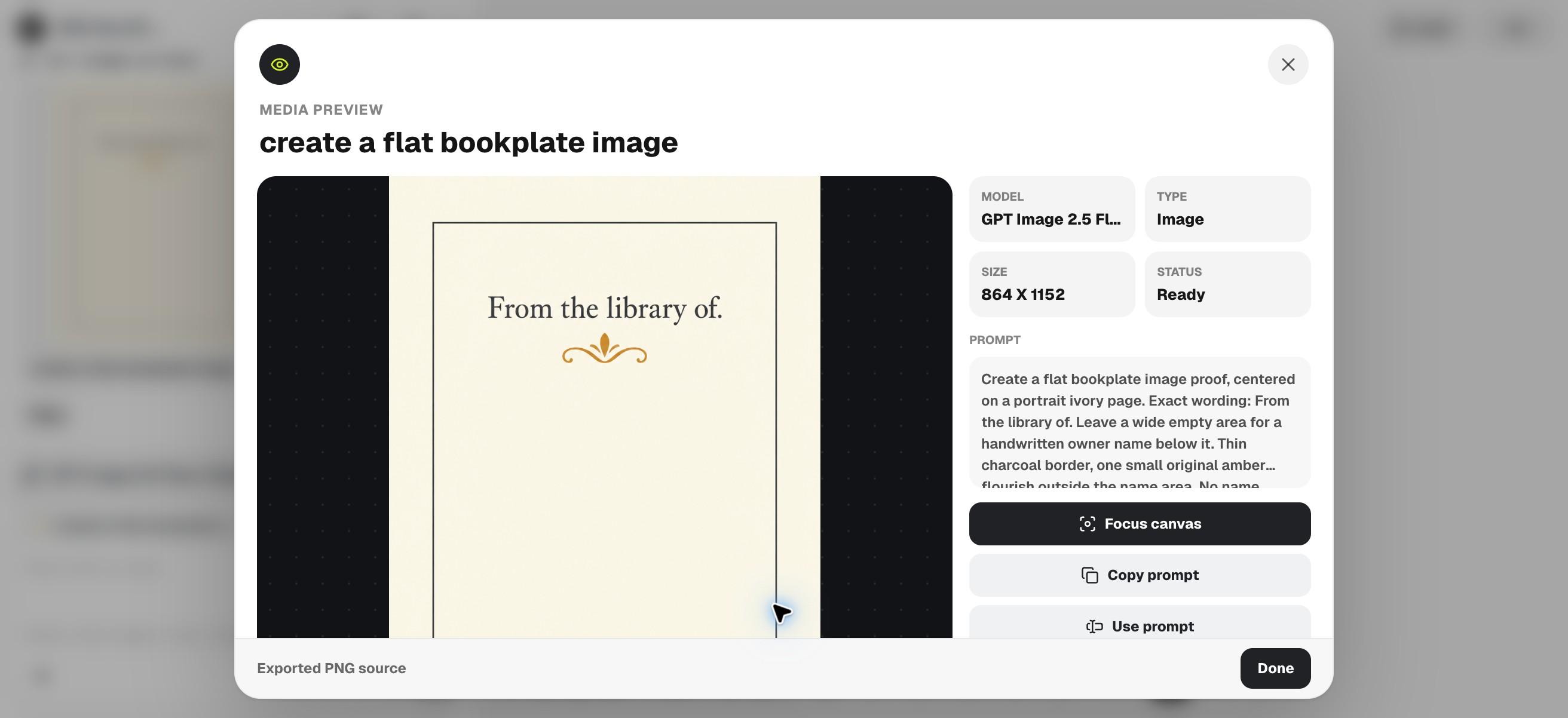
Create a flat bookplate image proof, centered on a portrait ivory page. Exact wording: From the library of. Leave a wide empty area for a handwritten owner name below it. Thin charcoal border, one small original amber flourish outside the name area. No name, signature, logo, extra words or mockup objects. Keep the name area completely blank. This is a visual composition proof only, not a measured label-stock template.4. Inspect the words and the protected blank area
Read the ownership phrase carefully and look for accidental names, extra lettering or decoration inside the writing area. A model may fill empty space because it appears unfinished. For this task, that blank area is the essential feature rather than a gap to decorate.
The downloaded image says From the library of. with an added final period and leaves the area below the flourish blank. It is a portrait composition, not the measured 80 by 50 mm label. Treat that difference as a correction to make in the vector source, not as proof of physical fit. The companion retains the approved phrase without the added period and the explicit landscape dimensions.
5. Print a dimensional proof before choosing materials
The English SVG is an editable vector companion; the PDF shows one measured label on a page with review instructions. Both were assembled independently from the Ciyo image. Print the proof at 100%, measure the outer rectangle and the writing area, then make any scale correction in your print workflow.
Test your materials on an expendable sample appropriate to the book before applying a label. For a personal collection, a handwritten blank may be enough. For a gift batch, check each recipient's spelling in the source. The downloads include no commercial label-sheet alignment, bleed specification or tested adhesive recommendation.
Choose the workflow and review the final file
Choose a vector editor when exact size, repeated placement or typed names are the main requirement. Use a Ciyo proof to explore the relationship between the ownership phrase, blank area and ornament. Treat a print-service template as its own constraint and rebuild the layout to that verified specification if needed.
Download the English working files
These English companions are separately assembled editorial files. They preserve the source information or blank fields described above; they are not exports from Ciyo's image-generation step. Review and adapt them before use.
Practical questions
Does the template fit a specific label sheet?
No. The 80 by 50 mm size is an original design choice. No commercial stock alignment has been tested.
Is the name area guaranteed to fit my handwriting?
No. Print at the intended scale and try the actual name and pen in the 60 by 12 mm area.
Is it safe for a valuable book?
No adhesive or book-surface suitability test was performed. Assess your materials on an appropriate expendable sample before use.
Protect the name space first
Choose the ownership phrase and handwriting area, then explore a restrained bookplate proof in Ciyo before checking a measured print.