New models · Tested
Can GPT-6 Sol or Luna Make Images?
OpenAI released GPT-6 Sol and GPT-6 Luna on September 22, 2026. The first question most people type is whether they can make pictures, and the honest answer has two halves: the models themselves only write text, but the app around them may still hand you an image.
We tested both halves on September 23 with one fictional job — a launch post for a neighbourhood bakery — and asked Claude Opus 5.5, released the same day, the same question. The results decide where each model belongs in a picture workflow.
The short answer
OpenAI's model pages list the same thing for both new models: text and image input, text output. Neither model draws pixels. Both can call an image-generation tool when a developer turns that tool on in the Responses API, which is a different model doing the drawing.
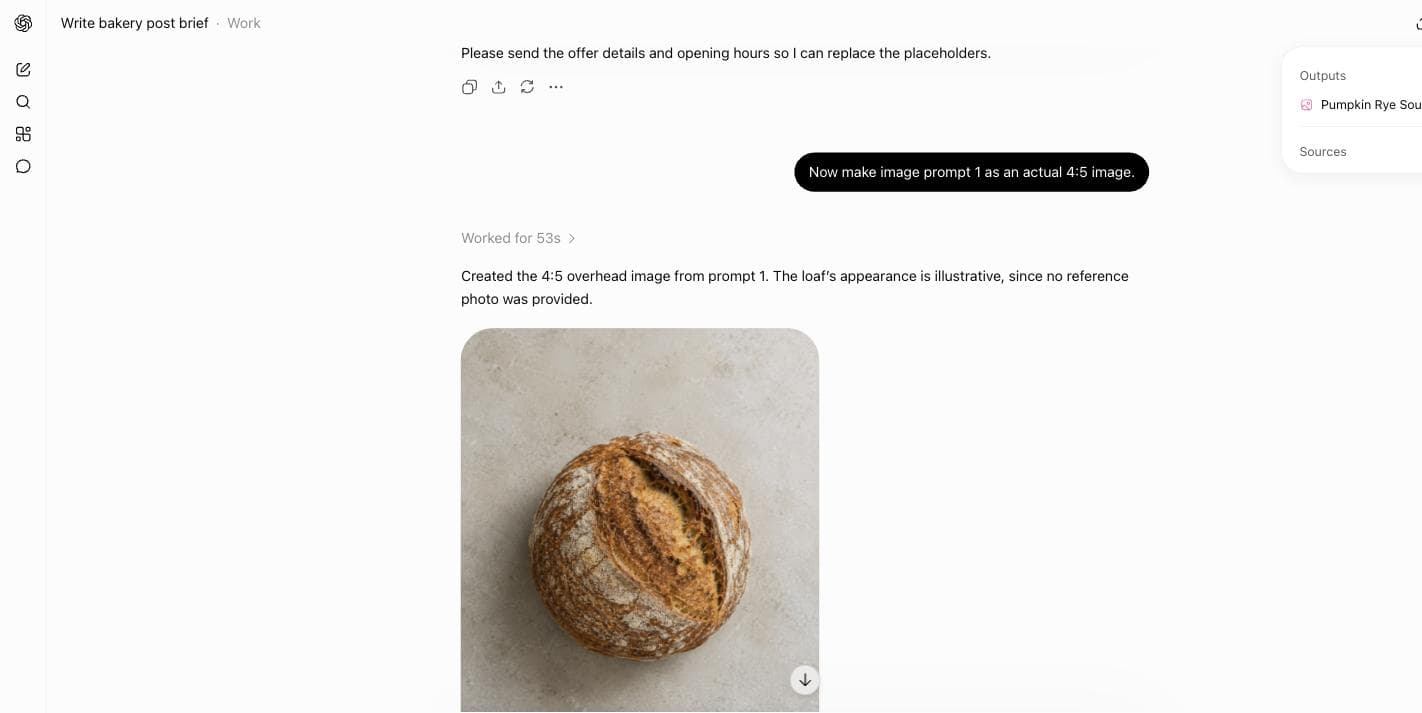
In ChatGPT the tool is already switched on. When we asked GPT-6 Sol for a picture, ChatGPT said it was using its image skill and returned a 4:5 photo after 53 seconds. So in the app, asking Sol for an image works; in the API, it works only if you wire up the tool.
Ciyo does not run GPT-6 Sol or Luna. Its agent offers Ciyo Agent and GPT-6 Astra, and pictures are made by image models such as GPT Image 2.5. You can plan in Sol and make the image in Ciyo, which is what the rest of this article shows.
| Model | Where we asked | What came back |
|---|---|---|
| GPT-6 Sol | ChatGPT Work, Medium | A 4:5 photo, made by ChatGPT's image tool |
| GPT-6 Luna | API documentation only | Text; images only through the image tool |
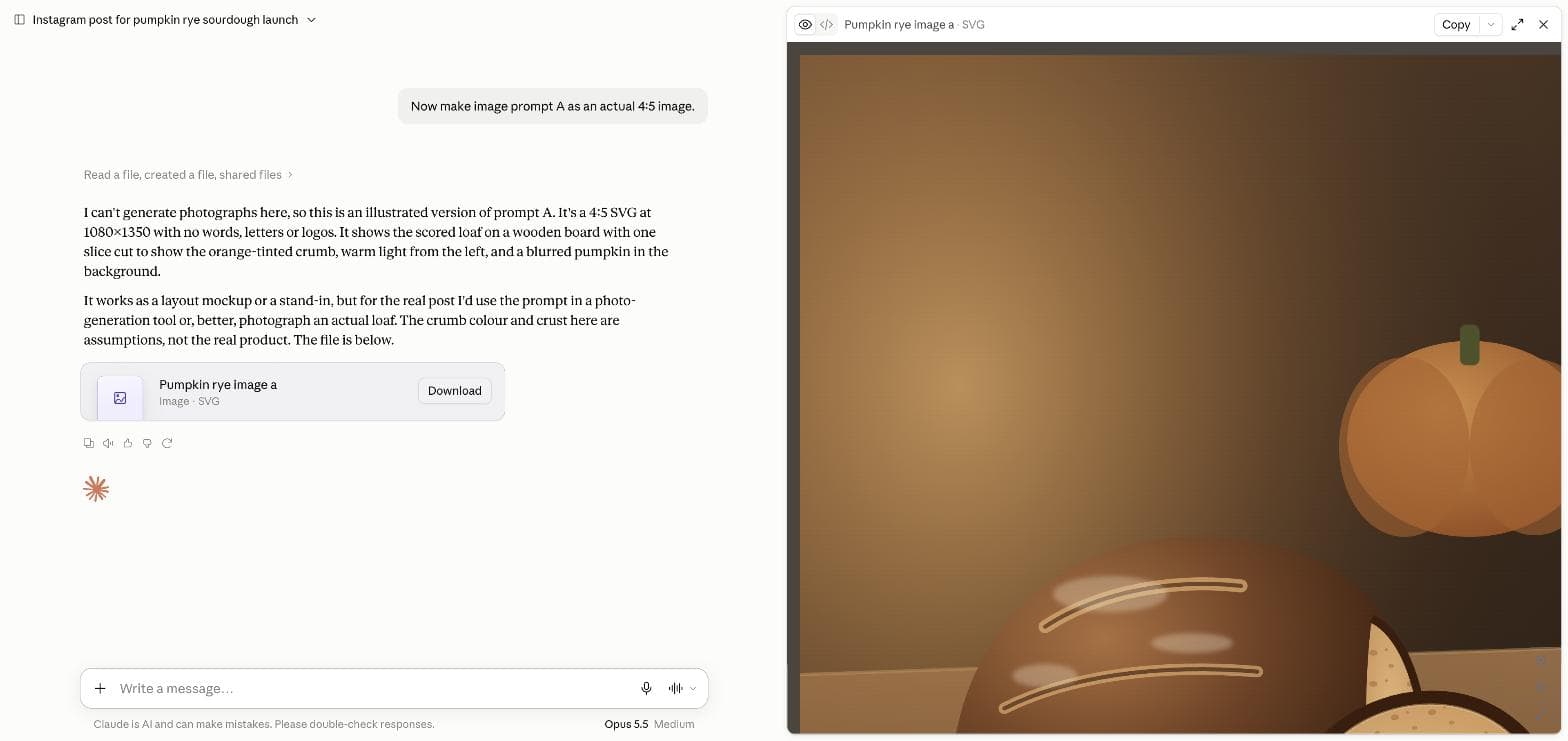
| Claude Opus 5.5 | claude.ai, Medium | No photo; an illustrated SVG file instead |
The test brief
Every model got the same brief: a fictional bakery, Kettle & Crumb, launching a Pumpkin Rye Sourdough on Saturday 3 October at $9 a loaf, with 60 loaves and preorders closing on the Thursday. The brief asks for a short creative brief, three image prompts and a caption, and it tells the model to list anything it has to guess.
We then followed up with one line: make image prompt 1 as an actual 4:5 image.
You are planning one Instagram post for a small neighbourhood bakery. Use only the facts below. If you need anything that is not in the facts, write it in a list called "Assumptions" instead of stating it as true.

Facts:
- Bakery: Kettle & Crumb, 14 Alder Street
- New product: Pumpkin Rye Sourdough, launching Saturday 3 October
- Price: $9 a loaf
- Only 60 loaves on launch day
- Preorder closes Thursday 1 October, through the link in our bio
- No discount, no delivery
- Audience: people who already follow us on Instagram and live nearby

Give me three things:
1. A creative brief in no more than 80 words.
2. Three different image prompts for a 4:5 photo. The image must contain no words, letters or logos.
3. One caption of no more than 60 words.
What GPT-6 Sol did
Sol's first answer was careful. It wrote three plain prompts — overhead, close-up, three-quarter view — and listed its visual choices as assumptions because the brief never describes the loaf.
Asked for the picture, it announced it was using the image skill and returned an overhead photo of a round, uncut loaf on a pale surface. Its note said the loaf's appearance was illustrative because no reference photo had been supplied. That is the right caveat: the picture is a guess at your product, not your product.
What Claude Opus 5.5 did
Opus 5.5 said plainly that it can't generate photographs in that chat. Instead it wrote an SVG illustration at 1080 × 1350 pixels — the right 4:5 shape — with a scored loaf, a slice and a blurred pumpkin, and it recommended a photo tool or, better, a photograph of the real loaf.
An illustrated SVG is useful as a layout mock-up. It is not a product photo, and Opus said so. Anthropic's announcement does not list image generation among Opus 5.5's outputs.
Making the picture in Ciyo
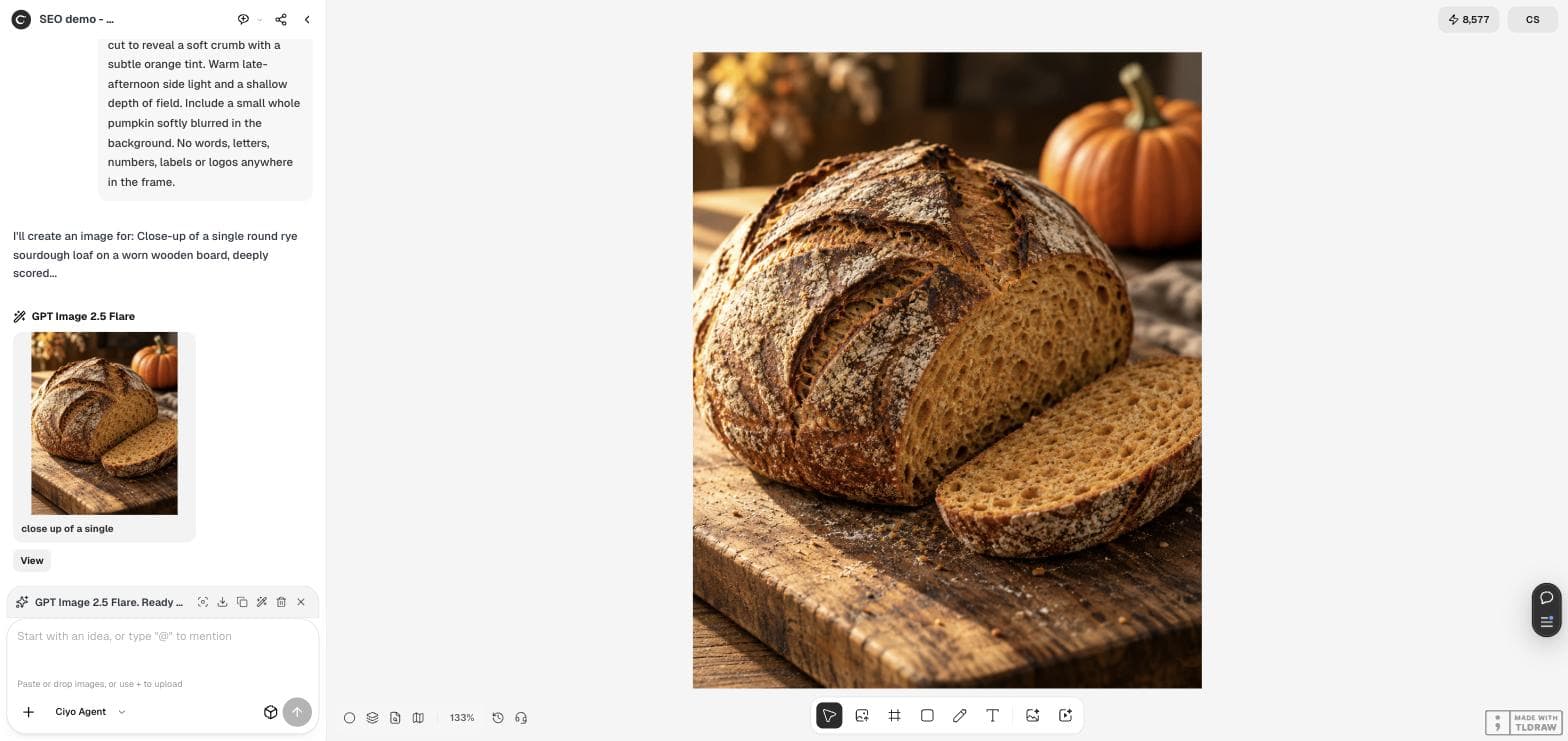
We pasted Opus's first prompt — the close-up with a cut slice and a pumpkin behind — into Ciyo's Image Generator with GPT Image 2.5 Flare at 4:5 and 1K. It cost 2 credits and returned an 896 × 1120 photo in well under a minute.
The image followed the prompt closely: scored crust, orange-tinted crumb, one slice, worn board, pumpkin top right, and no lettering. The planning model chose the details; the image model drew them.
Which one to use for your post
Use Sol or Luna to plan: the brief, the list of shots, the caption and the list of guesses to check. If you are already in ChatGPT, asking Sol for the image is convenient, but you cannot choose the image model or its settings from there.
Use an image model you can steer for the final picture — ratio, resolution, quality and a reference photo of the real product. In Ciyo that is the Image Generator or the agent with GPT-6 Astra, which writes the prompt and places the image on the canvas in one turn.
What OpenAI said at launch
The launch post describes Sol and Luna as faster, cheaper models built on Astra's advances. It does not claim image output, which matches the model pages.
Posted 2026-09-22 by OpenAI's own account. It frames Sol and Luna as faster, more affordable models that build on GPT-6 Astra. The post says nothing about generating images; the pictures in this article came from separate image tools.
Sol, Luna and images
Can GPT-6 Sol generate images on its own?
No. OpenAI lists text as its only output. In ChatGPT it can call an image tool, and through the API a developer can enable the same tool.
Is GPT-6 Luna any different?
Not for images. Luna has the same text and image input and text-only output as Sol, at a lower price.
Can Claude Opus 5.5 make a photo?
In our test it said it could not and drew an illustrated SVG instead. That works as a mock-up, not as a product photo.
Does Ciyo run GPT-6 Sol or Luna?
No. Ciyo's agent offers Ciyo Agent and GPT-6 Astra. You can plan elsewhere and paste the prompt into Ciyo's Image Generator.
Plan in any model, make the picture in Ciyo
Paste your prompt into Ciyo's Image Generator, pick the ratio and quality, and see the credit cost before you run it.