Workshop feedback design
Workshop Feedback Form Template: Ask Neutral Questions and Leave Answer Space

A workshop feedback form template can lead the answer before a participant writes anything. Ask what helped, offer balanced pace choices and leave room for one change. Decide what you will do with the answers before adding more questions.
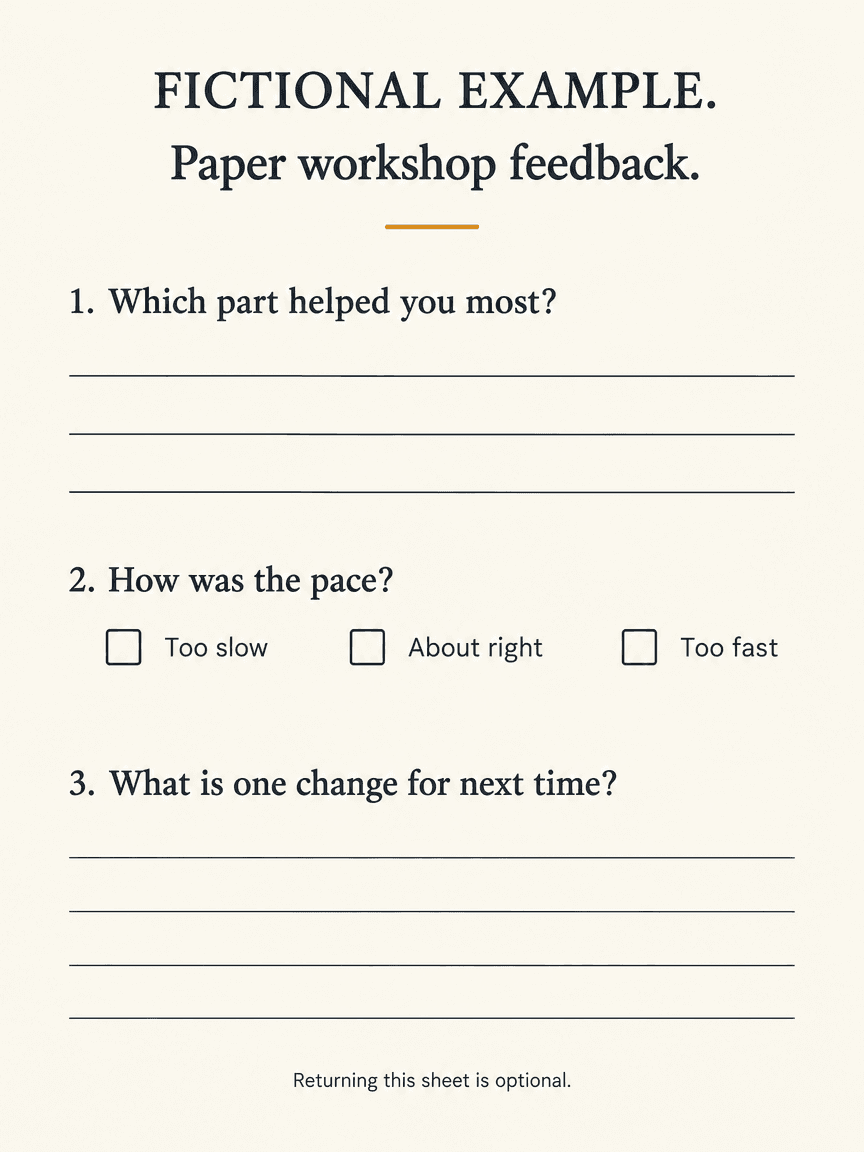
We generated a fictional Paper workshop feedback sheet in Ciyo on November 23, 2026. The image retains the three questions and optional-return footer, but omits the requested No name needed line. The English working HTML restores that instruction. No responses were collected, and the files include no hosted survey or tracking backend.
Quick answer: keep the source and inspect the proof
Use three focused questions: what helped, how the pace felt and one change for next time. Give the pace question balanced choices, leave writing space and make optional participation visible. Check the visual proof against the source before printing the editable version.
Follow five steps: define the task, prepare a checkable source, generate a visual proof, inspect the actual output and use the separately authored working files.
1. Choose questions that support a specific next action
Our first question asks Which part helped you most? rather than asking participants to praise the workshop. The third asks What is one change for next time? so a facilitator can consider a practical revision. Neither question establishes satisfaction or a measured outcome before anyone answers.
Canva's form-template collection includes feedback layouts. The task here is a paper workshop sheet, not an online survey integration. Choose only questions you are prepared to review and avoid collecting identifying details you do not need.
2. Balance the choices and preserve answer space
The pace options are Too slow, About right and Too fast. Keep all three equally readable and leave every box empty. The English working sheet adds Choose one to make the intended response convention explicit.
Question one has three writing lines; question three has four. The prompt also requests No name needed and Returning this sheet is optional. Keep those instructions in the final file, and ask respondents to leave identifying details out of free-text answers. Absence of a name field alone is not a guarantee of anonymity.
| Question | Response space | Use in review |
|---|---|---|
| Which part helped you most? | Three lines | Identify useful elements |
| How was the pace? | Three balanced choices | Review pacing feedback |
| What is one change for next time? | Four lines | Consider concrete revisions |
3. Generate one flat visual proof in Ciyo
Create an isolated Ciyo project and open Image Generator. Our authenticated development run on November 23, 2026 used GPT Image 2.5 Flare, Medium quality, portrait 3:4, 1K and one image. Select the controls before entering the complete prompt, then review the displayed credit quote. Our run showed 2 credits; check your own current quote.
The copyable prompt is the actual English request. Replace the fictional details consistently and retain the stated constraints. The result is a raster image proof; the editable downloads below were assembled independently and are not Ciyo exports.
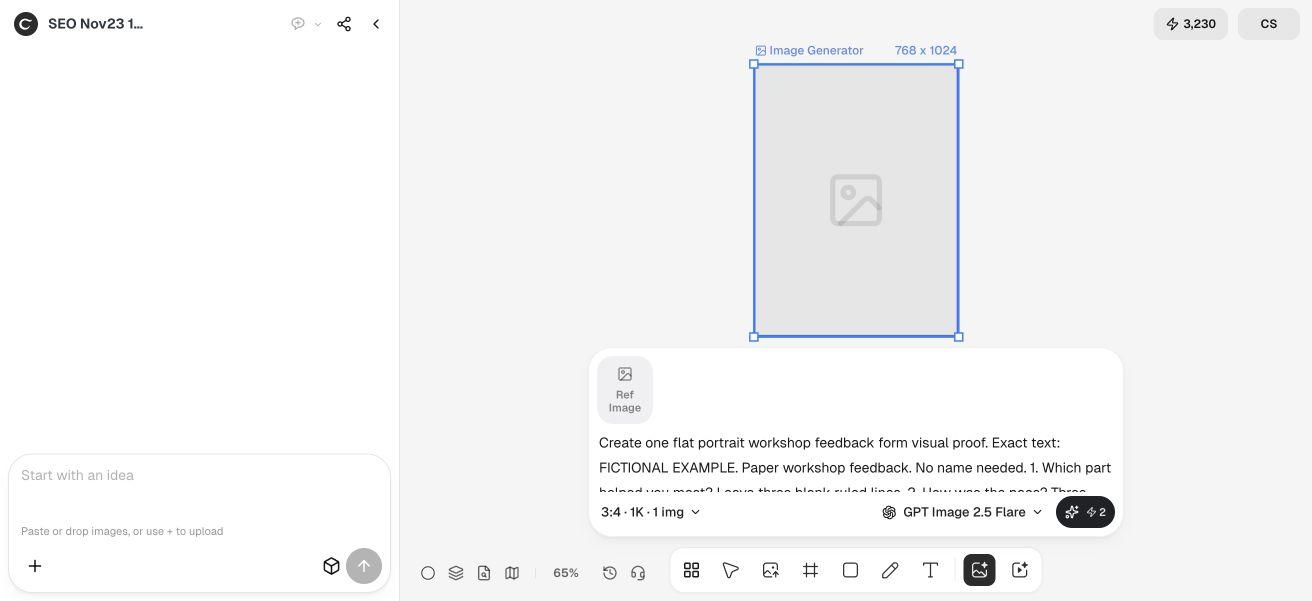
Create one flat portrait workshop feedback form visual proof. Exact text: FICTIONAL EXAMPLE. Paper workshop feedback. No name needed. 1. Which part helped you most? Leave three blank ruled lines. 2. How was the pace? Three empty choices: Too slow | About right | Too fast. 3. What is one change for next time? Leave four blank ruled lines. Footer: Returning this sheet is optional. Ivory and charcoal, readable type, small amber divider. No filled answers, ratings, percentages, tracking codes or submit button. This is a blank visual proof.4. Compare the actual output with the source
The downloaded PNG includes all three questions, three lines for the first answer, four for the last and the three unmarked pace choices. The optional-return footer is visible. It omits No name needed, so the generated image is not a complete match to the requested text.
The independently authored HTML restores that line and adds Choose one beside the pace question. This correction is in the working source, not a claim that the original PNG was repaired. Review the actual file you intend to distribute, rather than relying on the prompt's wording.
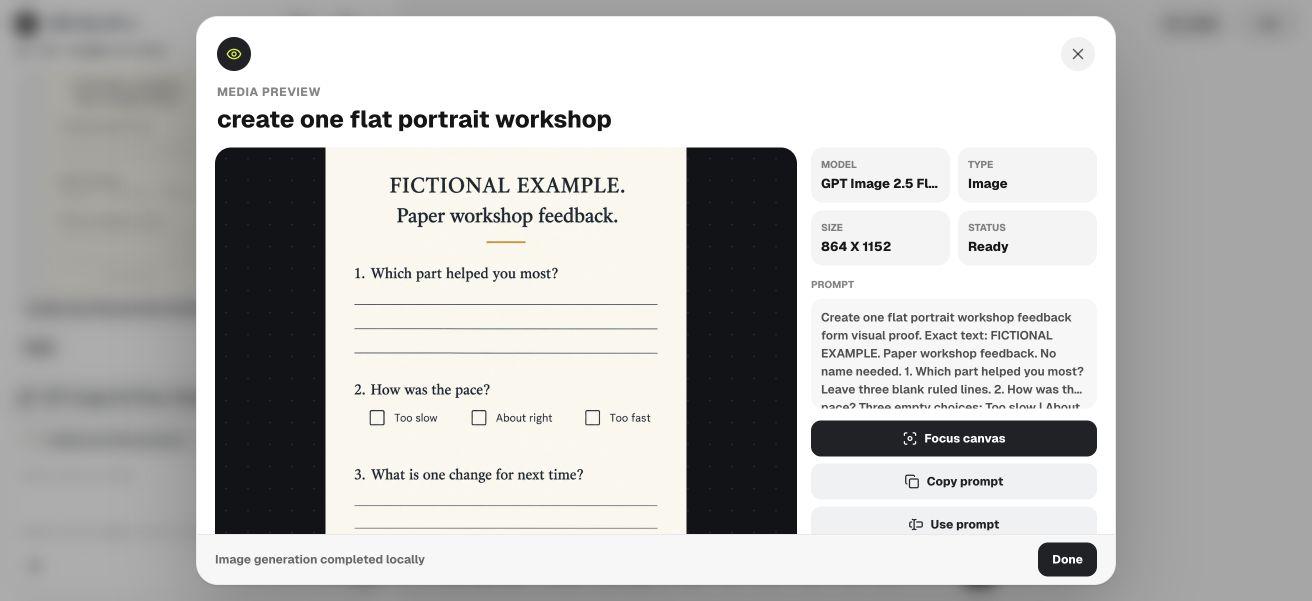
Ciyo media preview: inspect the model and original request
Open the generated asset in Ciyo’s media preview to compare the result with the model details and original English prompt. This whole-product capture shows that review step; the readable prompt and output inspection above remain the reference for small text.
5. Print the corrected source and review responses manually
The English HTML has no submit button, response upload or tracking code. It is a printable sheet with the no-name and optional-return instructions. The separate CSV is a blank manual-coding aid with fields for an assigned sheet ID, verbatim answers, pace choice and an optional editorial theme.
If you collect paper responses, decide who may read them and where they will be kept. Keep original wording when coding; distinguish a respondent's answer from your interpretation. The blank CSV contains no survey results, ratings or participant statistics.
Choose the source you will maintain
Use the paper sheet for a small session when manual review is appropriate. Use an actual form service if you need online collection and assess its settings yourself. Ciyo supplies a visual proof here; the editable source controls the final questions and instructions.
Frequently asked questions
Did the generated image retain every instruction?
No. It omitted No name needed. The supplied HTML restores that line, while the original output is shown honestly with its limitation.
Does the download collect responses online?
No. The HTML is a standalone printable, and the CSV is an empty manual-coding aid. Neither includes a response backend.
Does omitting a name field guarantee anonymity?
No. Free-text answers can identify someone. Keep the instructions and handling appropriate to your setting, and avoid requesting unnecessary identifying details.
Explore a clear feedback-sheet proof
Start with your approved source, generate one visual proof and inspect the actual result before preparing the final working file.