Buying creative tools
AI Banner Ad Generator: Buy for the Export You Need

A marketer buying an AI banner workflow needs an ad file that fits its placement. A beautiful square preview does not automatically become a readable leaderboard.
Our Cedar Workshop example creates a 300×250 rectangle and a 728×90 leaderboard from the same approved copy in Ciyo. It demonstrates layout and export checks, not a live advertising campaign.
Choose the placement before choosing the model
For uploaded static display images, Google’s specification lists PNG, JPG and GIF with a 150 KB limit, including 300×250 and 728×90 placements. Check the current requirements for your selected campaign format; responsive ads use a different asset workflow.
Write down the exact dimensions, allowed format and byte limit in the brief. Our files are static PNGs. They are not HTML5 ad bundles and have not been submitted to Google Ads.
Freeze the offer and CTA
Our fictional text contract is Pottery taster; Book a seat; FICTIONAL DEMO. It deliberately has no price, availability claim or real booking destination.
For a real promotion, supply approved offer terms and landing-page copy. Keep the ad consistent with the destination. Do not let a layout request invent urgency, discounts or customer testimonials.
| File | Dimensions | Checks |
|---|---|---|
| Rectangle PNG | 300×250 | Exact copy; under 150,000 bytes |
| Leaderboard PNG | 728×90 | Recomposed; under 150,000 bytes |
| SVG sources | Matching viewBox | Retained copy and layout |
| Review | Actual pixel size | Readable CTA; no clipping |
Recompose two layouts in Ciyo
Ask for a stacked rectangle and a horizontal leaderboard as separate compositions. Preserve the same message and visual identity while changing the arrangement for the available space.
We used code for a simple bowl illustration and typography. This is a practical option for an exact-copy banner; it does not test a photographic image model. A paid generation model may be useful when the brief needs imagery, but the final file still needs these checks.
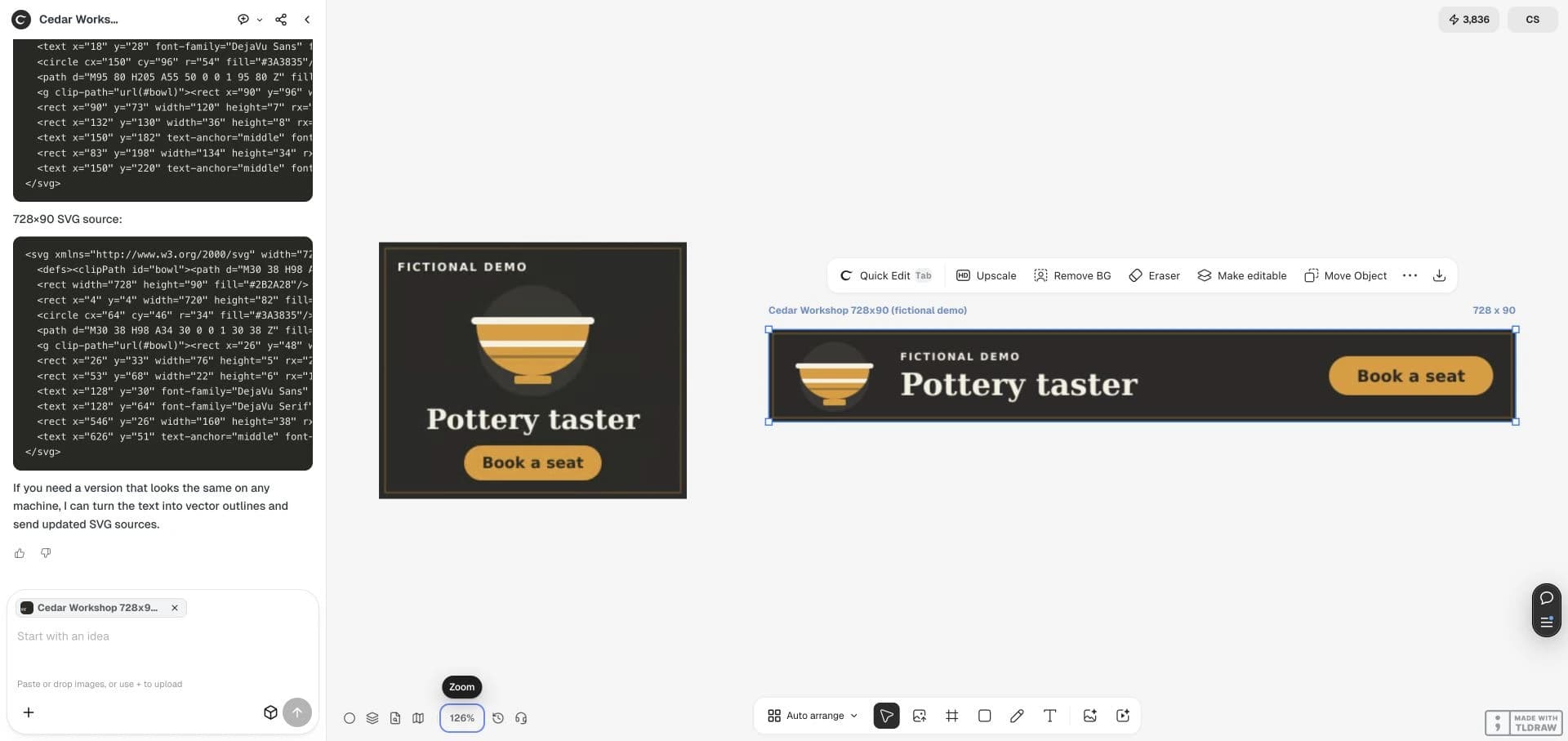
Use code only for fictional Cedar Workshop banners: separate 300×250 and 728×90 PNGs, each under 150000 bytes. Keep exact English copy: Pottery taster; Book a seat; FICTIONAL DEMO. Recompose rather than stretch. Use a simple original bowl in ivory, charcoal and amber. Check intrinsic dimensions, byte counts, exact text and clipping at actual size. Put PNGs on canvas, allow downloads, and print full SVG sources. No paid generator or Google Ads submission, approval or performance claim.

Check the exported files, not only the canvas
Open the downloaded PNGs and read their intrinsic dimensions and byte counts. Inspect the wording at actual size. A canvas display can scale an image, so apparent size there is not proof of export dimensions.
Check whether the CTA fits the narrow layout and whether any decorative shape obscures the text. A valid byte count does not compensate for a truncated offer. Keep the source alongside the accepted export so a correction is reproducible.
The PNGs downloaded through Ciyo were 15,500 and 14,238 bytes, at the requested dimensions. Both pass our conservative 150,000-byte check. This checks the actual downloads, not the sandbox file sizes reported in chat.


Decide what is worth paying to regenerate
When only text or spacing changes, revise the retained source first. Generating a new background for every copy correction can change the campaign’s identity and add work to the acceptance process.
If you do need new imagery, set a bounded number of candidates and review product fidelity, copy space and export feasibility before expanding. Record the actual quote for those settings; the file demonstration supplies no measured generation price or ad performance.
Hand off the ad with its destination and approval
Give the campaign owner the accepted PNG, its placement, copy version and intended landing-page URL. Recheck the destination after the final copy change.
These demo files show a controlled layout/export workflow only. Platform approval, delivery, impressions and conversions remain unknown. Use a small real campaign and its own reporting to evaluate advertising results.
Practical questions
Can I stretch the square banner into a leaderboard?
Recompose it. Stretching distorts the artwork and leaves too little room for readable text.
Are these Google-approved ads?
No. They are fictional files checked against selected format requirements, with no platform submission.
Does a small file guarantee a better ad?
No. Byte size is a delivery constraint; effectiveness needs actual campaign evidence.
Build one placement-ready banner pair
Bring approved copy and the target sizes. Inspect the actual exported files before committing a campaign budget.