Sketch workflows
How to Get Useful AI Feedback on a Rough Sketch

You have a rough social post for a local business, but something feels wrong. Asking whether it looks good may produce a long list of opinions. Asking whether the headline fits and the next action is obvious gives you something to fix.
We used a fictional florist’s weekend mini-bouquet post for this Ciyo demonstration. The screenshots show the real sketch and agent responses. The review led to a specific layout correction and a clearer campaign question.
Set the review question before opening the conversation
The florist wants nearby residents to ask about a small weekend gift by direct message. The draft contains three flowers in paper wrapping, a portrait boundary and the headline “WEEKEND BLOOMS”. At first, the headline extends past the boundary.
That gives us a bounded review: can someone scrolling on a phone recognize the offer, read the headline and find the action to take? Tell the agent that context. Texture, polished petals and final color choices can wait until the layout communicates the basic message.
Show a readable view and ask for observations
Bring the complete sketch into view and choose Plan. Start with a short request for a description and one issue. In our first exchange, Ciyo recognized the three flowers and identified the overflowing headline. That observation was easy to check against the drawing.
The same response called the wrapping a vase. We corrected that interpretation explicitly. Visual feedback can be useful while still containing mistakes; confirm the subject before following advice that depends on it.
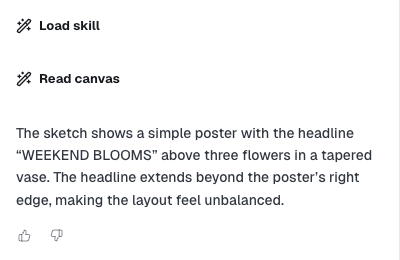
Look at the sketch on my canvas. In two short sentences, describe what you see and one layout issue. Do not create an image yet.Turn vague opinions into checks you can perform
“It needs more impact” does not identify a useful edit. “The headline extends beyond the poster’s right edge” does. Select the headline, reduce its font size and reposition it within the boundary. Judge the new reading order before changing the illustration too.
The table is a menu of review questions, not a scoring formula. Choose the row that fits your current decision. Do not combine every category into one request unless the sketch is already mature enough to support that level of review.
| Review goal | Ask this | Check it yourself |
|---|---|---|
| Reading order | Which element appears dominant, and what competes with it? | View the sketch at thumbnail size |
| Spacing | Where do unrelated forms seem to touch? | Separate one pair and compare |
| Message clarity | What does the composition suggest before reading the copy? | Ask a person unfamiliar with the brief |
| Room for text | Which region can hold my actual headline? | Place the real words at the intended size |
| Consistency | Which repeated shapes differ in a distracting way? | Compare the repeated forms side by side |
Ask for reasons, then challenge the recommendation
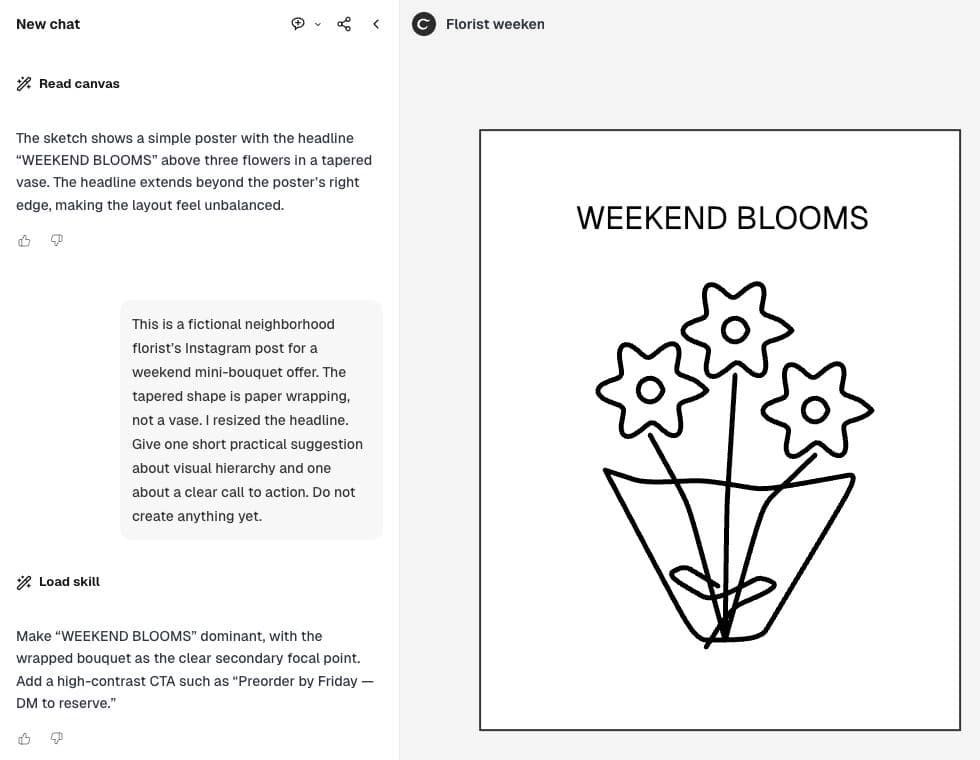
After the headline fit, we explained the florist’s audience and asked for one hierarchy suggestion and one call-to-action suggestion. Ciyo recommended a dominant headline, a secondary bouquet and a high-contrast CTA. Those are proposals to judge at the size the post will actually be seen.
The response offered “Preorder by Friday — DM to reserve” as example copy. We had not supplied a Friday deadline, so we kept “DM TO RESERVE” and left the deadline out. A plausible marketing phrase can contain an unconfirmed business fact. Check the offer as carefully as the layout.
Make one revision you can compare
Keep the original sketch or a screenshot before changing it. In this demo, the first change was the headline size and position. The flower drawing stayed the same. A single deliberate revision makes it easier to explain what improved.
End the review with a decision: the headline fits inside the post, the bouquet remains the subject, and the final concept will include “DM TO RESERVE” below it. You can now develop the image or hand that decision to a colleague without reopening every design choice.
This is a fictional neighborhood florist’s Instagram post for a weekend mini-bouquet offer. The tapered shape is paper wrapping, not a vase. I resized the headline. Give one short practical suggestion about visual hierarchy and one about a clear call to action. Do not create anything yet.Borrow a lesson from human critique
In a Reddit discussion, illustrator u/klart_vann describes clients mistaking rough drafts for the eventual finished artwork. One reply recommends saying exactly which decisions the current feedback round should address. The conversation is about human client communication, not AI evaluation.
That framing also makes a useful prompt habit: specify what is ready to judge. In the florist exercise, hierarchy and the enquiry action are open for feedback while the final illustration is still undecided. This is our adaptation for a Ciyo conversation; the thread does not demonstrate that AI feedback is accurate.
July 3, 2024: an illustrator asks how to keep clients from treating rough sketches as finished work. Our focused-review prompts adapt the discussion’s communication problem; the poster did not use or endorse Ciyo.
Keep the review separate from approval
Use the agent to surface questions you might have missed. Your audience, collaborator or client still decides whether the direction meets the real need. If you show the sketch to another person, include the intended message and the specific decision you want from them.
Once the direction is clear, choose the next workflow: develop one image, or turn the decisions into a written brief. Both are easier when the feedback ends with a concrete choice instead of a long list of possible improvements.
Frequently asked questions
Can AI tell me whether my drawing is good?
It can offer observations and suggestions, but a broad quality verdict is hard to act on. Ask about a defined goal such as reading order, spacing or subject clarity, then judge the recommendation against your own intent.
Can I get feedback without generating an image?
Yes. Choose Plan and ask for a review. You can discuss the visible sketch and refine the direction before choosing to create from a plan.
What should I do if the critique describes the wrong thing?
Correct the description first. Make the relevant sketch larger or isolate it in the view, explain ambiguous marks, and send a fresh message. Do not apply advice that depends on an incorrect reading.
Should I use a numerical score for each sketch?
A number can hide the reason for a recommendation. For an early sketch, ask for a visible observation, a likely effect and one proposed change. Use audience testing when the decision depends on how real viewers respond.
Review the post before you polish it
Bring your rough social layout into view, choose Plan and ask one question about its headline, subject or call to action.