Textile design
Choose a fabric pattern scale that still reads on a shirt pocket
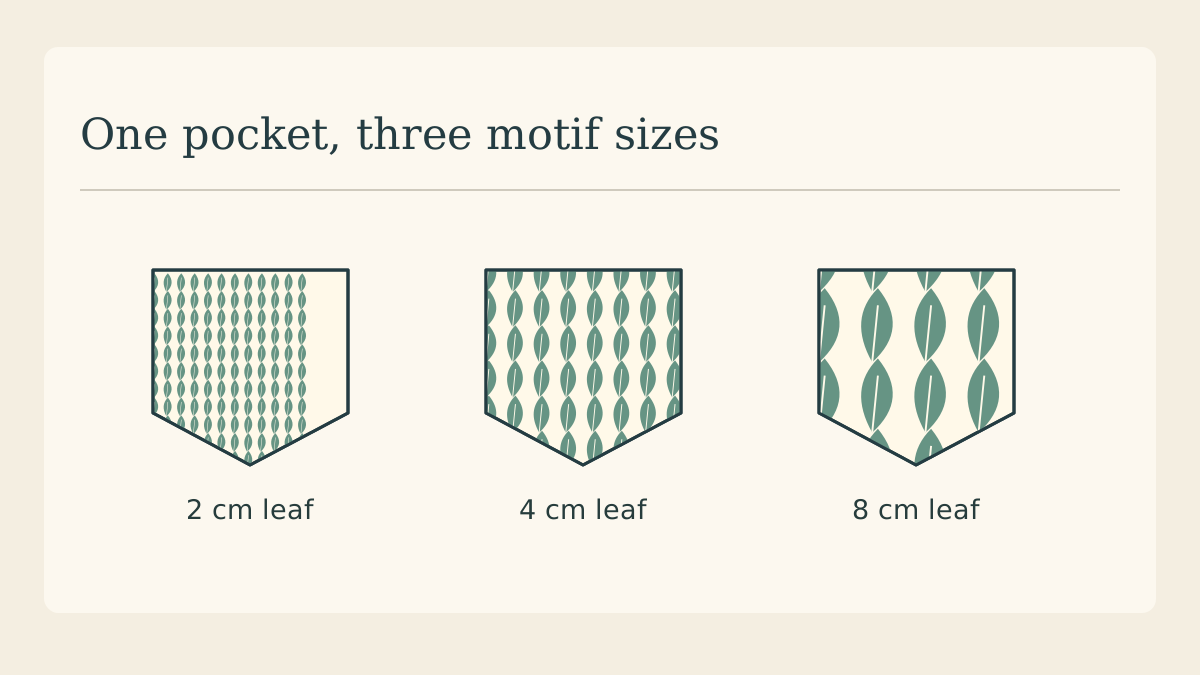
A repeat can look balanced across a metre of fabric and lose its subject on a pocket. The design decision here is motif size. Use a paper window cut to the finished pocket dimensions and compare several scales against the same edge.
Start with the visible pocket
Measure a finished pocket and trace its outline. An example measuring 12 by 14 centimetres gives you a small viewing window. Include the angled bottom if your actual pocket has one. Seam allowances belong outside this finished window.
Print three motif sizes
For a leaf print, try leaves 2, 4 and 8 centimetres long on separate swatches. Keep the density and colour family similar enough to compare the sizes. Write the actual scale on the reverse of each piece before cutting samples.
Move the paper window
Place the pocket window over each swatch and slide it by half a repeat. Count how many whole leaves remain at two different placements. At the largest scale a single vein may fill the pocket while the leaf silhouette falls outside it.
Compare the pocket with the body
Place the window over a second copy of the print to simulate the shirt front. Decide whether the pocket should disappear into a matched repeat or read as a separate shape. Those outcomes demand different cutting and placement decisions.
Look at a normal viewing distance
Pin the swatches to a shirt and step back. A busy two-centimetre motif may become an even colour at this distance. A four-centimetre leaf might still show its outline and leave room for an adjacent motif to enter the pocket.
Hand the scale to production
Include a scale bar, a centimetre measurement for one repeated element and a photo of the chosen placement. A digital thumbnail by itself changes size on every screen. The physical measurement lets a printer reproduce the approved decision.
Continue with the full repeat
Once the leaf scale works through the pocket window, check how neighbouring repeats join on a full sheet.