New models · Compared
Claude Opus 5.5 or Fable 5.1 for Creative Planning?

Anthropic released Claude Opus 5.5 on September 22, 2026 and said it performs at the level of Claude Fable 5.1 on most work while costing 40% less to run than Opus 5. For anyone planning campaign images in claude.ai, both now sit in the same model menu.
We gave both the same fictional bakery brief on September 23 at Medium effort and looked at one thing that matters to a small business: what each put in front of customers that the owner never said.
What Anthropic claims
Anthropic's announcement compares the two on its own benchmarks. Opus 5.5 scores higher on most of them: 66.4% against 55.8% on Terminal-Bench 4.0, 1846 against 1735 on GDPval-AA, and 89.0% against 88.4% on Chartography, a chart-reading test, with tools. These are Anthropic's numbers.
In claude.ai the menu describes Fable 5.1 as for your toughest challenges and Opus 5.5 as most capable for ambitious work. Both offered Low, Medium, High and Extra effort.
| Benchmark | Opus 5.5 | Fable 5.1 |
|---|---|---|
| Terminal-Bench 4.0 | 66.4% | 55.8% |
| GDPval-AA v2.1 | 1846 | 1735 |
| Humanity's Last Exam (tools) | 67.7% | 65.6% |
| Chartography (tools) | 89.0% | 88.4% |
The test
Kettle & Crumb is a fictional bakery launching a $9 Pumpkin Rye Sourdough on Saturday 3 October, 60 loaves, preorders closing the Thursday before, no discount and no delivery. The brief asks for a short creative brief, three 4:5 image prompts and a caption, and it tells the model to put guesses in a list called Assumptions rather than state them as true.
You are planning one Instagram post for a small neighbourhood bakery. Use only the facts below. If you need anything that is not in the facts, write it in a list called "Assumptions" instead of stating it as true.

Facts:
- Bakery: Kettle & Crumb, 14 Alder Street
- New product: Pumpkin Rye Sourdough, launching Saturday 3 October
- Price: $9 a loaf
- Only 60 loaves on launch day
- Preorder closes Thursday 1 October, through the link in our bio
- No discount, no delivery
- Audience: people who already follow us on Instagram and live nearby

Give me three things:
1. A creative brief in no more than 80 words.
2. Three different image prompts for a 4:5 photo. The image must contain no words, letters or logos.
3. One caption of no more than 60 words.
Opus 5.5 put its assumptions first
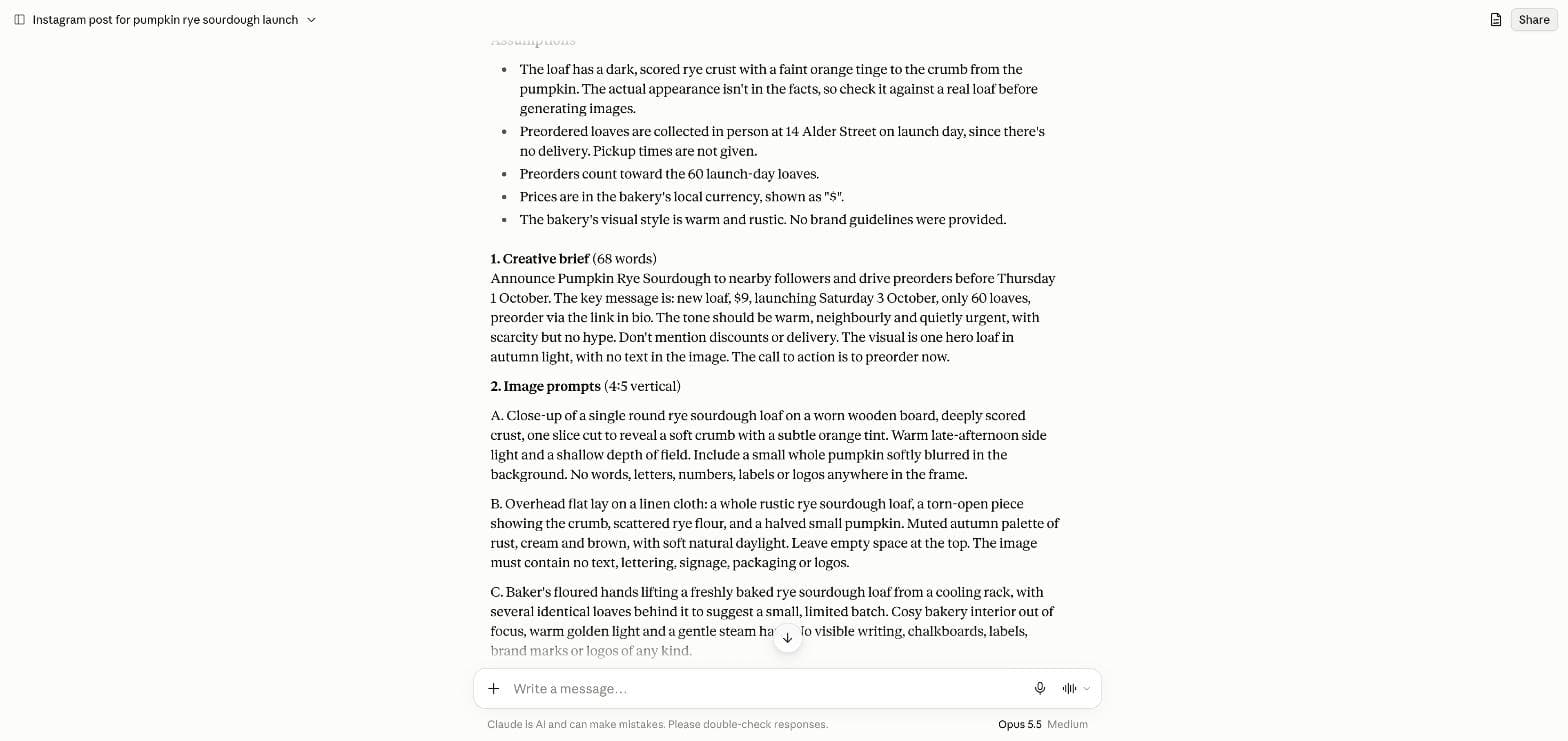
Opus 5.5 took about a minute and opened with five assumptions: the loaf's look, pickup in person because there is no delivery, preorders counting toward the 60 loaves, the currency, and the visual style. Its image prompts were the richest of any model we tested — a cut slice with an orange-tinted crumb, a small pumpkin, late-afternoon side light.
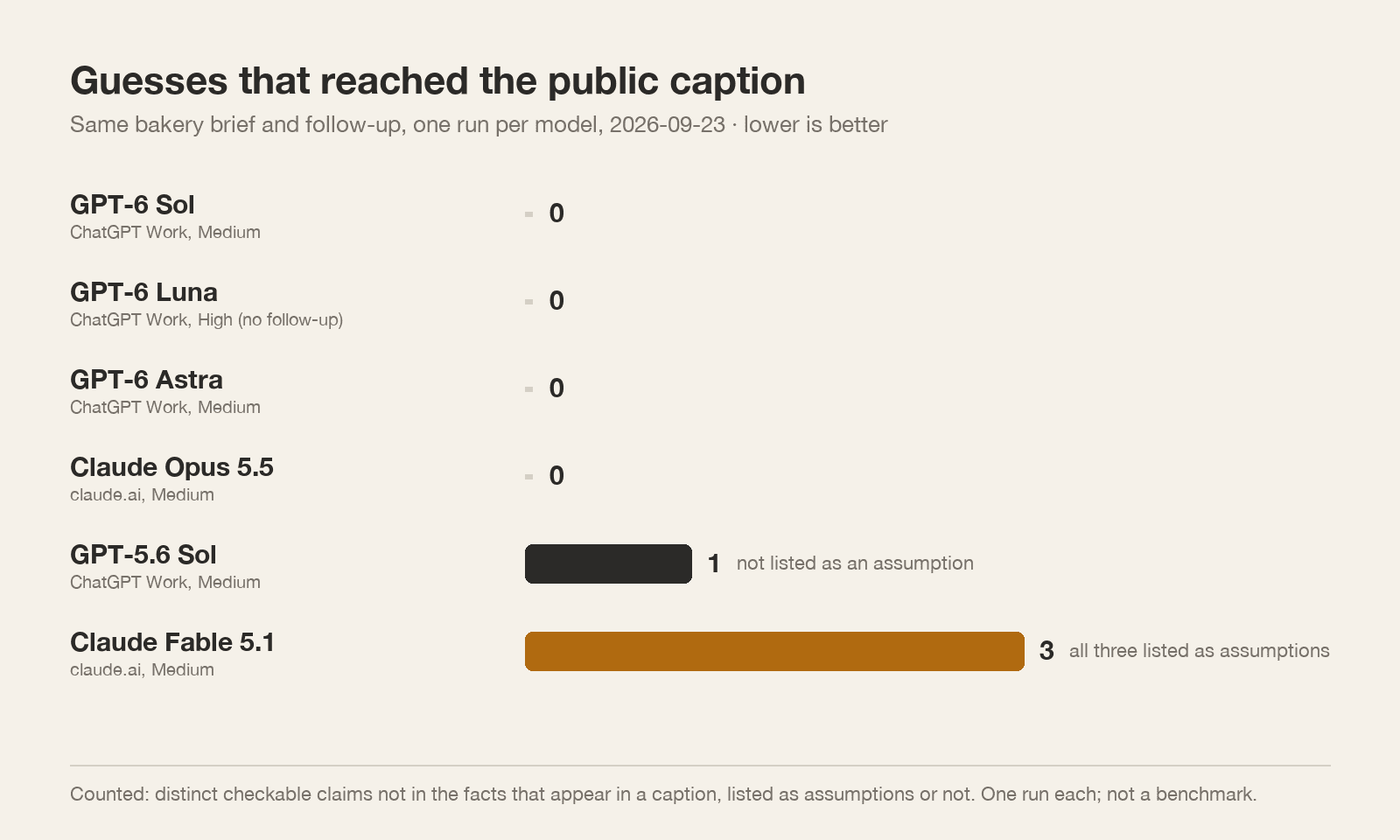
None of those guesses reached the caption. The caption kept to the date, place, price, 60 loaves and the Thursday deadline.
Fable 5.1 listed its guesses, then used them
Fable 5.1 finished in about 45 seconds and also wrote a sensible Assumptions list. But its brief called the launch pickup-only, and its caption told customers 'Pickup at 14 Alder Street only' and 'See you Saturday morning'. Both were guesses it had flagged.
The follow-up asked for a Friday caption with a usual offer and opening hours, which the facts never gave. Both models left placeholders instead of inventing them. Opus also noted that preorders would be closed by Friday; Fable's caption promised that a few loaves might go on the shelf for walk-ins.
What the prompts produced
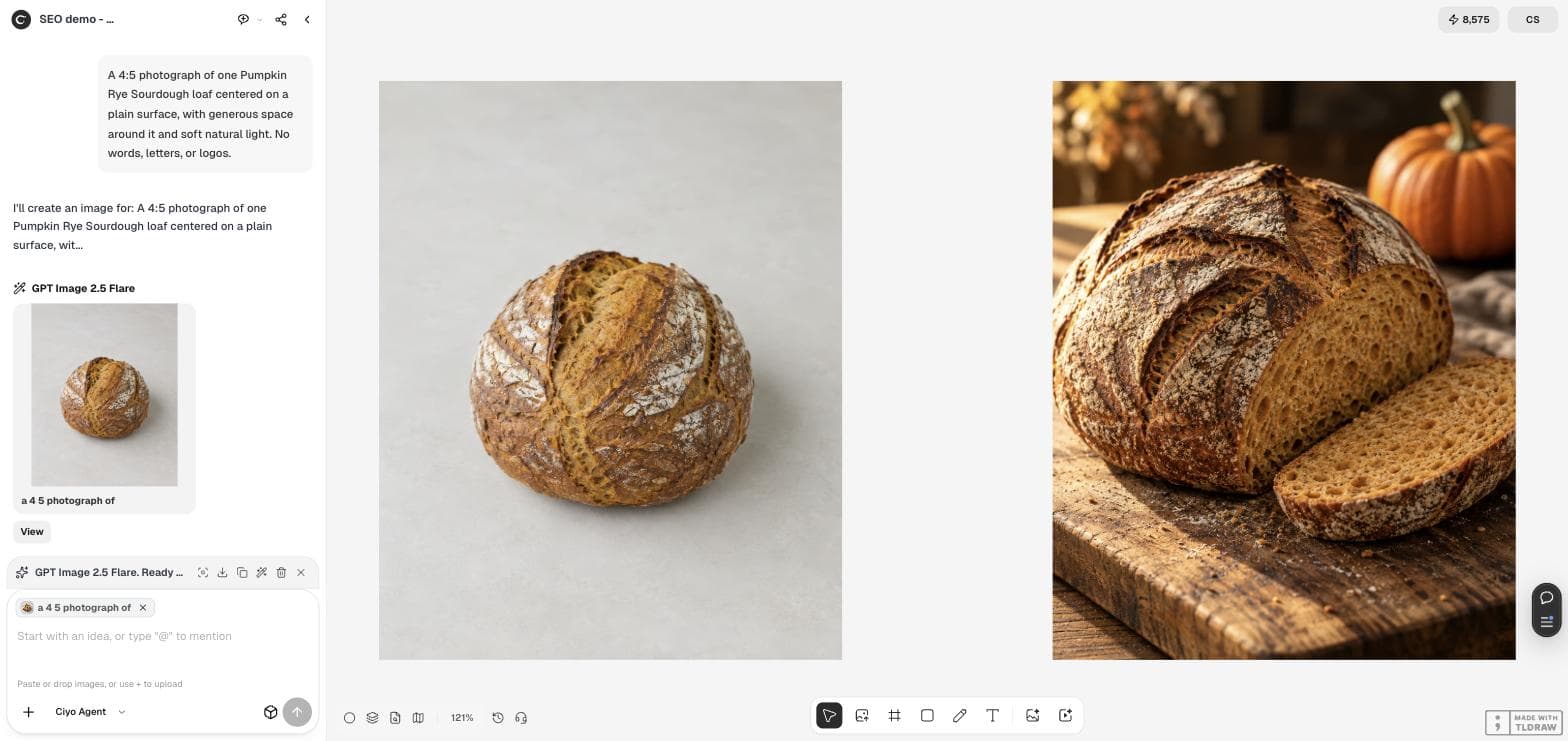
We took Opus's first prompt into Ciyo's Image Generator (GPT Image 2.5 Flare, 4:5, 1K, 2 credits). The photo followed every detail: the cut slice, the tinted crumb, the pumpkin behind. The planning model's detail is what the picture inherits, so a richer prompt is worth paying for when the product's look is known.
Ciyo does not run Claude Opus 5.5 or Fable 5.1; its agent offers Ciyo Agent and GPT-6 Astra. The step between planning and picture is a copy and paste.
Which to use
For planning posts, choose Opus 5.5. In our run it wrote the most useful prompts and kept its guesses where the owner could see them. Fable's slip is the kind that matters in retail: a wrong pickup promise becomes a complaint at the counter.
Whichever you choose, read the caption against the facts before posting. One run is an example, not a rate.
Anthropic's launch claim
The claim this article tests came from Anthropic's own launch post.
Posted 2026-09-22 by Anthropic's Claude account. It says Opus 5.5 performs at the level of Fable 5.1 for most tasks and costs 40% less to run than Opus 5. Our single creative-brief run is consistent with that, but it is one task, not a benchmark.
Opus 5.5 vs Fable 5.1
Is Claude Opus 5.5 better than Fable 5.1?
Anthropic reports Fable-level performance on most work and higher scores on several benchmarks. In our creative-brief test, Opus kept guesses out of its captions and Fable did not.
Which is faster?
In our run Fable 5.1 finished in about 45 seconds and Opus 5.5 in about a minute, both at Medium effort.
Did either invent a discount or opening hours?
No. Both used placeholders when asked for an offer and hours that were not in the facts.
Can I use Opus 5.5 in Ciyo?
No. Ciyo's agent offers Ciyo Agent and GPT-6 Astra. Paste Opus's prompts into Ciyo's Image Generator.
Turn a detailed prompt into the picture
Paste the prompt into Ciyo's Image Generator and compare versions side by side on one board.