Ciyo · GPT-6
GPT-6 Astra vs Claude Fable 5.1 for Creative Work

OpenAI released GPT-6 Astra on September 3, 2026, two days after Anthropic released Claude Fable 5.1. Both models take text and images as input, return text, and list the same headline API price of $10 per million input tokens and $50 per million output tokens. That makes “which one is better for design work” a fair question with no simple answer.
This is a documentation-based comparison checked on September 7, 2026. It uses the vendors’ model pages, pricing pages, OpenAI’s launch evaluations, and one independent index. We have not run a controlled creative benchmark between the two models. Where a number comes from one vendor’s own testing, the article says so.
Start with the specifications that actually differ
Astra’s model page lists a 1,050,000-token context window, a 922,000-token input ceiling, and a 128,000-token output ceiling. Fable 5.1 lists a 1M-token context window and a 128K-token maximum output. Both accept text and images and return only text, so neither model produces a finished picture by itself.
Reasoning is controlled differently. Astra exposes an effort setting from low to max. Fable 5.1 uses adaptive thinking that is always on and steered by an effort parameter whose default is high. Astra’s knowledge cutoff is April 30, 2026; Fable 5.1 lists a reliable knowledge cutoff of June 2026. These are the facts to record before any taste-based comparison.
| Property | GPT-6 Astra | Claude Fable 5.1 |
|---|---|---|
| API model | gpt-6-astra | claude-fable-5-1 |
| Input / output | Text + images / text | Text + images / text |
| Context window | 1,050,000 tokens | 1M tokens |
| Maximum output | 128,000 tokens | 128K tokens |
| Reasoning control | Effort: low to max | Adaptive thinking, effort default high |
| Knowledge cutoff | April 30, 2026 | June 2026 (reliable) |
Same headline price, different meters
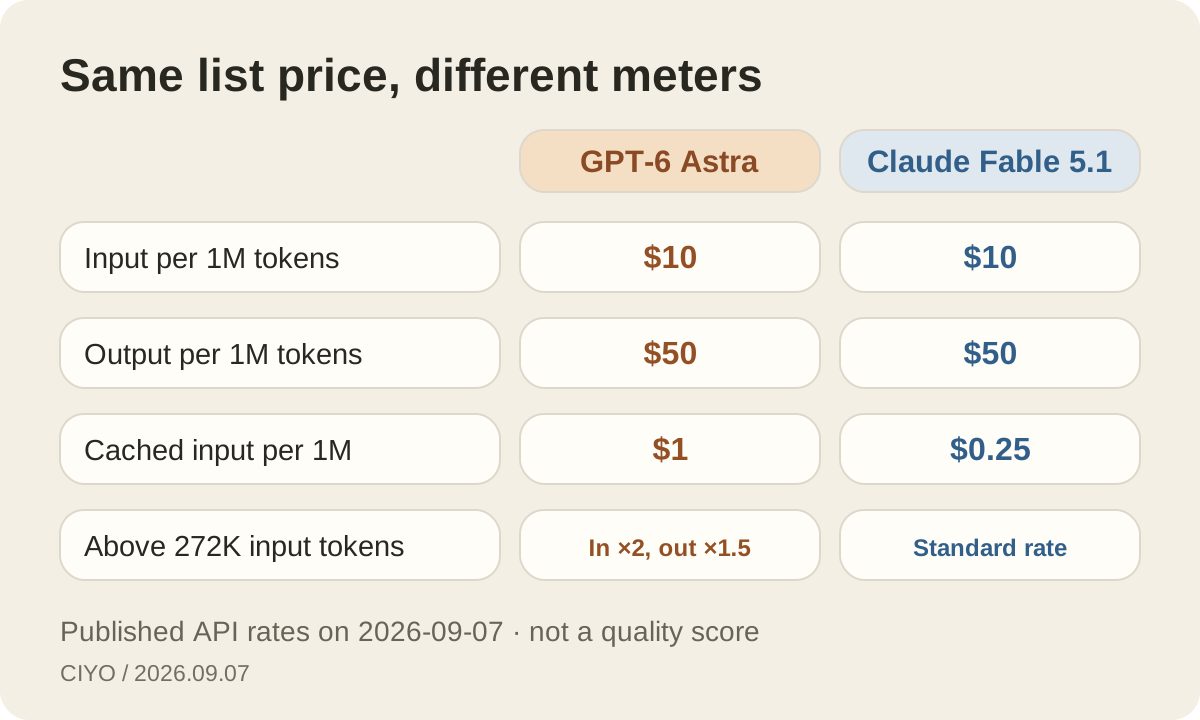
At standard rates both models charge $10 per million input tokens and $50 per million output tokens, and both bill reasoning or thinking tokens as output. The differences appear in the details. Astra’s cached input costs $1 per million tokens; Fable 5.1’s cache reads cost $0.25 per million, a quarter of Astra’s rate, while its five-minute cache write costs $12.50, the same as Astra’s cache write.
Long requests diverge further. Once an Astra request exceeds 272,000 input tokens, the whole request moves to $20 input and $75 output per million tokens. Anthropic’s pricing page states that Claude 4.6 and later models include the full 1M context at standard pricing. A team that repeatedly sends a large brand book will see different bills from two models with identical list prices.
The benchmark rows where both models appear
OpenAI’s launch post publishes a table with a Claude Fable 5.1 column. On AutomationBench it reports 41.4% for Astra against 31.4% for Fable 5.1. On BenchCAD, which reconstructs 3D objects by generating CAD code, it reports 95.9% against 84.3%, with a footnote that the Claude scores reflect three modifications described in Anthropic’s system card. On Terminal-Bench 4.0 the figures are 57.9% and 55.8%.
The same table also shows rows where Fable 5.1 leads. On Humanity’s Last Exam with tools, Astra scores 57.2% and Fable 5.1 scores 65.0%. On the Artificial Analysis Intelligence Index v4.1.1, an independent aggregate, Astra scores 61.2 and Fable 5.1 scores 65.7. On the Artificial Analysis Coding Agent Index, Claude Opus 5 leads at 68.1 versus Astra’s 67.0. Every number here is reported at the maximum score across effort levels.
What none of those rows measure
No published row scores typography, layout hierarchy, colour judgment, or brand consistency. OpenAI lists an internal Design Tasks evaluation at 50.0% for Astra and 47.4% for GPT-5.6 Sol, but the tasks are not public and no Fable 5.1 result is shown. The Intelligence Index is a weighted average of ten evaluations covering agents, coding, scientific reasoning, and general knowledge; none of them is an image-quality test.
For a creative team the useful reading is narrower. Computer-use rows, such as Astra’s 72.6% on OSWorld 2.0, say something about operating design software and running visual QA. Long-context rows say something about reading a large reference pack. A picture’s quality still comes from the renderer and from your review, not from these tables.
Tools decide how a picture actually gets made
Astra’s model page lists an image_generation tool alongside web search, file search, code interpreter, computer use, MCP, and skills. In a Responses API request, Astra can plan a visual, call the image tool, and return the rendered result in the same turn. The pixels come from the GPT Image 2 renderer, which is billed separately from Astra’s own tokens.
Anthropic’s documentation describes Fable 5.1 as text and images in, text out, with server-side tools for computer use, browser use, code execution, web search, and web fetch. There is no first-party image-generation tool in that list. A Claude-based workflow therefore hands the rendering step to an external image model, which is exactly what a canvas like Ciyo does with GPT Image 2 regardless of which assistant wrote the brief.
Where each model lives for a working designer
Astra reaches ChatGPT as GPT-6 Pro on Pro, Business, and Enterprise plans, and Plus plans include Astra in ChatGPT Work and Codex as the rollout continues. In the API it is gpt-6-astra, and OpenAI also names Microsoft Azure and AWS Bedrock. Fable 5.1 is available on the Claude API, Amazon Bedrock, Google Cloud, Microsoft Foundry, and Claude Platform on AWS.
The practical consequence is that your existing account often decides the first test. Check which product exposes the model before you compare quality. A designer with a Plus plan can already run Astra in Work or Codex, while an API developer can run both models from one script with the same brief.
A cost example for one campaign brief
Take a request with 20,000 uncached input tokens and 4,000 output tokens. At standard short-context rates it costs $0.40 on either model. Now repeat it twenty times with the same 15,000-token brand section cached. On Astra the cached part costs $0.015 per request; on Fable 5.1 it costs $0.00375. Over twenty requests the difference is about $0.23, small in isolation and larger for an agency running hundreds of variants.
Reasoning changes the picture more than caching does. Both vendors bill hidden reasoning as output at $50 per million tokens, so a request that thinks for 30,000 tokens costs $1.50 before it writes a word. Record the effort setting for every test, because comparing Astra at max with Fable 5.1 at its default is not a fair comparison of either quality or cost.
Run a comparison you can actually judge
Choose three assignments that resemble your work: a brief with conflicting constraints, a landing-page review from screenshots, and a revision that touches several deliverables. Fix the acceptance criteria before you see any output. Use identical references, the same effort level on both sides, and the same renderer for any images, so that a difference in pictures is not mistaken for a difference in planning.
Record the model ID, date, effort, token usage, tool charges, elapsed time, and the number of corrections. Hide the model names from the reviewer when you can. A single striking example from either vendor’s launch material is not evidence about your product photography or your mobile layouts. Several representative tasks, reviewed blind, are.
What a fair conclusion sounds like
A useful result is specific and dated: one model needed fewer revisions on your packaging briefs in September 2026, or both were acceptable and the cached-input price decided the default. Keep the conditions next to the conclusion and revisit it when prices or models change. Anthropic commits to keeping Fable 5.1 available until at least September 1, 2027, so a decision made now has room to be re-tested.
For the rendering step, the choice of planner matters less than the reference images, the output size, and the review loop. In Ciyo you can bring either assistant’s brief to the canvas, generate with GPT Image 2, and compare selected outputs side by side without changing which model wrote the plan.
Continue reading
Questions about Astra versus Fable 5.1
Is Claude Fable 5.1 cheaper than GPT-6 Astra?
Not at the headline rate: both list $10 input and $50 output per million tokens. Fable 5.1’s cache reads cost $0.25 versus Astra’s $1, and Astra doubles input pricing above 272,000 input tokens while Anthropic prices the full 1M context at standard rates.
Can Claude Fable 5.1 generate images?
Its documentation lists text and images as input and text as output, with no first-party image-generation tool. Astra can call an image tool that renders with GPT Image 2. In either workflow a separate image model produces the final pixels.
Which model is better for design?
The published evaluations do not settle that. Astra leads on the computer-use and CAD rows OpenAI reports; Fable 5.1 leads on the independent Intelligence Index and on Humanity’s Last Exam. Test your own briefs under matched conditions.
Keep the renderer constant while you test the planners
Bring the same brief and references to Ciyo, generate with GPT Image 2 on pay-as-you-go credits, and compare the outputs each assistant helped you plan.