New models · Compared
Opus 5.5 vs GPT-6 Sol: One Brief, Two Models

Anthropic's Claude Opus 5.5 and OpenAI's GPT-6 Sol were both released on September 22, 2026, and both are sold as the capable, cheaper option below each company's flagship. The searches that followed ask the obvious thing: which one is better?
We answered it for one job on September 23 — planning a small bakery's launch post — then turned each model's first image prompt into a real picture in Ciyo. The pictures made the difference easier to see than the text.
Price and access
GPT-6 Sol costs $2 per million input tokens and $10 per million output tokens; Claude Opus 5.5 costs $4 and $20. In the apps, Sol is in ChatGPT Work and Codex on paid plans, and Opus 5.5 is on claude.ai's Pro, Max, Team and Enterprise plans.
Both read images and answer in text. Neither is available in Ciyo, whose agent offers Ciyo Agent and GPT-6 Astra.
| Item | GPT-6 Sol | Claude Opus 5.5 |
|---|---|---|
| Where | ChatGPT Work, Medium | claude.ai, Medium |
| Time to answer | 15 s | about 60 s |
| Facts wrong | 0 | 0 |
| Guesses in captions | 0 | 0 |
| Assumptions listed | 1 line | 5 items, first |
| Invented offer or hours on follow-up | No, placeholders | No, placeholders |
The brief
Kettle & Crumb is fictional: a neighbourhood bakery launching a $9 Pumpkin Rye Sourdough on Saturday 3 October, with 60 loaves and preorders closing on Thursday. The brief asks for a creative brief, three 4:5 image prompts with no lettering, and a caption, and it asks the model to list its guesses.
You are planning one Instagram post for a small neighbourhood bakery. Use only the facts below. If you need anything that is not in the facts, write it in a list called "Assumptions" instead of stating it as true.

Facts:
- Bakery: Kettle & Crumb, 14 Alder Street
- New product: Pumpkin Rye Sourdough, launching Saturday 3 October
- Price: $9 a loaf
- Only 60 loaves on launch day
- Preorder closes Thursday 1 October, through the link in our bio
- No discount, no delivery
- Audience: people who already follow us on Instagram and live nearby

Give me three things:
1. A creative brief in no more than 80 words.
2. Three different image prompts for a 4:5 photo. The image must contain no words, letters or logos.
3. One caption of no more than 60 words.
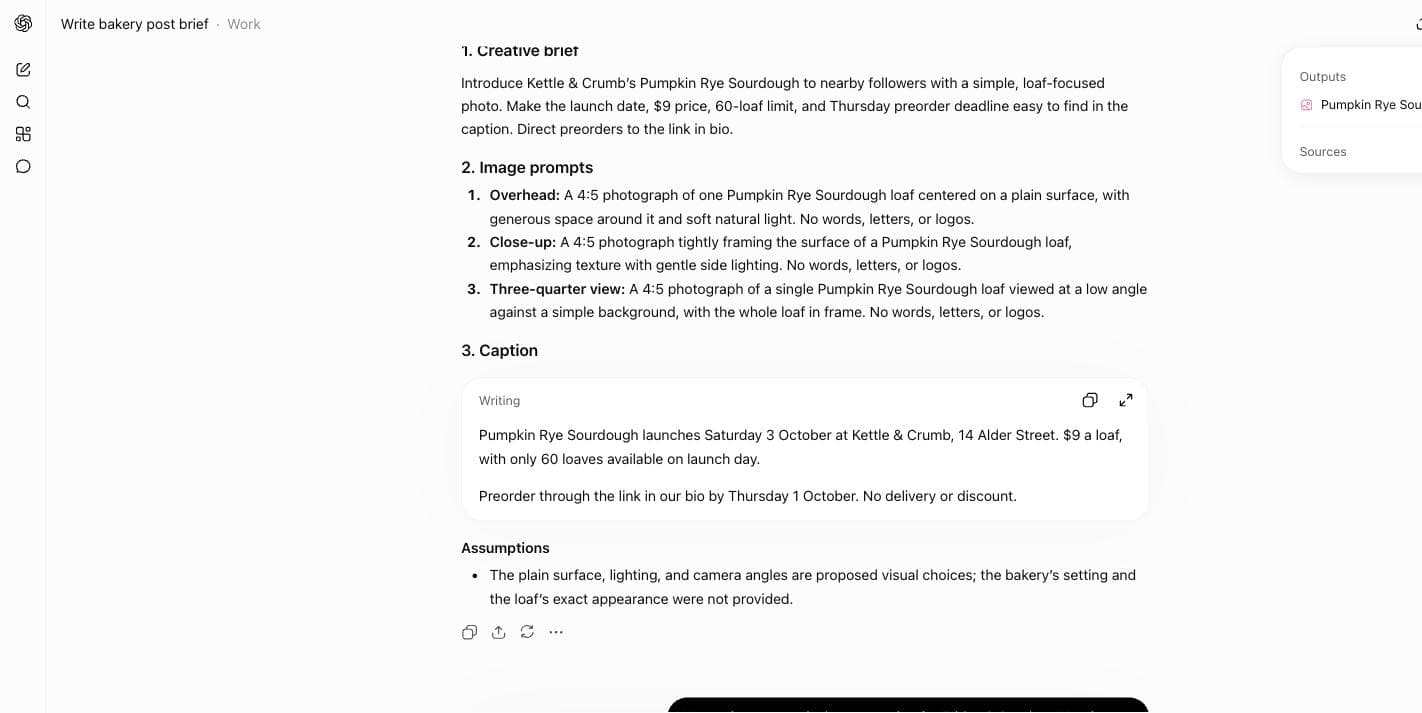
Sol: correct and plain
Sol answered in 15 seconds with no errors and no invented details. Its prompts were deliberately bare: one loaf on a plain surface, a close-up of the crust, a low three-quarter view. It noted that the loaf's look was not given, and so it did not describe one.
Opus: slower and specific
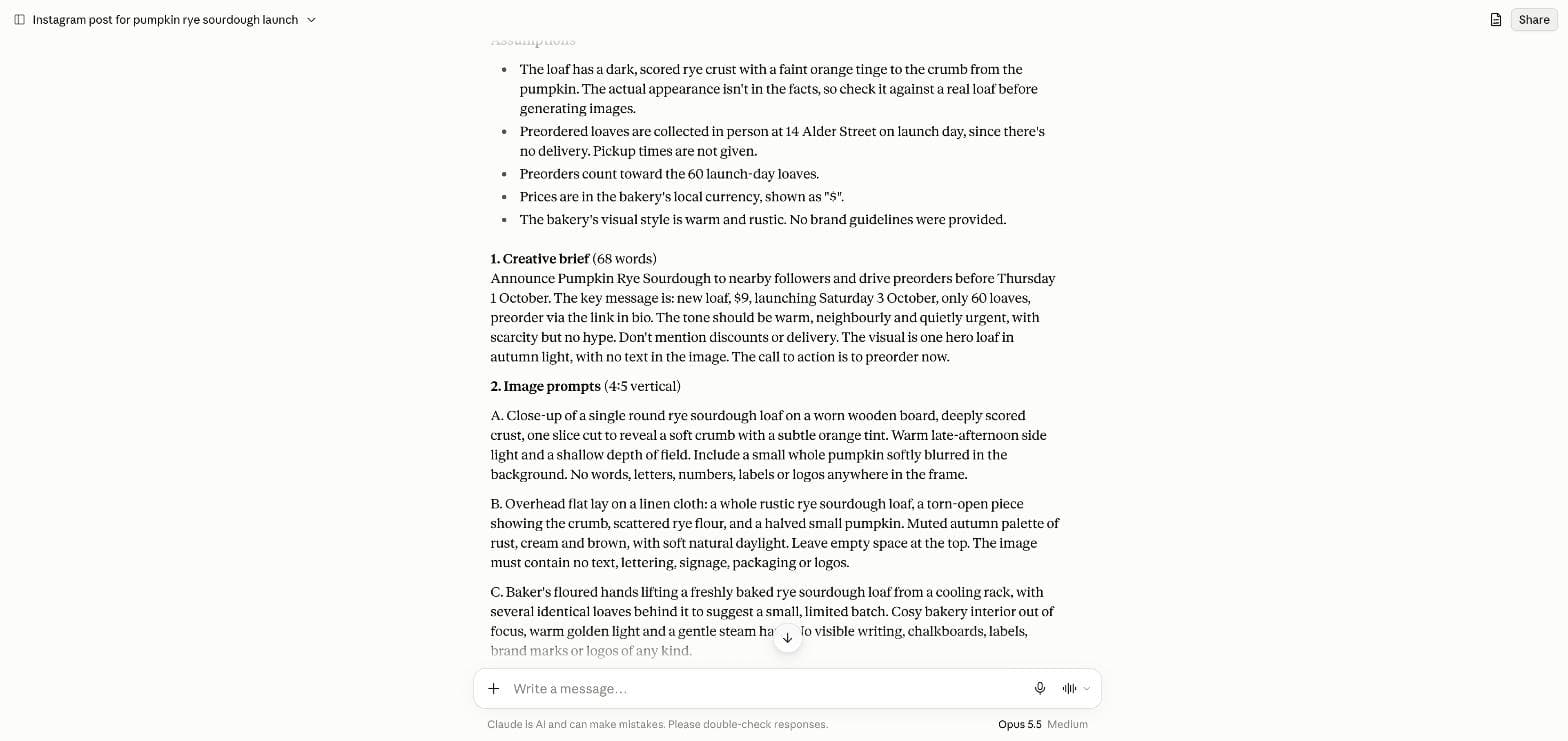
Opus took about a minute. It opened with five assumptions, including that the crumb might be orange-tinted from the pumpkin, and told the owner to check the loaf's real appearance before generating images. Its prompts then used those assumptions: a cut slice, a pumpkin in the background, warm side light, a baker's floured hands.
The pictures
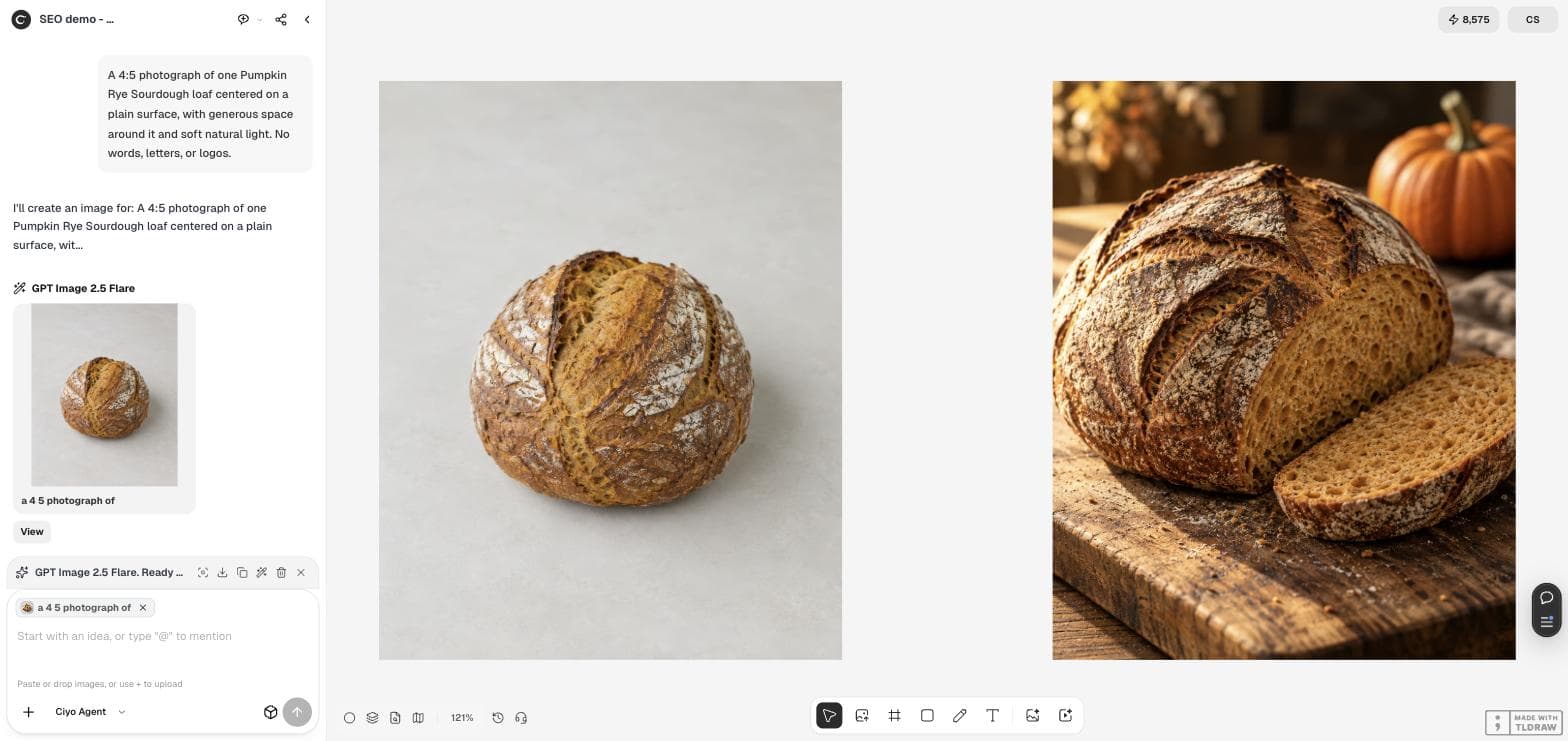
We pasted each model's first prompt into Ciyo's Image Generator with the same settings: GPT Image 2.5 Flare, 4:5, 1K, 2 credits each. Sol's prompt produced a clean, uncut loaf on a grey surface — accurate and generic. Opus's produced a cut loaf with a tinted crumb, a slice and a pumpkin — more appealing, and built on guesses the owner has to confirm.
Neither is wrong. Sol's picture is safe to post for any sourdough; Opus's sells this loaf better if the crumb really is orange.
A second task: checking a chart
We also asked both to check a chart slide on which we had changed one label. Both caught it. On the unedited slide, Opus reported no mismatch and gave its reading precision; Sol flagged a three-unit difference as a mismatch. The full test is in its own article.
What others found on launch day
Early side-by-side posts compared the two on code rather than creative work. They are useful as sentiment, not as evidence for briefs.
Posted 2026-09-22. The poster gave both models one game-building prompt and says Opus 5.5 was far ahead. It is a single-prompt opinion about game code; our comparison is about a marketing brief.
Opus 5.5 vs GPT-6 Sol
Which is better for planning social posts?
In our one run, Opus 5.5 wrote richer prompts and put its guesses up front; GPT-6 Sol was faster and more literal. Both kept every fact right.
Which is cheaper?
GPT-6 Sol: $2 and $10 per million input and output tokens. Claude Opus 5.5: $4 and $20.
Can either make the image?
Both answer in text. ChatGPT can call an image tool for Sol; Opus drew an SVG illustration when asked. We made the photos in Ciyo.
Are these models available in Ciyo?
No. Ciyo's agent offers Ciyo Agent and GPT-6 Astra; paste either model's prompt into the Image Generator.
Compare prompts on one board
Paste each model's prompt into Ciyo and see the pictures side by side before you pick one.