Models · For designers
The AI That Makes No Pictures and Writes No Words

Every AI story of the last three years has been about generation: more words, better pictures, faster video. The model that came out on September 15, 2026 is interesting because it does neither, and the reason it matters to a design studio is not obvious until somebody spells it out.
Jev, from TypeSafe AI, answers questions. Not open questions — questions you declared in advance, with the possible answers written down. It returns one of them, with a number saying how sure it is, in roughly a third of a second, for a fraction of a cent. Ciyo cannot run Jev: it produces no image and no video, and it appears in neither of our model registries. We are writing about it because of what it does to the work that sits around creative work.
The part of the job nobody puts on a portfolio
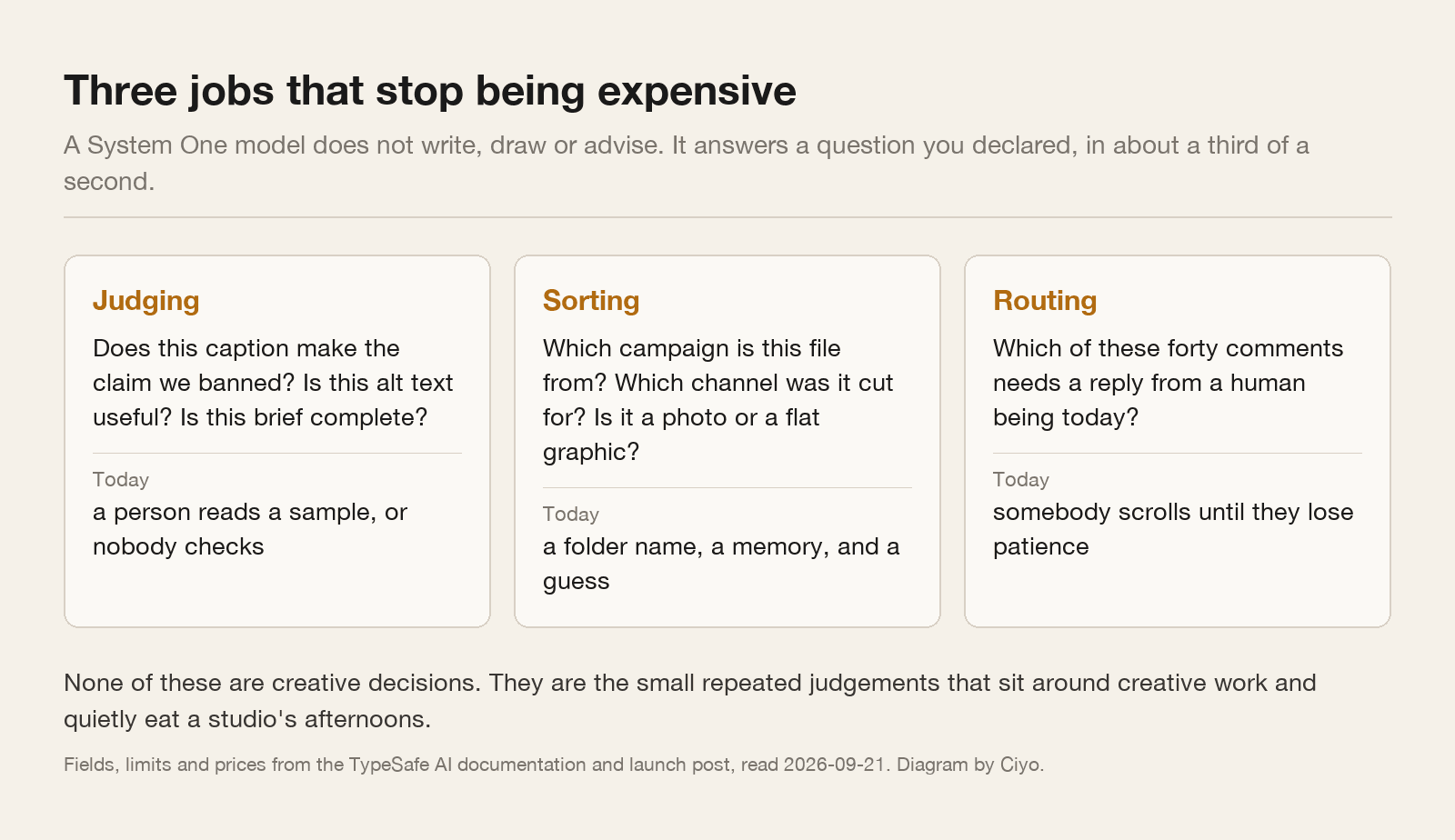
Think about a week in a small studio. Somewhere in it, somebody renames two hundred files. Somebody reads the comments under a campaign post to see whether any of them need a reply. Somebody checks that a caption does not repeat a claim the client's lawyer struck out. Somebody decides which of four versions goes to the client.
None of that is design. All of it is judgement, it is repetitive, and it is the first thing to be skipped when a deadline arrives. Skipping it is also how the wrong price ends up in a post.
A decision model is built precisely for that layer. It cannot design anything. It can answer the same small question ten thousand times without getting bored or inconsistent.
How it differs from asking a chatbot
You can already ask a language model whether a caption is on brand. It will answer, in a paragraph, and the answer will be slightly different tomorrow.
A decision model is asked in a different shape. You declare the question and the permitted answers first: choose one of these five categories, or score this against these four levels, or answer this yes-or-no. What comes back is a value of that type, plus a confidence number, and nothing else. No prose to parse, no sentence that hedges both ways.
The practical upshot for a team is repeatability. When a judgement is a typed value rather than a written opinion, you can count it, chart it, set a rule on it, and notice when it changes.
Where it sits next to the tools you already have
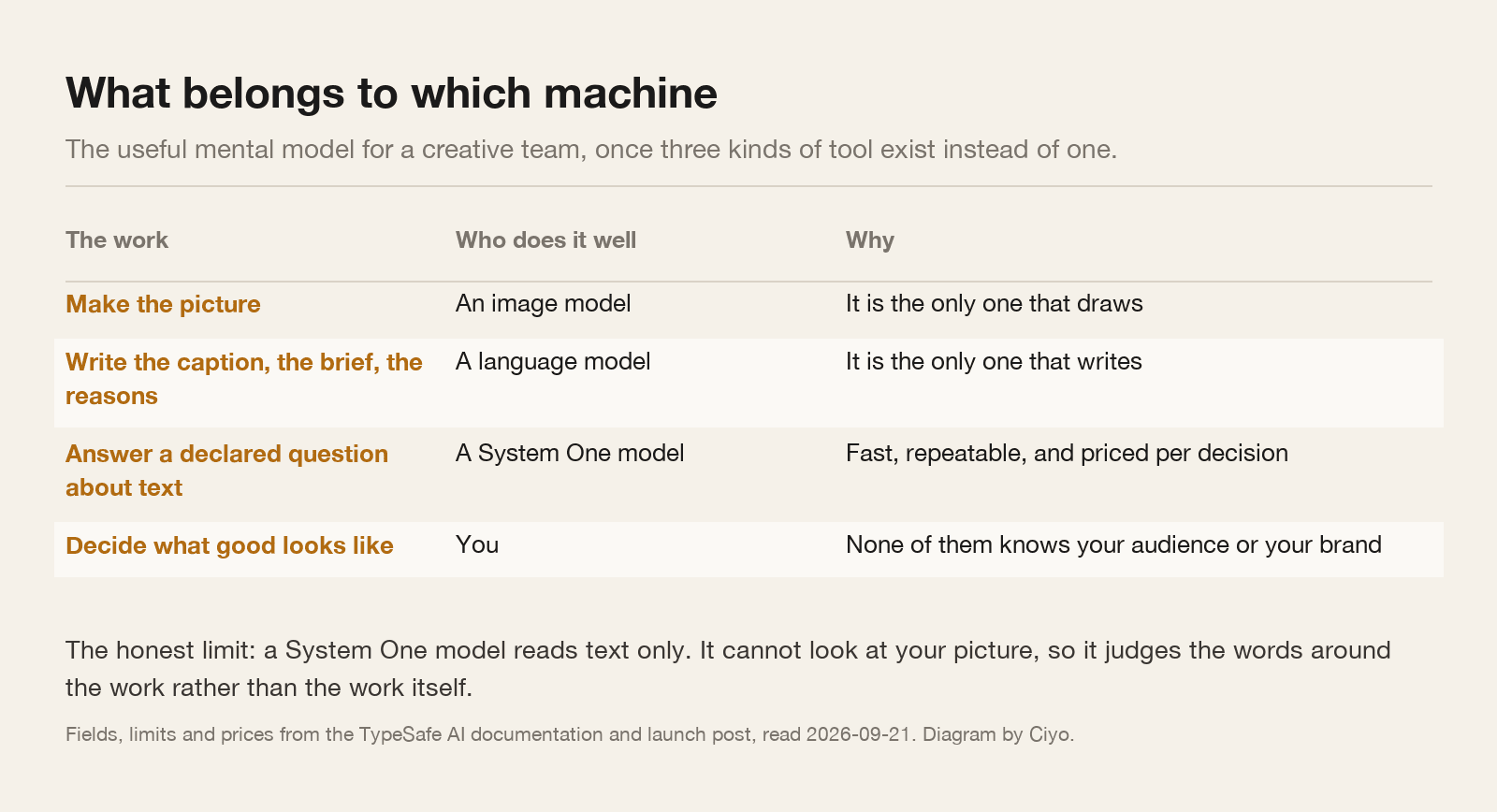
It is genuinely a third kind of tool rather than a replacement for either of the two you know.
The image model draws. The language model writes and explains. The decision model judges text against criteria you wrote. And the fourth participant, the one none of them replaces, decides what good means in the first place.
The limit that matters most in creative work
It reads text only. TypeSafe's documentation states that the material you send must be a string, a JSON object or an array of text values, and that images, audio and video are not supported yet.
So it cannot look at your poster. It cannot tell you whether the logo is too small, whether the crop is awkward, or whether the photograph matches the brief. Everything in this article is about the words around the work: captions, briefs, alt text, file metadata, comments, copy.
That is a real boundary and it is worth holding on to, because a great deal of coverage this week has been vague about it. If somebody tells you this model will review your designs, they have not read the documentation.
Why the price changes behaviour, not just the bill
The published price is $0.042 per million input tokens, with output charged at nothing. In round numbers, a short text record costs a small fraction of a cent to ask a question about.
At that price the interesting decision is not what to automate, it is what to stop sampling. Checking a tenth of your captions is a compromise you made because checking all of them cost a person's afternoon. That compromise stops being necessary.
The sting in the tail arrives with it. A checker that is wrong in a consistent direction is now wrong on everything, quietly. A pre-registered independent evaluation published on September 20, 2026 found that when no “none of these” option was offered, none of thirty out-of-scope cases were flagged: the model simply picked the nearest wrong answer and reported a confidence for it.
| What changes | The gain | The new obligation |
|---|---|---|
| Checking everything instead of a sample | Nothing slips through because nobody had time | A wrong rule now applies to everything |
| A judgement becomes a number | You can chart it, alert on it, and audit it | You have to write down what the levels mean |
| Consistency between Monday and Friday | The same answer for the same input | A consistent mistake is repeated exactly |
| Answers arrive in a third of a second | Checks can run while somebody waits | Nobody reads them unless you make the result visible |
Posted 2026-09-21 by the founder of Doist, quoting the creator of Redis. The poster calls it “a new family of models focused on super-fast and cheap decision-making”; the post he quotes calls the same thing “a minor thing happening in AI” whose hype shows the bubble misjudging what matters. Both views are worth holding while the evidence is one week old.
What to do about it this month
Nothing technical, and nothing that depends on this particular model existing.
Pick one judgement your team makes repeatedly and write it down properly: the question, the permitted answers, and what each one means. Do it for “is this caption on brand” or “which campaign does this file belong to”.
Then label fifty real examples by hand and keep them. That set is the only thing that will ever tell you whether an automated checker is helping, and it is useful immediately even if you never automate anything. Most teams discover, writing the rubric, that two people on the team have been applying different rules all year.
The rest of this series works through four specific jobs: sorting a library, checking campaign copy, triaging comments, and alt text.
Questions from designers
Can it review my artwork?
No. TypeSafe's documentation states that the material you send must be text: a string, a JSON object or an array of text values, and that images are not supported yet. It judges the words around the work.
Is this going to replace a designer?
It cannot design. It has no opinion about composition and it never produces anything. What it replaces is the hour spent renaming files and skim-reading comments.
Can I use it inside Ciyo?
No. Ciyo does not run Jev. It makes no image and no video, and it is in neither of our model registries. We cover it because it is part of the machinery being built around creative tools.
What does it cost?
TypeSafe publishes $0.042 per million input tokens with output free, so a short text record costs a small fraction of a cent to ask about. Prices change; check the vendor's page.
Keep reading
Ciyo writes about the models behind creative and agent tooling, and tests the ones it can run.