AI models · Explainer
System One Models: What Jev Actually Does

TypeSafe AI released Jev on September 15, 2026 and called it the first of a new class: a System One model, “a new class of frontier models built to make fast, structured decisions that software can use directly.”
The easiest way to misread that sentence is to hear “smaller language model”. Jev is not a language model. It does not generate text, it cannot write your caption, and it will never answer an open question. It gives up string generation on purpose, and everything interesting about it follows from that trade.
A new class, and what it gives up
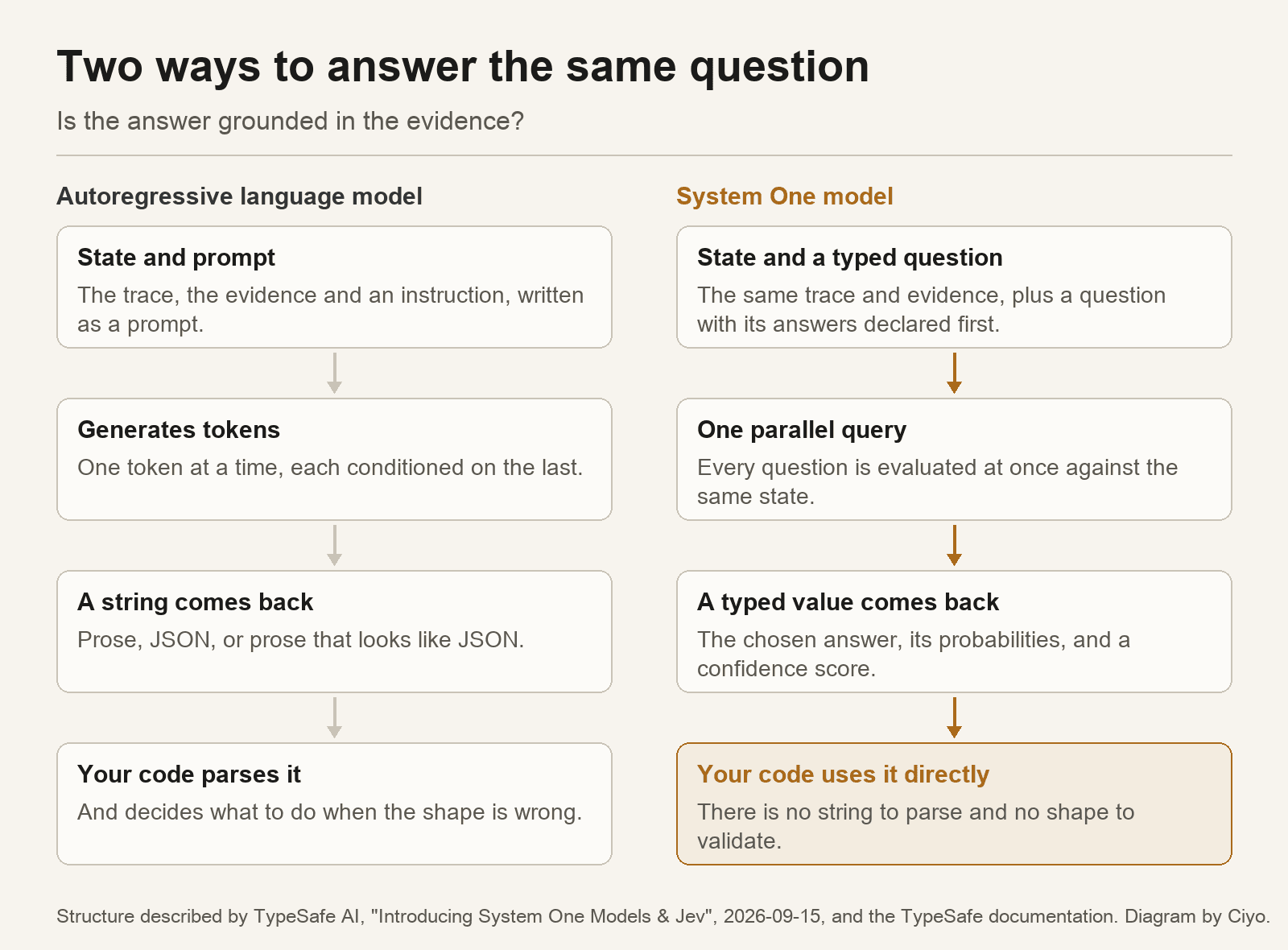
An autoregressive language model samples one token at a time, each conditioned on the last, and hands you a string. Whatever structure that string has is a convention the model has learned to imitate, which is why every production system that needs a value out of a model ends up with a parser, a schema validator and a retry.
A System One model removes that layer by inverting the order. You declare the possible outputs first, then give the model a structured state and a typed question. What comes back is a value of the type you declared, with the probabilities across the possible answers and a confidence score attached.
The cost is total: no prose, no code, no open-ended reply. TypeSafe frames this as a deliberate architectural trade rather than a limitation, and the name says as much. System One is the fast, automatic judgement; System Two is the deliberation. Jev is only the first.
| Aspect | Autoregressive language model | System One model |
|---|---|---|
| Sampling | One token at a time, each conditioned on the last | All outputs in a single parallel query |
| Output | A string, with whatever structure it has learned to imitate | A type-safe structured value, declared in advance |
| Uncertainty | Implied by the wording, if at all | Probabilities across the answers, plus a confidence score |
| Training | RLHF, optimised for a preferred response | RLCD, described as optimised for calibrated decisions |
| Gives up | Nothing, in principle | String generation entirely |
Two ways to answer the same question
Take one concrete question an agent asks constantly: is this answer grounded in the evidence it retrieved? Both kinds of model can answer it. They arrive by different routes, and the route is the whole story.
The left path is familiar. The right path never produces a string at all, so there is nothing to parse, nothing to validate, and no class of failure where the model writes a perfectly reasonable sentence in place of the field your code expected.
Atomic questions, composed in code
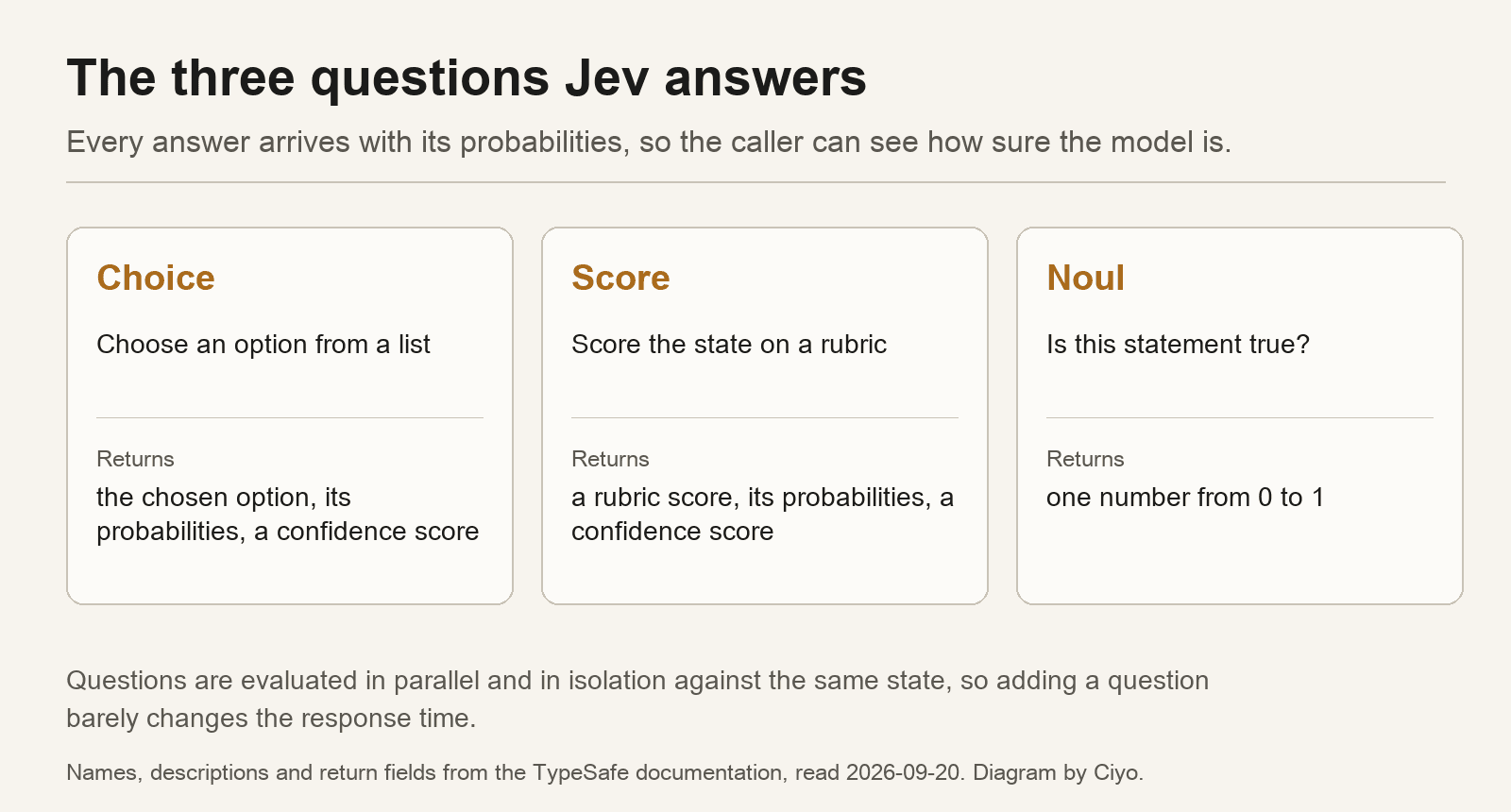
The documentation exposes three primitives and nothing else. Choice picks an option from a list and hands back the chosen option, the probabilities across all of them, and a confidence score. Score rates the state against a rubric and returns the same three fields, with a score in place of the choice. Noul answers whether a statement is true and returns a single number between 0 and 1.
The composition rule is the part engineers tend to underestimate. Every question is evaluated in parallel and in isolation against the same state, in one go, so asking twelve questions about one trace is not twelve round trips. The documentation puts it plainly: adding questions barely changes the response time.
That turns evaluation into something you write in ordinary code. Instead of one long prompt asking a model to weigh several things at once and report back in JSON, you ask several small questions with declared answers and combine the results yourself, where you can see them.
Why the hallucination claim is narrower than it sounds
TypeSafe says a System One model “can't hallucinate”. Read that as a claim about types, not about truth. Because the possible outputs and their structure are defined in advance, the model cannot return a category you did not declare, a malformed object, or a confident sentence about a document that does not exist. That class of bug is gone by construction.
What remains is ordinary wrongness. A Choice can select the wrong option from your list. A Score can rate a bad answer highly. The model will tell you how sure it is, and TypeSafe describes those probabilities as calibrated and “epistemically honest”, but a calibrated 0.7 is still wrong three times in ten.
This is why the confidence value is part of the interface rather than a nicety. Developers quoted in TechCrunch's coverage on September 18 described exactly that shift: the number is yours to interpret, and deciding what to do at 0.55 is now your design problem rather than the model's.
How it was trained, as far as anyone has said
TypeSafe names its method Reinforcement Learning for Calibrated Decisions, or RLCD, positioned against the RLHF that shaped chat models. Where RLHF optimises for a response a human prefers, RLCD is described as optimising for probabilities that mean what they say.
Beyond the name and the output contract, the architecture is not public. TechCrunch noted that the founder stayed tight-lipped about it, and the model has no open weights. Anyone telling you how Jev works inside is reasoning from the shape of its API, not from a paper.
Where it runs today
Access is an early-access waitlist, with a console and documentation at typesafe.ai. OpenRouter's TypeSafe provider page lists jev-latest and jev-1.13 with a 32,000 token context, but those entries do not appear in OpenRouter's public model list, so the route is gated rather than open.
The more telling distribution news is infrastructure. On September 17, 2026 Cloudflare announced Jev was live on its AI Gateway, described in exactly the vocabulary the model uses: send state and typed questions, get structured answers your code can use directly. That is how a model of this kind reaches most people — not as an app, but as a call inside something you already run.
Posted 2026-09-17. A vendor announcing its own integration: evidence of availability, not of performance.
System One model questions
Is Jev a small language model?
No. It is not autoregressive and it generates no text. It evaluates a typed question against a structured state and returns a value of the declared type with probabilities and a confidence score.
What does “cannot hallucinate” actually cover?
The shape of the output. The model cannot return a category you did not declare or a malformed object. It can still pick the wrong option, which is why the confidence value ships with every answer.
Can I try it today?
Only through the early-access waitlist, the TypeSafe console, or an integration such as Cloudflare's AI Gateway. There are no open weights, and OpenRouter's listing is not in its public model API.
Keep reading
Ciyo writes about the models behind creative and agent tooling, and tests the ones it can run.