Ensemble poster layout
Overlap shoulders on a cast poster without hiding identities

Three full shoulders can take more width than a narrow programme cover allows. Overlap the coat shapes while keeping enough distinct contour around each head and role prop.
Cut three paper shapes
Work with flat silhouettes first. Arrange them in the intended billing order and pin the centres of the faces. Leave room for the bottom name band before fitting the coats.
Pick the depth order
Choose which shoulder sits in front at each junction. Follow the seam visually from neck to outer edge. A seam that crosses back in front on the other side makes the depth hard to understand.
Preserve the visible cues
Leave Ada’s strap, Ivo’s lamp handle and one outside edge of Noor’s chart fan readable. A hidden section of coat usually costs less than losing the one cue that identifies the role.
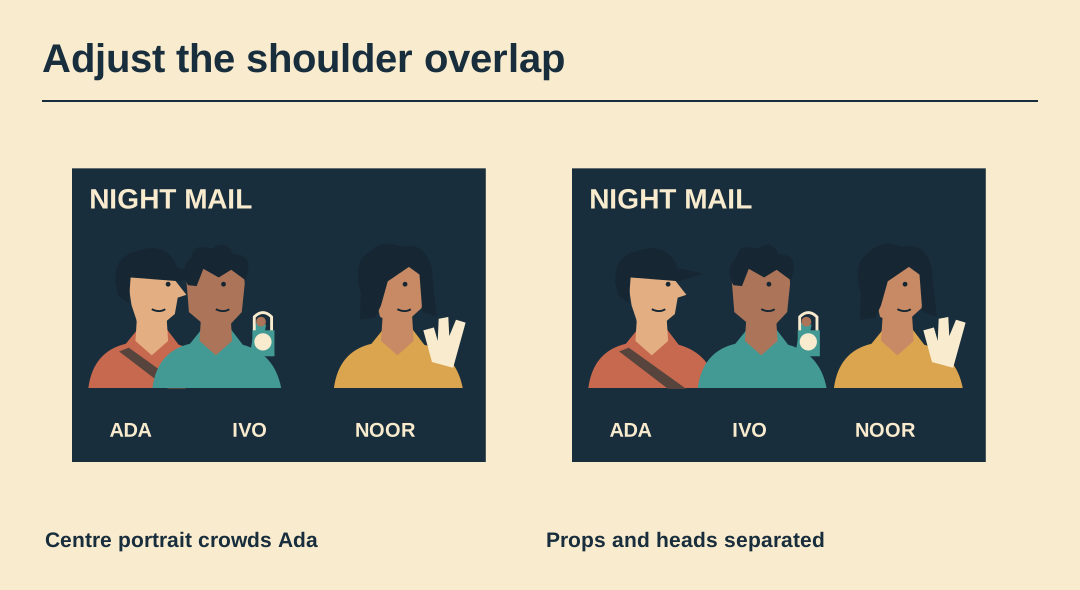
Keep faces independent
Zoom out and count the readable head shapes. If a hair edge touches another person’s cheek, change the shoulder pose or spacing rather than masking part of the second face.
Check the narrow proof
Apply a narrow crop to a duplicate composition. Inspect both end characters. An overlap that works in the middle may leave an outer character with almost no recognisable shoulder.
Flatten a review copy
Label the front-to-back order in the editable file. Export a flattened copy for approval so a different layer order on another machine cannot change who stands in front.
Inspect the ensemble master
The SVG retains the original lettering and portrait shapes. Use a copy to try a different size or arrangement.