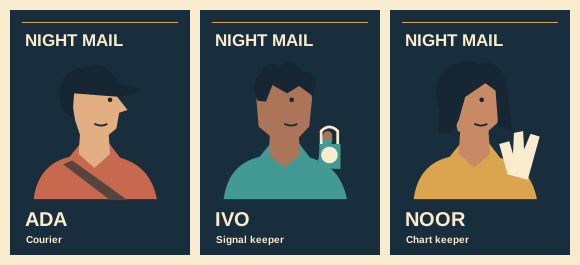
Cast portrait illustration
Leave looking room in a profile poster crop
A character looking toward the right edge can seem to stare out of the design. Give the gaze somewhere to land while keeping the back of the head and the costume recognisable.
Mark the gaze direction
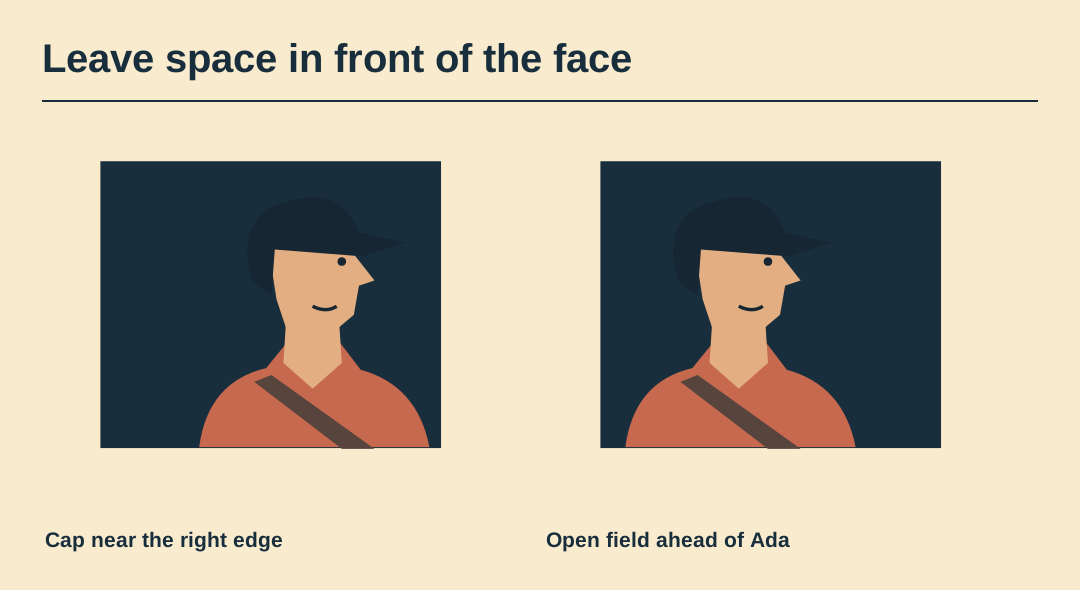
Draw a temporary arrow from the eye on a copy of the art. For Ada’s right-facing sketch, the open background belongs in front of the nose. Keep her cap in its original orientation.
Compare two frames
Move a paper rectangle over the same portrait. In one crop the nose nearly touches the boundary. In the other, shift the portrait left and leave a clean field in front. Judge the pair at identical scale.
Protect the rear landmark
Watch what the second crop removes behind the ear. If it loses the knot that identifies the costume, enlarge the frame or reduce the drawing slightly instead of sacrificing the detail.
Place the secondary copy
Try a short role line in the space ahead of the face. Keep it clear of the eye height if it looks like a speech bubble or creates an awkward visual collision.
Test the partner portrait
Set the profile beside Ivo’s card on the ensemble strip. Inward gazes can guide attention across a pair, but make sure the individual card still looks intentional when used alone.
Export the crop coordinates
Write down the frame dimensions and offset in the master. Use the unmirrored drawing when supplying a second orientation, especially if the costume or lettering is asymmetric.
Inspect the portrait artwork
Open the layered vector shapes and inspect how the face, costume and role prop separate at a smaller size.