GPT-6 Astra · Faster first results
GPT-6 Astra: Scope One Creative Task Before a Long Run

A long wait is not always a slow model. Often the request asked for a whole campaign at once: images, video, a website and a pitch deck, from facts that nobody has confirmed. The agent then spends time on work that you later throw away.
This guide shows how to ask GPT-6 Astra for a short scope card before any generation starts. The example is a fictional stationery shop, Fold, launching an ivory notebook. We ran the request in Ciyo on September 18, 2026 and repeated it in a clean demo project on September 19; the screenshots show the September 19 run. No images were generated and no speed was measured.
Notice when the request is really five projects
Read your request as a list of deliverables. "Create a full launch campaign, twelve images, video, website and pitch deck" contains at least five separate jobs. Each one has its own inputs, reviewers and definition of done. When they arrive as one prompt, the first useful result is buried behind everything else.
Also list what is actually approved. For Fold we knew only three facts: the notebook is ivory, it is unbranded, and it is for desk workers. Price, launch date, dimensions and materials were unknown. Any image or copy that states them would be invented.
Speed itself is contested. On September 16, 2026, Tibo (@thsottiaux), whose X profile lists Codex and ChatGPT at OpenAI, described Astra as fast, frontier, efficient and for everyone. Other posts the same week described slow runs. Both can be true: model speed is only one part of the time to a usable result, and an oversized request adds work before anything usable appears.
Post by an OpenAI Codex and ChatGPT team member, quoting a benchmark release. It is a product claim, not a timing of any task; our scope card is an original workflow.
Ask for a scope card, not the work
Select GPT-6 Astra in the agent composer and give it the full oversized request together with the approved facts. Then ask it to reduce the request to one bounded first task. Tell it not to generate anything yet, so the answer stays short and costs no generation credits.
Ask for fixed fields. A scope card with the same five headings every time is easier to check than a free-form plan.
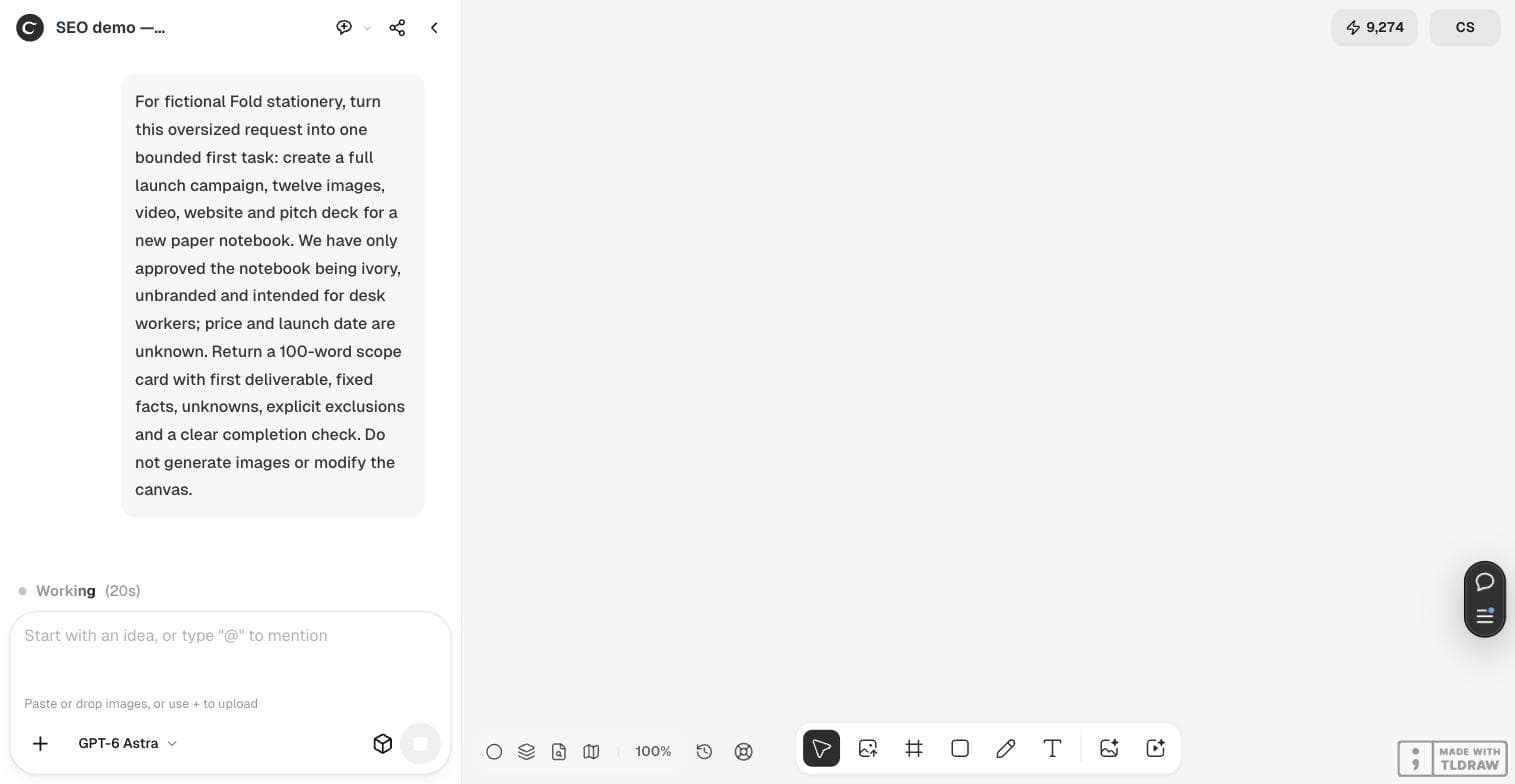
For fictional Fold stationery, turn this oversized request into one bounded first task: create a full launch campaign, twelve images, video, website and pitch deck for a new paper notebook. We have only approved the notebook being ivory, unbranded and intended for desk workers; price and launch date are unknown. Return a 100-word scope card with first deliverable, fixed facts, unknowns, explicit exclusions and a clear completion check. Do not generate images or modify the canvas.Check the card field by field
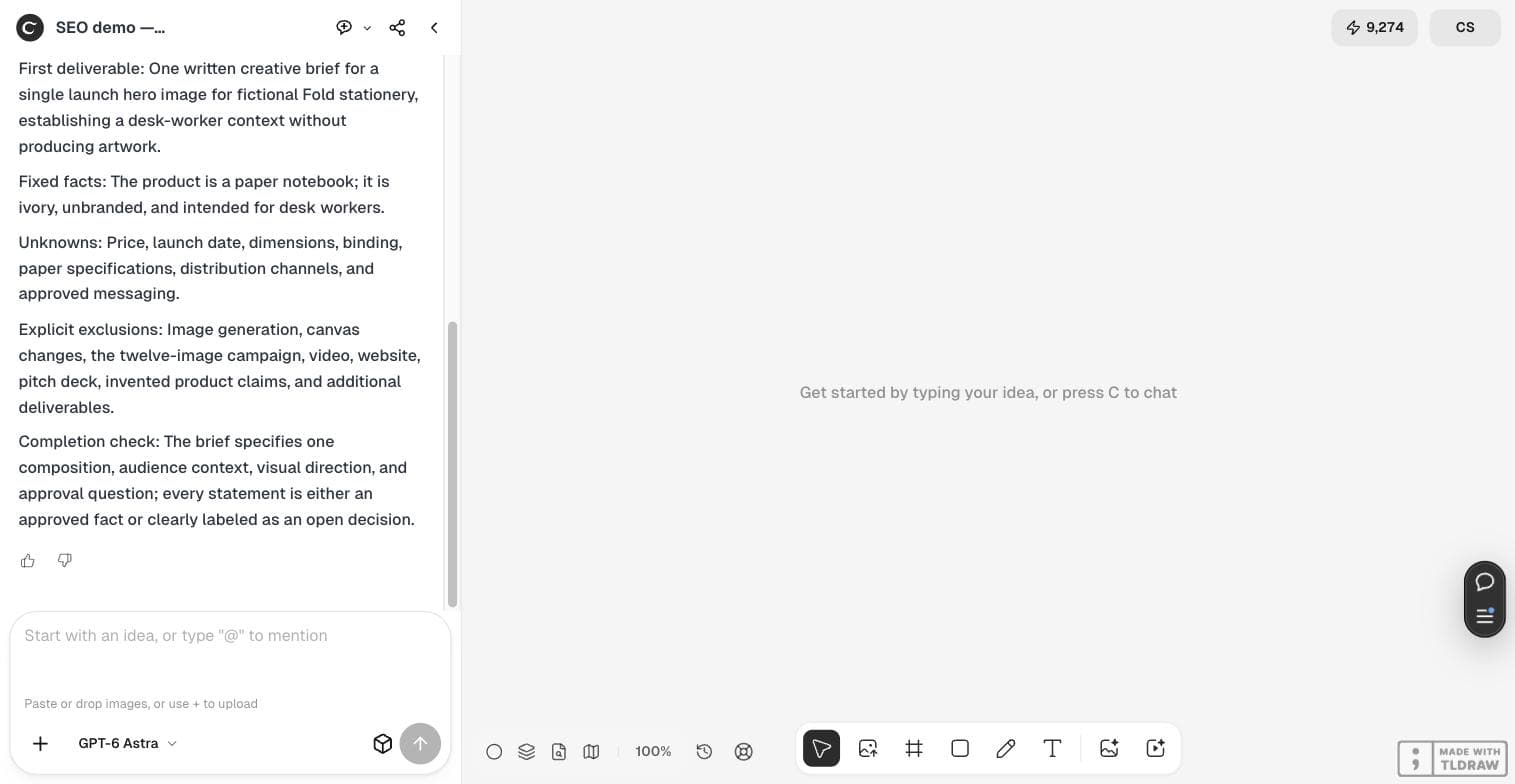
Astra proposed one written creative brief for a single launch hero image as the first deliverable, without producing artwork. It repeated only the approved facts; listed price, launch date, dimensions, binding, paper specifications, distribution channels and approved messaging as unknown; and excluded image generation, canvas changes, the twelve-image campaign, video, the website, the pitch deck, invented product claims and additional deliverables.
Read each field against your own notes. The fixed facts must not contain anything you did not approve. The unknowns should include every fact a later asset might need. The exclusions should name the jobs that wait, so they do not start quietly in the background.
Make the completion check observable
A completion check tells you when to stop. "Looks good" is not a check. The demonstrated card said the brief is done when it specifies one composition, audience context, visual direction and approval question, and every statement is either an approved fact or clearly labeled as an open decision.
Each condition can be answered with yes or no by a person who did not write the brief. If a condition needs a meeting to interpret, rewrite it before the work begins.
| Weak check | Useful check |
|---|---|
| The brief is strong | The brief names one audience and one visual direction |
| The copy works | A proposed headline exists and is marked for approval |
| Facts are right | Every product fact is either approved or listed as unknown |
| Ready to go | The owner has approved the brief before any generation |
Run only the first task, then review
Send the approved scope card back as the instruction for the next turn. Ask for the brief, not the campaign. A short task gives you a result you can judge in minutes, and a wrong direction costs one small revision instead of a full set of assets.
When the brief is approved, write the next scope card from it. The unknowns list becomes your question list for the owner. Answered questions move into fixed facts; unanswered ones stay out of the copy and the images.
Keep a handoff when the session gets long
Scoping and handoffs solve different problems. A scope card bounds the work before it starts. A handoff note carries checked decisions into a new conversation after a long session. Use both: scope each task, and save a handoff when the context becomes crowded.
Keep the approved cards together in the project. They show later reviewers why a deliverable was limited and which facts were unknown on that date.
Scoping questions
Does a scope card make GPT-6 Astra run faster?
We did not measure speed. A scope card shortens the first task, so you see a usable result sooner and discard less work. It does not change model or tool latency.
Did the scope request use generation credits?
The prompt asked Astra not to generate images or change the canvas, and it returned text only. Generation actions are metered separately in Ciyo.
What if Astra adds a fact I did not approve?
Move it to unknowns or delete it before you approve the card. The fixed-facts field should contain only what the owner confirmed.
Start with the smallest useful task
Open Ciyo, choose GPT-6 Astra and ask for a scope card before the first generation.