Social media · Workflow
Astra or Canva for a Weekend Social Post?
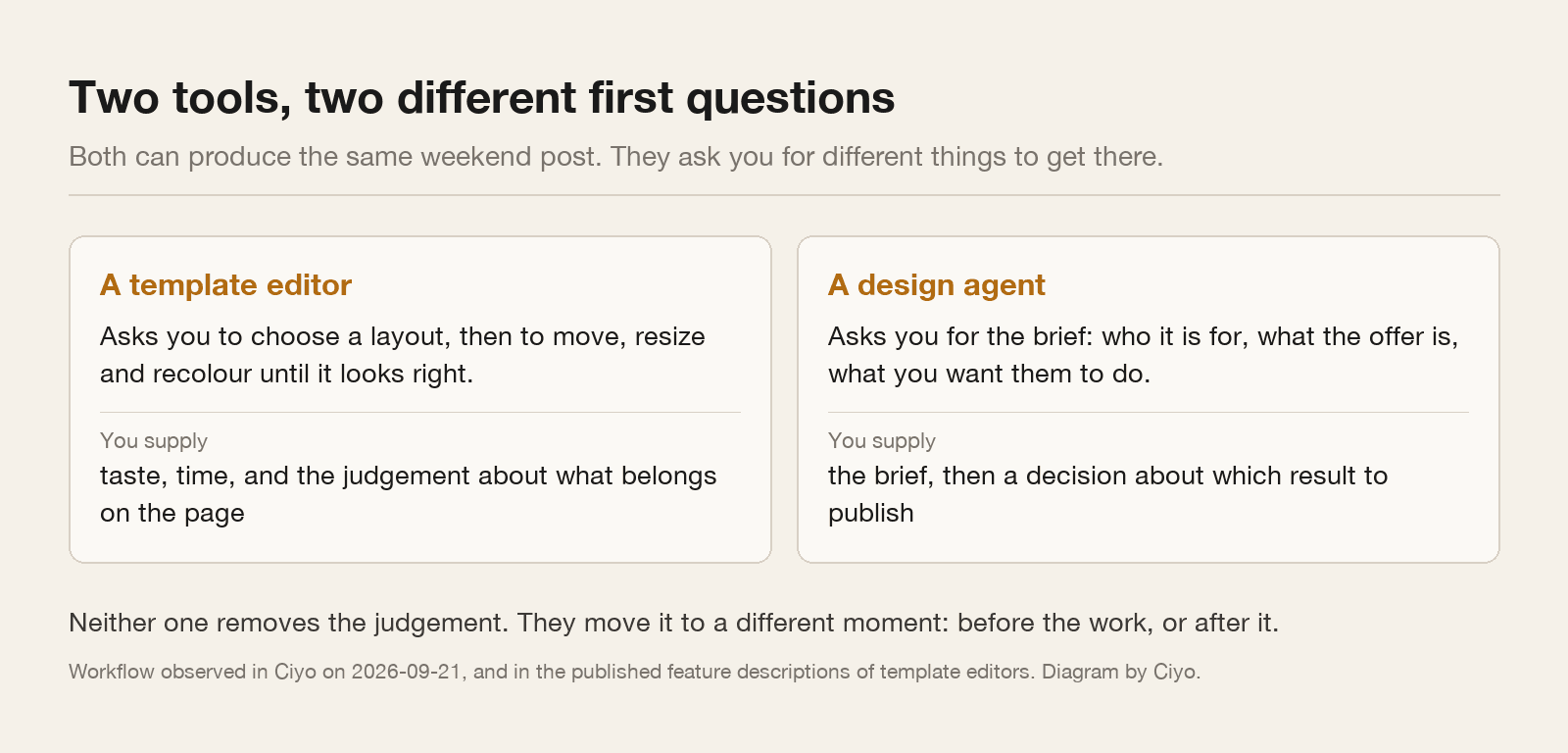
The honest answer is that they are not competing for the same minute of your day. A template editor asks you to pick a layout and then arrange things until they look right. A design agent asks you what the post is for and then hands you something to react to.
To make that concrete rather than theoretical, we ran one real task through the agent side: a fictional harbour coffee bar promoting a weekend drink. We did not run the same task in a template editor for this article, so nothing below is a head-to-head score. It is a description of two working habits and a note on which one suits which week.
The first question each tool asks
Open a template editor and the first decision is visual: which of these layouts do I want? Everything after that is arrangement. You are the art director, and the tool is very good at not getting in your way.
Open a design agent and the first decision is editorial: who is this for, what is the offer, what should they do next? The tool turns that into a picture, and your judgement moves to the end of the process, where you decide whether the picture earns a post.
Neither removes the judgement. They move it. That is the whole difference, and it is why people who love one often find the other frustrating.
The brief we actually sent
Here is the whole input. Four facts and one constraint. Nothing about colours, fonts or composition, because those are the parts the agent is supposed to propose.
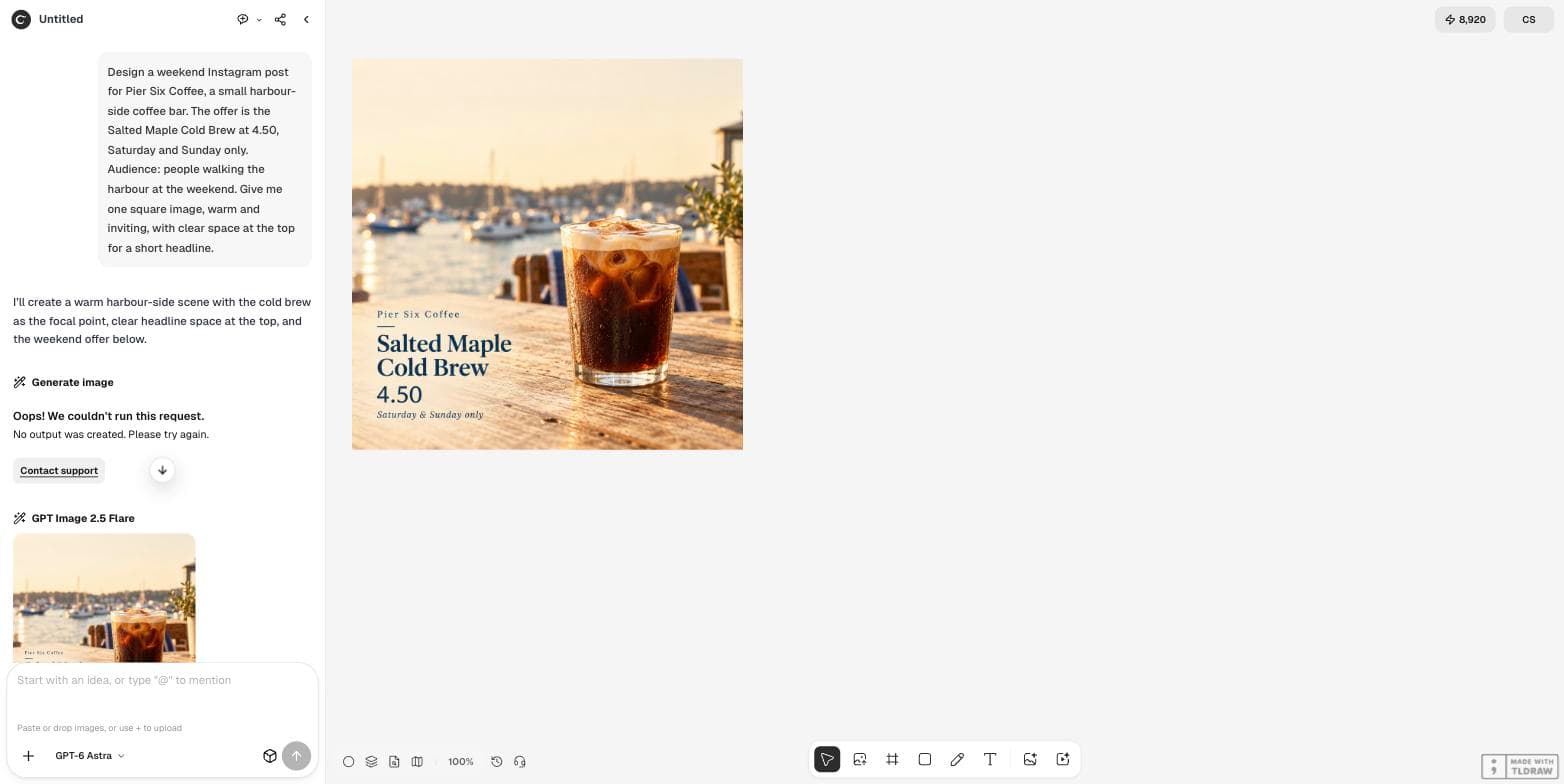
Design a weekend Instagram post for Pier Six Coffee, a small harbour-side coffee bar. The offer is the Salted Maple Cold Brew at 4.50, Saturday and Sunday only. Audience: people walking the harbour at the weekend. Give me one square image, warm and inviting, with clear space at the top for a short headline.What came back, and what it got wrong
The agent restated the plan before it started — a warm harbour scene, the drink as the focal point, headline space kept clear — then generated a 480 × 480 square with GPT Image 2.5 Flare and suggested a headline for the space it had reserved: “Your weekend, on ice.”
It is worth being unglamorous about the run. The first generation failed outright with “No output was created. Please try again.” The agent retried on its own and the second attempt produced the post. That failure is visible in the screenshot below, and it is the sort of thing a template editor simply does not do to you.
The drink, the price and the two-day window all landed in the image without being separately specified, which is the part that saves time. The returned square was 480 × 480, which is smaller than you want for a feed post, so a real run would ask for a larger size or upscale before publishing.
Where each approach is genuinely better
Some of this is preference. Some of it is not, and the parts that are not are worth stating plainly.
| The job | Template editor | Design agent |
|---|---|---|
| A post that must match last week's exactly | Stronger: the layout is already fixed and reusable | Weaker: you have to describe the constraint every time |
| A post where you do not know what it should look like | Weaker: you are choosing from a wall of options | Stronger: you get something concrete to react to |
| Precise text placement, exact brand colour, exact logo | Stronger: you place it yourself and it stays placed | Weaker: text and logos are rendered, so they need checking |
| Four different ideas for the same offer | Slower: four layouts, arranged four times | Faster: one instruction, four results, then you choose |
The habit that makes the agent side work
Write the brief like a person briefing a designer, not like a person typing into a search box. Audience, offer, channel, desired action, and one hard constraint. The brief above is 60 words and every word is doing a job.
Then judge the result against the brief rather than against your taste. “Is the price readable at thumbnail size” is a question with an answer. “Do I like it” is a question you will answer differently on a Tuesday.
And keep the boring checks: the price, the days, the spelling of the drink. A renderer will happily produce a beautiful post advertising the wrong day.
The answer, if you want one sentence
If you already know what the post should look like, a template editor will get you there with fewer surprises. If you are staring at an empty week and the real problem is deciding what to make, a design agent starts you further along, as long as you check the result the way you would check a junior's first draft.
Many people end up using both: the agent to find the idea and generate the artwork, the editor to place the final text exactly where it belongs.
Questions about the comparison
Did you run the same task in Canva?
No. We ran the agent side only, in Ciyo on September 21, 2026, and described the template-editor habit from how that class of tool works. Nothing here is a measured head-to-head.
Can an agent match my brand colours exactly?
Not reliably from a description. Give it a reference image or your existing post, and check the result against your palette. For an exact hex value on exact type, place the text yourself.
Is 480 × 480 big enough for Instagram?
No. It is fine for judging an idea, but ask for a larger render or upscale before publishing a feed post.
What happens if a generation fails?
In our run the agent noticed and retried without being asked, and the failed attempt was not charged. It is worth watching the panel rather than assuming the first attempt is the one you got.
Try it with your own weekend offer
Write the four facts — audience, offer, channel, action — and let the agent propose the picture. Then judge it against the brief you wrote.