Ciyo · GPT-6
GPT-6 Astra’s Context Window: 1M Tokens in Practice

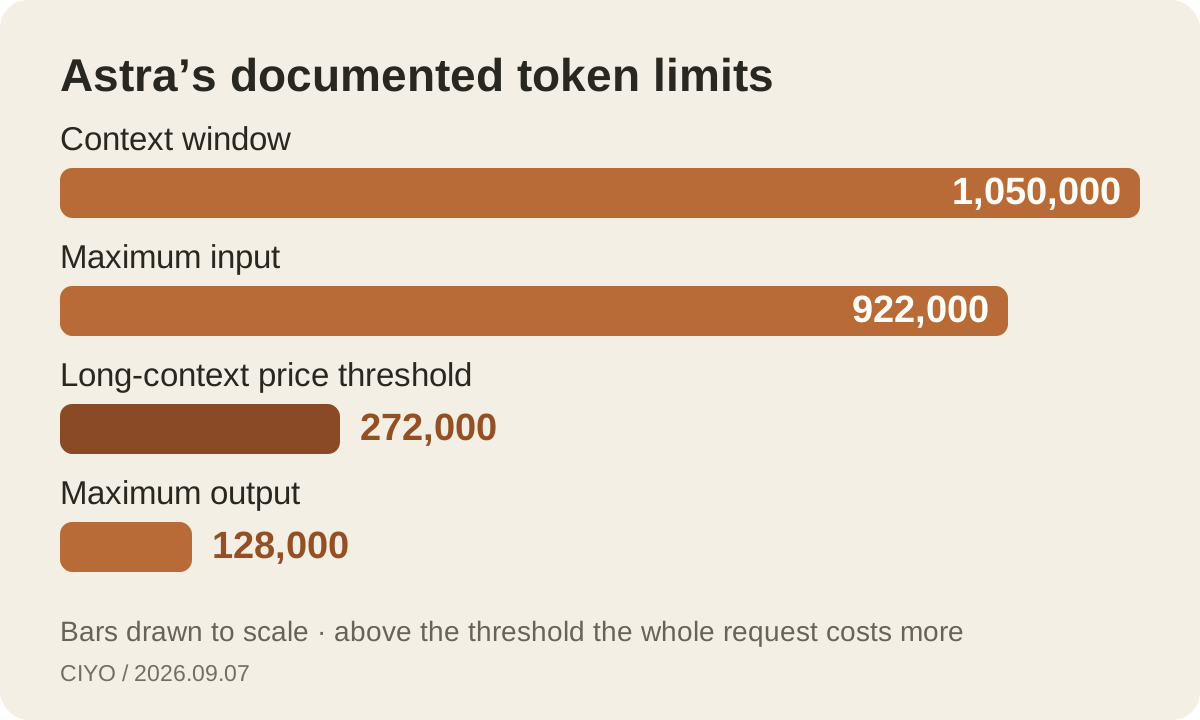
GPT-6 Astra’s model page lists three numbers that people often blur into one: a context window of 1,050,000 tokens, a maximum of 922,000 input tokens, and a maximum of 128,000 output tokens. A fourth number lives on the pricing page: above 272,000 input tokens a request is billed at the long-context band.
This guide explains how those figures relate, what a creative team can actually put into one request, and how to keep the bill predictable. It reflects OpenAI’s model page, pricing page, reasoning guide, and token documentation on September 7, 2026, plus the long-context results in the launch post, which are vendor-reported.
The three numbers and how they relate
The context window is the total space a request can occupy: your input, the model’s visible output, and its hidden reasoning tokens. The input ceiling of 922,000 tokens caps what you send. The output ceiling of 128,000 tokens caps what comes back. Because reasoning tokens occupy context and are billed as output, a heavily reasoned answer leaves less room than its visible length suggests.
OpenAI’s token guidance gives rough English estimates: one token is about four characters, or about three quarters of a word, so 100 tokens are roughly 75 words. Other languages tokenize differently. By that estimate the input ceiling holds on the order of 690,000 English words, which is more than a shelf of brand guidelines, campaign decks, and past copy combined.
Images count too
A reference image is not free context. OpenAI’s vision guide describes patch-based counting for current models: the image is divided into 32-pixel patches, capped by a per-detail budget, and multiplied by a model factor. Its examples put a 1024 by 1024 image at roughly 1,229 tokens and a 2048 by 2048 image at roughly 3,000 tokens for gpt-5.4 at high detail; the guide does not yet list a gpt-6-astra multiplier, so treat these as estimates.
Fifty product photographs at the larger size add on the order of 150,000 tokens before any text. That is well inside the window and still below the price threshold, but it is not negligible once the brand book is in the same request. Downscale references to the size the task needs, and send the sharpest ones rather than all of them.
The 272,000-token threshold
At standard rates Astra costs $10 per million input tokens, $1 for cached input, and $50 for output. When a request’s input exceeds 272,000 tokens, the entire request is billed at $20 input, $2 cached, $25 cache writes, and $75 output. The band applies to the whole request, not only to the tokens above the line.
A request with 270,000 input tokens and 2,000 output tokens costs $2.80. The same request with 275,000 input tokens costs $5.65, because the input line becomes $5.50 and the output line becomes $0.15. Five thousand extra tokens double the price. Anthropic, by comparison, prices Claude Fable 5.1’s full 1M context at standard rates, which is worth knowing if you run both.
| Request | Input cost | Output cost | Total |
|---|---|---|---|
| 270,000 input + 2,000 output | $2.70 | $0.10 | $2.80 |
| 275,000 input + 2,000 output | $5.50 | $0.15 | $5.65 |
Does the model actually use a million tokens?
OpenAI’s launch post reports MRCR v2 with eight needles: 100.0% for Astra between 256K and 512K tokens and 96.3% between 512K and 1M, compared with 91.5% and 73.8% for GPT-5.6 Sol. Those are vendor-reported retrieval results, and they suggest the second half of the window is far more usable than it was on the previous model.
Retrieval is not judgment. A model that can find a rule on page 400 of a brand book still has to apply it correctly to a headline. Test that with your own material: put a specific prohibition deep in the pack, ask for copy that would violate it, and check whether the model notices. That is a five-minute experiment with a clear pass condition.
Cache the pack and vary the task
Prompt caching turns a repeated prefix into $1-per-million input instead of $10. Put the stable material first, in the same order every time: brand rules, product facts, tone examples. Then append the task that changes. Astra uses a prompt_cache_options.ttl setting, and OpenAI’s guidance shows a 30m value for a half-hour cache window.
A 200,000-token pack costs $2.00 to read uncached and $0.20 from cache. Cache writes are billed at $12.50 per million, so rewriting the prefix on every request wastes the benefit. If you need to change reasoning effort between requests, use a configuration_update item rather than editing the prompt, which the guidance says preserves the cached prefix.
When to stay under the line
Most creative requests do not need the whole window. A campaign brief, a brand section, and twenty references fit in well under 100,000 tokens. Keep routine work in the standard band and reserve long-context requests for tasks that genuinely need the full pack, such as an audit of every claim across a year of campaigns.
For libraries that change often, the file_search tool is an alternative to loading everything: OpenAI prices it at $2.50 per thousand calls and $0.10 per gigabyte per day of storage with the first gigabyte free. It retrieves the relevant passages instead of sending the entire archive on every request, which keeps most calls in the cheaper band.
Output has its own ceiling
The 128,000-token output limit includes hidden reasoning, and the usage object reports reasoning separately under output_tokens_details.reasoning_tokens. A request that asks for fifty localized product descriptions in one go may spend much of its budget reasoning, then run out of room for the last descriptions. Ask for fewer items per request, or use Batch for bulk output at half price.
Set max_output_tokens deliberately. The token documentation reminds developers that reasoning models need space for reasoning as well as the visible answer, so a tight cap can truncate the reply rather than the thinking. Leave headroom, inspect usage, and tune from data.
Long context inside ChatGPT and Codex
The numbers above are API figures. Inside ChatGPT the product manages context for you and the model’s effective window can differ by product. The launch post describes a new Codex feature for Astra that keeps notes across context windows and leaves earlier windows searchable, so a long design session does not lose the reasons behind earlier decisions; it is experimental at launch and enabled in the Codex configuration file.
Work and Codex usage is metered in plan credits rather than API tokens, and their allowances are separate from Chat. If you push a large reference pack through those surfaces, watch the plan allowance rather than the per-token price, and check the current limits page rather than assuming API behaviour.
A practical setup for a creative team
Assemble a single, stable reference pack: brand rules, approved claims, tone samples, and a short glossary. Keep it under 200,000 tokens so cached reads are cheap and every request stays in the standard band with room for references. Version it, and record which version each deliverable used.
Then let the renderer do its own job. Whether Astra plans from a million tokens or from a tight pack, the picture still comes from an image model with its own settings. On Ciyo you can generate with GPT Image 2 from that plan, keep the approved outputs, and pay per generation without a plan allowance to watch.
Continue reading
Questions about Astra’s context window
Is the context window 1 million or 1.05 million tokens?
The model page lists 1,050,000 tokens of context, with a 922,000-token input maximum and a 128,000-token output maximum. Marketing often rounds it to 1M.
When does long-context pricing start?
When a request’s input exceeds 272,000 tokens. The whole request is then billed at $20 input, $2 cached input, and $75 output per million tokens instead of $10, $1, and $50.
Do reasoning tokens use up the context window?
Yes. OpenAI’s documentation says reasoning tokens occupy context and are billed as output. Leave headroom under the output limit and inspect output_tokens_details.reasoning_tokens after each request.
Plan from the pack, render on the canvas
Bring the brief Astra produced from your brand book to Ciyo, generate with GPT Image 2, and pay per output instead of per token.