Ciyo · GPT-6
GPT-6 vs GPT-5.6 for Creative Work

GPT-6 Astra is a candidate for complex creative work that involves reasoning across references and tools. GPT-5.6 Sol remains a useful comparison because it supports many of the same inputs and tools at lower published standard token rates. The decision should turn on the work you can complete and approve.
This is a documentation-based comparison checked on September 7, 2026, followed by a proposed evaluation method. We have not run a controlled creative benchmark between the models. Here, “GPT-5.6” specifically means Sol; Terra and Luna are different options and should not be silently mixed into the comparison.
Compare the parts that actually differ
Both Astra and Sol list text and image input, text output, and a 1,050,000-token context window. Both list a 922,000-token input ceiling and a 128,000-token output ceiling. A larger version number therefore does not mean a larger documented context window in this comparison.
Astra’s reasoning options begin at low, while Sol also supports none. At up to 272,000 input tokens, Astra’s standard API input/output rates are $10/$50 per million tokens; Sol’s promotional rates are $4/$20. Sol’s promotion is listed as applying at least through November 21, 2026. Model choice, reasoning settings, and service tier should all appear in your test notes.
| Property | GPT-6 Astra | GPT-5.6 Sol |
|---|---|---|
| API model | gpt-6-astra | gpt-5.6-sol |
| Input / direct output | Text + images / text | Text + images / text |
| Context window | 1,050,000 tokens | 1,050,000 tokens |
| Reasoning effort | low through max | none through max |
| Standard input / output per 1M tokens | $10 / $50 | $4 / $20 promotional |
For a brief, evaluate whether ambiguity gets resolved
A difficult creative brief often contains competing requirements: a premium tone with a low price, several audiences, a small mobile canvas, and reference images that pull in different directions. The useful output identifies the conflict, makes a defensible recommendation, and asks for the missing business decision when it cannot infer one.
Give both models the same brief and ask for a production plan with explicit assumptions. Score whether they preserve mandatory claims, respect the intended audience, and distinguish approved facts from suggestions. A longer plan can still miss the central decision. If Sol reliably meets those criteria, there may be little reason to pay more for that stage.
For image production, hold the renderer constant
An image workflow can combine a reasoning model with an image generation tool. If Astra uses one image model and Sol uses another, differences in the pictures cannot be attributed cleanly to the planner. Use the same image model, output dimensions, quality settings, and reference assets when comparing how the two models direct production.
Separate the judgments. Evaluate the brief and prompts for clarity, then evaluate the rendered images for product fidelity, composition, text accuracy, and editability in your workflow. Repeat more than once because generative outputs vary. The Astra model documentation listing text output also means you should describe which image tool produced the final pixels.
For multi-step work, inspect the handoffs
OpenAI highlights Astra’s ability to work across tools, continue independent work while asynchronous tools run, and incorporate instructions during an active task. These features may matter when a campaign includes research, a landing page, several assets, and a late change in requirements. Their benefit depends on the application implementing the relevant capabilities.
Test a change that resembles your actual work: after the first layout draft, supply a revised headline and require a narrow mobile version. Record whether the model preserves previously approved facts, updates all affected placements, and verifies the final result. A beautiful first draft followed by inconsistent revisions is expensive in a production workflow.
Published computer-use results are one piece of evidence
In its launch material, OpenAI reports an OSWorld 2.0 comparison using latency simulations: Astra reaches 72.6% at about 40 minutes, versus Sol’s 65.7% at about 75 minutes. Those are vendor-reported results under the described evaluation conditions. They support investigating computer-use work; they do not establish a universal speedup for your campaign.
Brand fidelity, visual taste, and local-language quality require their own review. A benchmark can show that a model completed more software tasks while leaving unanswered whether a particular product photograph looks accurate. Use published results to choose what to test, then make the decision from representative deliverables.
Run a small comparison you can actually judge
Select three representative assignments: a brief with conflicting constraints, an image-led landing-page review, and a revision that changes several deliverables. Use work you have rights to share and remove unnecessary confidential material. Define the acceptance criteria before seeing either output, including exact copy, required assets, mobile behavior, and export format.
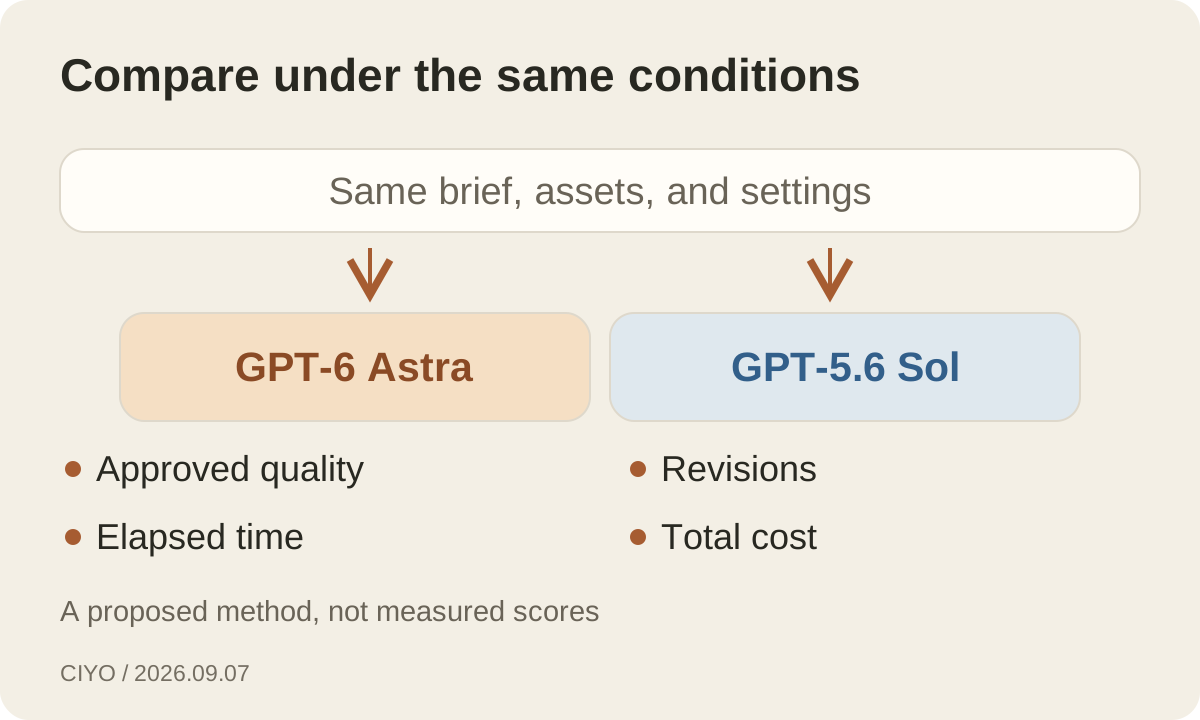
Keep inputs and tool access identical. Record model ID, reasoning effort, date, settings, total time, tool charges, and the number of corrections. Hide the model names from the reviewer when practical, and retain all outputs. A single impressive example is a weak basis for changing a team’s default workflow.
Treat a result with an incorrect product claim or unusable export as a failure even if it looks attractive. After the mandatory checks, compare hierarchy, legibility, consistency, and how much editing remains. This gives creative judgment a clear place in the process without reducing it to an invented universal score.
Measure the cost of getting to approval
At the published short-context standard rates, identical token counts cost 2.5 times as much on Astra as on Sol. An illustrative request using 20,000 uncached input and 4,000 output tokens costs $0.40 on Astra and $0.16 on Sol, before image tools and other charges. The comparison changes if one model uses different token counts or needs additional attempts.
Track model charges, tool charges, and review time separately. A small API saving can disappear if a reviewer spends substantially longer fixing the result. Conversely, paying for extra reasoning on a predictable rewrite can add cost without a visible benefit. Compare cost per approved deliverable over several tasks rather than cost per isolated response.
Use the result to choose a default and an escalation rule
A practical outcome may be Sol for well-specified everyday work and Astra for tasks that repeatedly fail acceptance checks or involve difficult coordination. That is a proposed operating rule, not a benchmark conclusion. Your evaluation might justify Astra as the default for a particular team, or show that improving briefs matters more than changing models.
Write down the trigger for switching: unresolved constraints, repeated missed revisions, or a task that requires an Astra-specific integration feature. Preserve the brief and reference assets when switching so the second model receives the same evidence. For image work in Ciyo, you can evaluate the renderer and selected output independently of which assistant helped prepare the brief.
What a fair comparison should let you say
A useful conclusion is specific: one model needed fewer corrections on your mobile landing-page revisions, or both produced acceptable image briefs at different costs. Keep the date, number of trials, and conditions beside that conclusion. Avoid extending it to a different tool setup, language, or task you did not test.
For a creative team, the goal is a repeatable route to good work. Clear references, stable acceptance criteria, and an honest review process make either model easier to evaluate. They also make it possible to revisit the decision when prices, models, or your production needs change.
Continue reading
Questions about Astra versus Sol
Does GPT-6 have a bigger context window than GPT-5.6 Sol?
Their current model pages both list 1,050,000 tokens of context, with the same maximum input and output limits. Other capabilities and prices differ.
Will Astra always make better images?
That is not established by the documentation. A workflow may use a separate image model, so compare the planner and renderer under controlled settings and review the actual outputs.
Should I move every creative task to Astra?
Test representative tasks first. Use approved quality, revision effort, elapsed time, and total cost to decide which tasks benefit from a different model.
Test with a real creative brief
Use the same references and image settings in Ciyo, keep the selected outputs, and compare the work required to reach an asset you would publish.