GPT-6 · Cost
Is the GPT-6 Image API Free? What One Picture Actually Costs

No, the API is not free, and it does not have a price per picture either. OpenAI publishes rates per million tokens for its image models and points you at a calculator for anything more specific, which is an honest answer and a useless one when you just want to know whether making forty images this afternoon will cost four dollars or forty.
So we measured the other route. On September 20, 2026 we ran a full afternoon of real work in Ciyo, wrote down every quote and every charge, and turned it into numbers you can plan against.
What OpenAI publishes
On the developer pricing page, read on September 20, 2026, gpt-image-2.5-sunburst and gpt-image-2.5-flare are both listed at $5.00 per million text input tokens, $1.25 per million cached input tokens, and $30.00 per million image output tokens. The batch tier is half of that. The page adds: “For image generation cost estimates, use the calculator.”
That is the whole difficulty. A price per million output tokens only becomes a price per picture once you know how many tokens your picture is, and that depends on the size and quality you asked for. You also need an account, a key and code before any of it applies.
| Model | Text input per 1M | Cached input per 1M | Image output per 1M |
|---|---|---|---|
| gpt-image-2.5-sunburst | $5.00 | $1.25 | $30.00 |
| gpt-image-2.5-flare | $5.00 | $1.25 | $30.00 |
| gpt-image-2 | $5.00 | $1.25 | $30.00 |
| gpt-image-1.5 | $5.00 | $1.25 | $32.00 |
| gpt-image-1-mini | $2.00 | $0.20 | $8.00 |
The other route quotes you a number first
In Ciyo the same models are behind a Run button that shows the price before you press it. Ciyo sells credits at 1,000 for $10, so one credit is one cent, and the number on the button converts straight into money.
The quote moves with the settings. The same empty 16:9 frame quoted four credits at 1K on High quality and seven credits at 2K on High. That is four cents against seven.
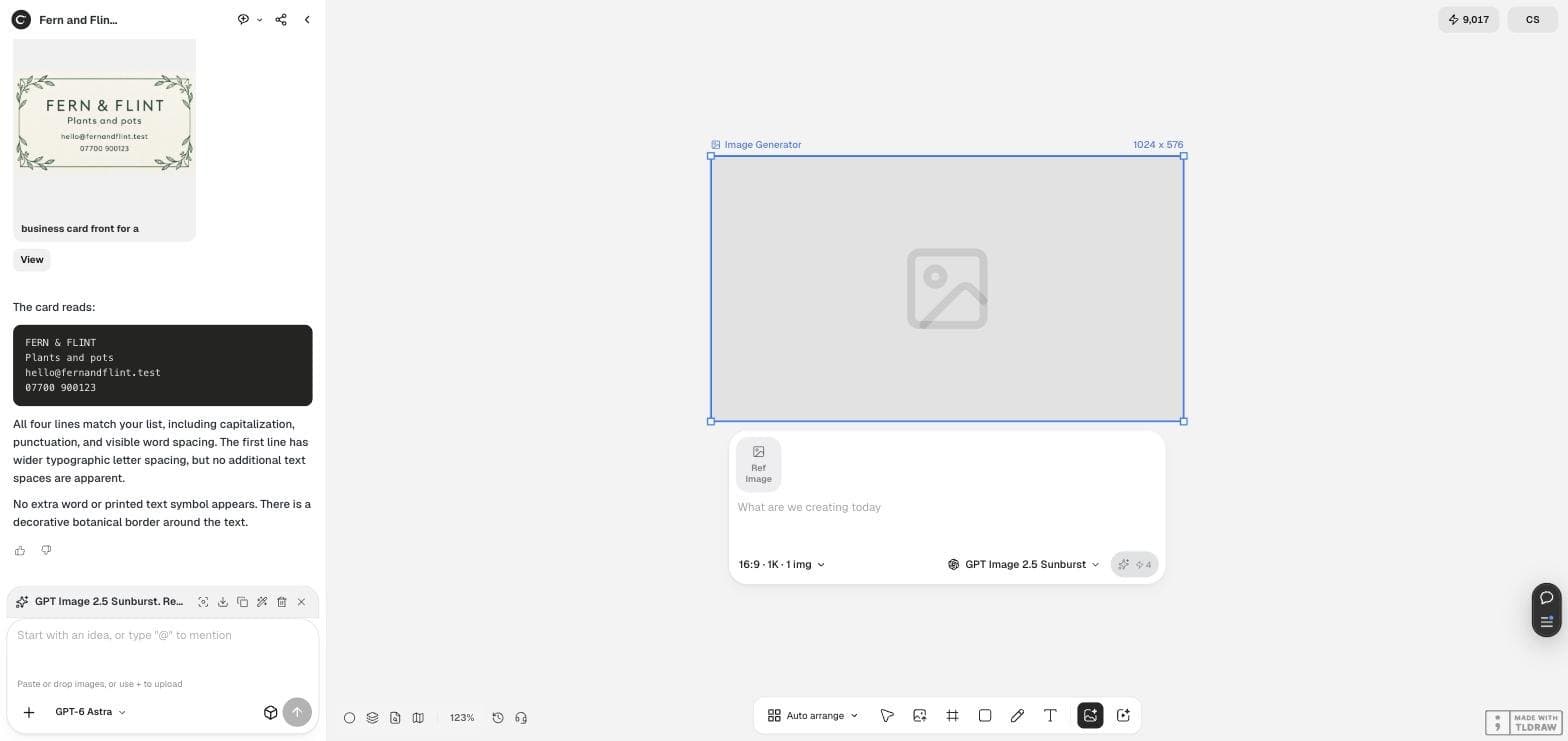
The quote is an estimate, not the bill
This is the part worth knowing before you budget. The number on the button is calculated before your prompt is counted, so a long prompt pushes the real charge above it.
Our diagram slide quoted seven credits with an empty prompt and charged nine once a 68-word prompt was typed. Our business card, at identical settings with a shorter prompt, quoted seven and charged seven. Treat the button as a floor.

What an afternoon actually cost
Here is the whole session, measured from the balance rather than estimated. We started at 9,137 credits and finished at 9,000, so the afternoon cost 137 credits, which is $1.37.
That included thirteen large 2K covers, two print-ready assets, a sprite, a background removal, a diagram slide and four post variants. The expensive line is the one you would expect: big images at 2K, run thirteen times.
| Job | Settings | Credits | Money |
|---|---|---|---|
| 13 editorial covers | Sunburst, 16:9, 2K, High | 104 | $1.04 |
| Business card | Sunburst, 16:9, 2K, High | 7 | $0.07 |
| YouTube banner | Sunburst, 16:9, 2K, High | 7 | $0.07 |
| Diagram slide | Sunburst, 16:9, 2K, High, long prompt | 9 | $0.09 |
| Four post variants | Flare, 1:1, 1K, Medium | 8 | $0.08 |
| Pixel sprite | Sunburst, 1:1, 1K, Medium | 2 | $0.02 |
| Remove BG | On the sprite | 0 observed | — |
| Astra reading and scoring images | Text replies | 0 observed | — |
Which route fits which job
The API wins when the work is repetitive and programmatic: thousands of images on a schedule, generated by your own code, where a developer's time is already committed and per-token billing is cheaper at volume.
The credit route wins when a person is deciding. You see the price before each run, you stop when the result is right, and nobody has to hold an API key. For a marketer making a dozen assets a week, the difference between the two is a few dollars a month and several hours of setup.
One more line from Ciyo's pricing page, worth checking against whatever you use: “If a generation fails, its credits return to your balance automatically.”
Free access is the wrong question
Searches for free API access are really searches for predictability: people want to know they will not be surprised. On September 16, 2026 a post in r/ChatGPT listed four places to use GPT Image 2.5 without paying and what each one holds back.
We are citing it carefully. The post promotes a GitHub prompt repository, and the same repository shows up from a second account, so treat it as promotion rather than a survey. The useful part is the framing it shares with this article: every free route holds something back, and the question worth asking is what.
Posted 2026-09-16. It promotes a prompt repository, so we cite it for its framing only, not as independent research.
Image cost questions
Is there a per-image price for the GPT-6 image models?
OpenAI does not publish one. The pricing page lists $5.00 per million text input tokens and $30.00 per million image output tokens for gpt-image-2.5, and points to a calculator for estimates.
How much is one credit in Ciyo?
Ciyo's pricing page lists 1,000 credits for $10, so one credit is one cent. A 1K image on High quality quoted four credits in our run, which is four cents.
Why was I charged more than the quote?
The quote is calculated before your prompt text is counted. Our 68-word prompt turned a seven credit quote into a nine credit charge at the same settings.
See the price before you run
Open the canvas, set the size you actually need, and read the number on the Run button before you spend anything.