Ciyo · GPT-6
Is GPT-6 Free? Plans, API Pricing and Usage Limits

GPT-6 Astra is not listed as a free model in the current OpenAI access documentation. Some paid plans include it in particular products, while API use has separate metered pricing. A subscription that includes access still has usage limits.
The difficult part is identifying what you are paying for. Chat, ChatGPT Work, Codex, and an API application have different allowances and billing rules. The figures below are a September 7, 2026 snapshot in US dollars. The worked examples are calculations from published rates, not measured production bills.
Start with the product you actually use
In ChatGPT, Astra appears as GPT-6 Pro on eligible plans as the rollout reaches accounts. OpenAI names Pro $100, Pro $200, Business, and Enterprise for that Chat rollout. Plus includes Astra in ChatGPT Work and Codex as it rolls out; that does not make GPT-6 Pro available in an ordinary Plus chat.
An API application selects the model by its API ID and incurs API charges. Check the account, organization, project, and billing route before buying anything. A ChatGPT plan and an API balance serve different products. If all you need is a finished image, also compare an image tool’s displayed per-generation cost with the effort of building an API workflow.
Included access still has an allowance
ChatGPT’s help page currently lists 200 GPT-6 Pro messages per week for Pro $200 and a shared 50-message weekly allowance across GPT-6 Pro and GPT-5.6 Sol Pro for Pro $100. The $200 plan also has daily rules involving Sol Pro. These are Chat allowances, so carrying the numbers over to a Work or Codex task would give you the wrong expectation.
Work and Codex share usage under their own rules. OpenAI explains that task length, context, tools, and reasoning affect consumption, and its message estimates span broad ranges. Read the usage dashboard and displayed reset time for your account. A short instruction can launch a long task, so counting only what you type is not a useful way to forecast remaining work.
The standard API rates
For requests with up to 272,000 input tokens, Astra’s standard rates are $10 per million input tokens and $50 per million output tokens. GPT-5.6 Sol’s corresponding promotional rates are $4 and $20, listed as applying at least through November 21, 2026. The pricing page separates ordinary input, cached input, cache writes, and output; they are not interchangeable units.
The table uses uncached input and output only. Cached reads can be cheaper, while cache writes have their own price. Tool charges, service tier, long-context pricing, regional processing, and applicable taxes can change a bill. Save the applicable price schedule alongside an estimate, especially if a campaign will run after a promotion ends.
| Model | Uncached input | Output |
|---|---|---|
| GPT-6 Astra | $10 | $50 |
| GPT-5.6 Sol | $4 | $20 |
A worked estimate for one creative task
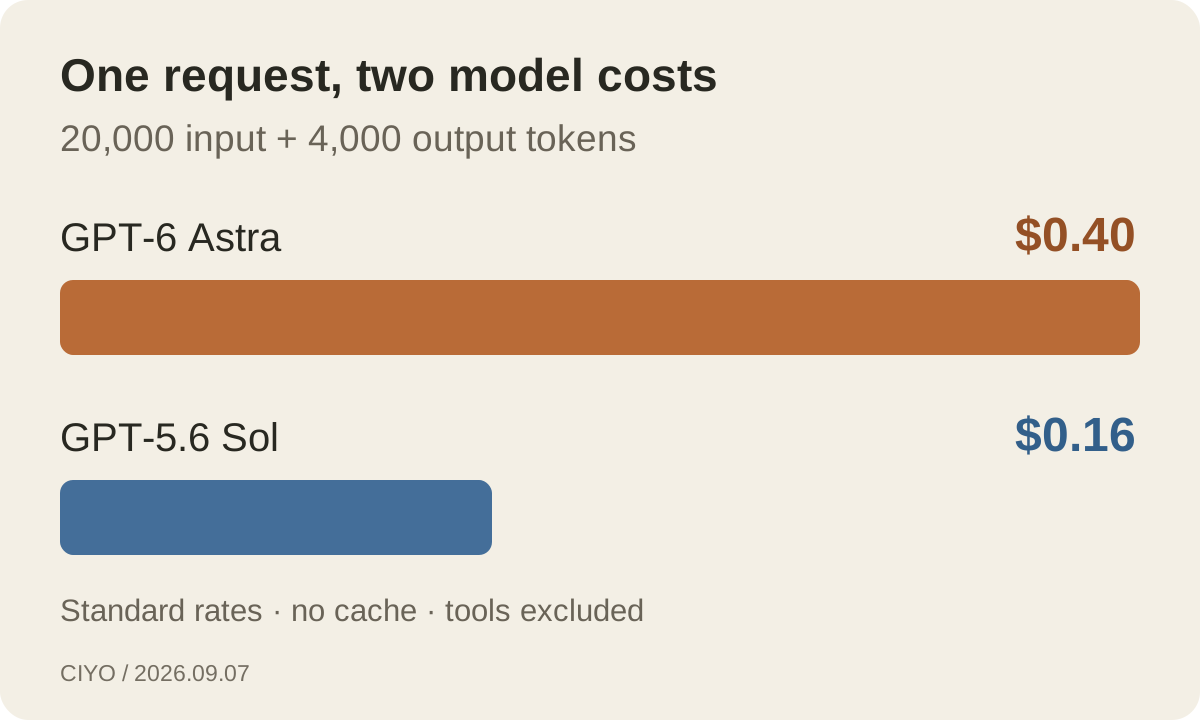
Suppose a brief, references, and instructions total 20,000 uncached input tokens, and the completed request records 4,000 billed output tokens. Astra costs (20,000 ÷ 1,000,000 × $10) + (4,000 ÷ 1,000,000 × $50), or $0.40. With the same counts, Sol costs $0.16. One hundred identical requests would therefore cost $40 or $16 before other charges.
Those token counts describe a hypothetical text-model request. They do not include rendering an image, searching, or a second revision. Use the API’s actual usage record when reconciling a bill; the visible final answer alone may not describe all billed output. For a production budget, count the whole accepted task, including failed attempts and revisions, instead of pricing only the first response.
The long-context threshold can change the whole request
Astra’s model page specifies that input beyond 272,000 tokens activates higher rates for the entire request: input and cached input are doubled, and output is multiplied by 1.5. This is a pricing threshold below the model’s maximum context capacity. A request fitting in the context window can still fall into the more expensive band.
With standard uncached pricing and 2,000 output tokens, a request containing 270,000 input tokens costs $2.80. Increase the input to 275,000 tokens and the estimate becomes $5.65. The sharp change comes from repricing the whole request, not merely charging more for the extra 5,000 tokens. Curate reference material and check the band before attaching an entire project archive.
Speed modes and caching require their own assumptions
OpenAI lists Batch and Flex at half the applicable standard API token rates and API Fast at twice the applicable rates. Whether those modes suit a job depends on supported features and latency requirements. An overnight analysis can tolerate a different service profile from a designer waiting for an interactive revision.
Codex Fast has a different credit rule: its pricing guide lists a 2.5× credit multiplier. Applying the API’s 2× multiplier to a Codex allowance would mix two billing systems. Likewise, do not budget every repeated brief as a guaranteed cache hit. Cache behavior depends on the request and platform; verify usage records before treating savings as recurring.
Budget images separately from the planning model
If Astra calls an image tool, account for the image model as well as the reasoning model. Image settings such as quality and dimensions affect the operation you request. Compare like-for-like outputs: a draft thumbnail and a final large asset serve different purposes, so a single headline price can conceal an expensive mismatch.
In Ciyo, use the price shown for the selected model and settings before generating. Ciyo’s purchase is separate from a ChatGPT plan and OpenAI API billing. A practical campaign estimate records the number of exploratory images, the likely revision count, and final exports. Keep a small reserve for rejected variants instead of assuming every first attempt will be publishable.
Choose on cost per accepted result
At the short-context standard rates above, Astra costs 2.5 times Sol for the same input and output counts. That does not prove that a completed Astra task always costs 2.5 times as much. A model that needs fewer retries or less manual repair can change the total. Conversely, a routine rewrite may offer little opportunity to recover the extra model cost.
Run a small comparison on representative work. Give both models the same references and acceptance criteria, record API charges and reviewer time, and count a result only after it passes review. For a complex campaign, test the planning phase separately from rendering. This exposes where additional reasoning helps and where it merely increases the bill.
Continue reading
Questions about GPT-6 cost
Does ChatGPT Plus include GPT-6?
OpenAI currently lists Astra for Plus in ChatGPT Work and Codex as it rolls out. GPT-6 Pro access in Chat follows a different plan list. Verify the specific product before upgrading.
Is GPT-6 Pro unlimited on a Pro plan?
No. OpenAI publishes GPT-6 Pro allowances and sharing rules. Work and Codex also have their own usage system. Your account’s dashboard is the place to check remaining usage and resets.
Is an API rate the price of an image?
Astra token rates describe the reasoning-model request. Image generation can add image-model charges. A consumer image service may instead display a per-generation credit price.
Price the output you need
Check Ciyo’s current image and video pricing, select your generation settings, and build a budget around usable assets and expected revisions.