Portrait design
Map a portrait into the four tones of a HOPE-style poster
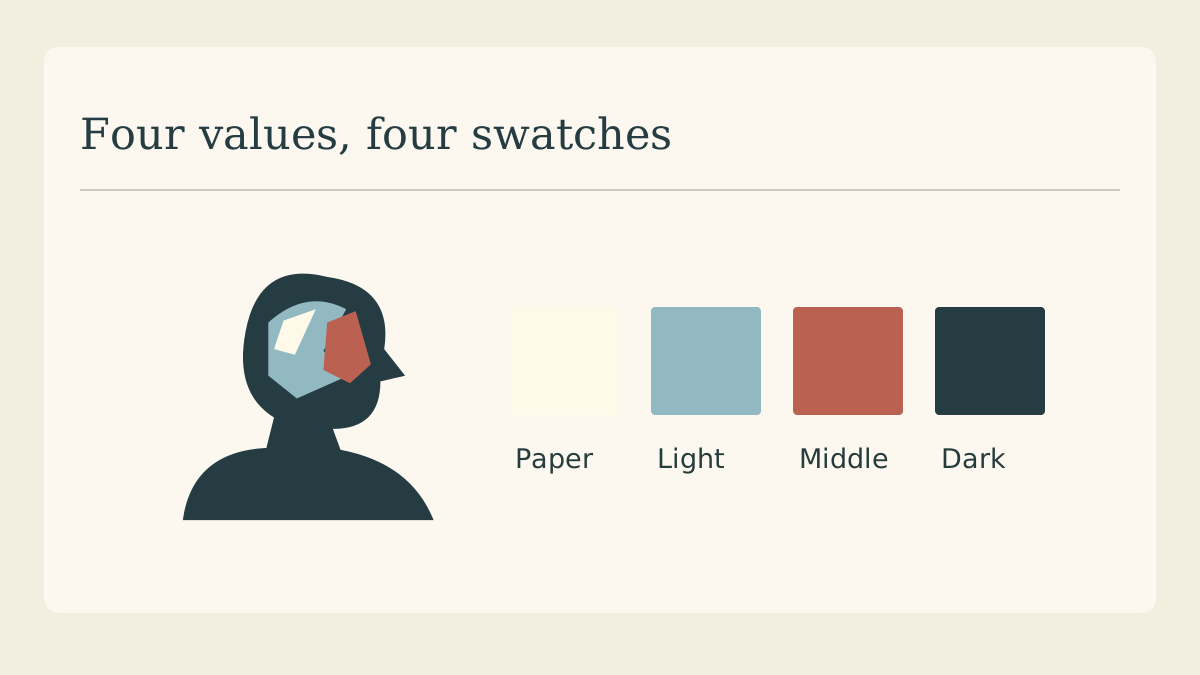
The Smithsonian describes Shepard Fairey’s Obama poster through its red, beige, blue and dark blue palette. To study the graphic technique, start with your own portrait and decide which parts of the face belong to four broad areas of light.
Pick a photograph with a clear side light
Use a consenting sitter photographed near a window. Look for a bright cheek and a shadow beneath the chin. Flat frontal light often merges the nose and cheek into one area, making the next step much harder.
Make the light map before choosing hues
View a grayscale copy and group the values into paper, light midtone, darker midtone and shadow. Trace the largest shapes first. Where the cheek turns away from the light, keep a single clear boundary that follows the form.
Give each colour a job
Let warm paper carry the brightest forehead, pale blue describe the lit plane, red pick out a middle plane, and navy anchor the deepest features. Use broad shapes to describe a face. The colour assignment is an exercise with your own photograph.
Open up the eye
Zoom out until the head is the size of a thumbnail. If the brow and upper eyelid become one dark bar, carve out a small area of the lighter tone. Check the same detail at full size before altering the second eye.
Set the word after the face reads
For a studio self-portrait, try a short title such as “MAKE”. Put it on a separate band and leave a margin around it. The title should survive a reduction without becoming the darkest feature in the whole face.
Proof the four swatches
Print or display a thumbnail beside the colour study. If two midtones merge, change their brightness and repeat the test. Keep the photograph, four-value study and finished art together so viewers can see how the translation was made.
Continue with your portrait
Compare another method for laying out a portrait with editable lettering.