AI models · Numbers
Jev's Price and Speed Claims, Checked

Every launch arrives with a multiplier, and Jev's are large: 40 to 200 times faster “for the same levels of frontier intelligence”, input at $0.042 per million tokens, and output tokens “FREE (too cheap to meter)”.
Five days later there is exactly one measurement from outside the company. This article puts the two side by side, and neither result is what a launch thread would lead you to expect.
What TypeSafe published
The launch post of September 15, 2026 gives a latency range of 70 to 500 milliseconds against 3 to 329 seconds for frontier language models, which is where the 40 to 200 times figure comes from. It adds 193.6 times faster and 444.6 times cheaper on production workflows, and zero hallucinations with zero type errors.
The pricing is unusual enough to be worth stating twice: input is metered by the billion rather than the million, and output is free. TechCrunch's coverage on September 18 reported customer figures alongside it — Vercel measuring 5 to 18 times faster, another team 10 to 20 times cheaper than Gemini.
Every one of those numbers comes from TypeSafe or from its early users. That does not make any of them wrong. It makes all of them unverified.
| Claim | Figure | Source | Independent? |
|---|---|---|---|
| Latency | 70 to 500 ms, against 3 to 329 s | TypeSafe launch post | No |
| Speed on production workflows | 193.6 times faster | TypeSafe launch post | No |
| Cost on production workflows | 444.6 times cheaper | TypeSafe launch post | No |
| Reliability | Zero hallucinations, zero type errors | TypeSafe launch post | No |
| Price | $0.042 per million input tokens, output free | TypeSafe pricing | Published, not measured |
| Customer speed | 5 to 18 times faster | Vercel, via TechCrunch | No, reported by the customer |
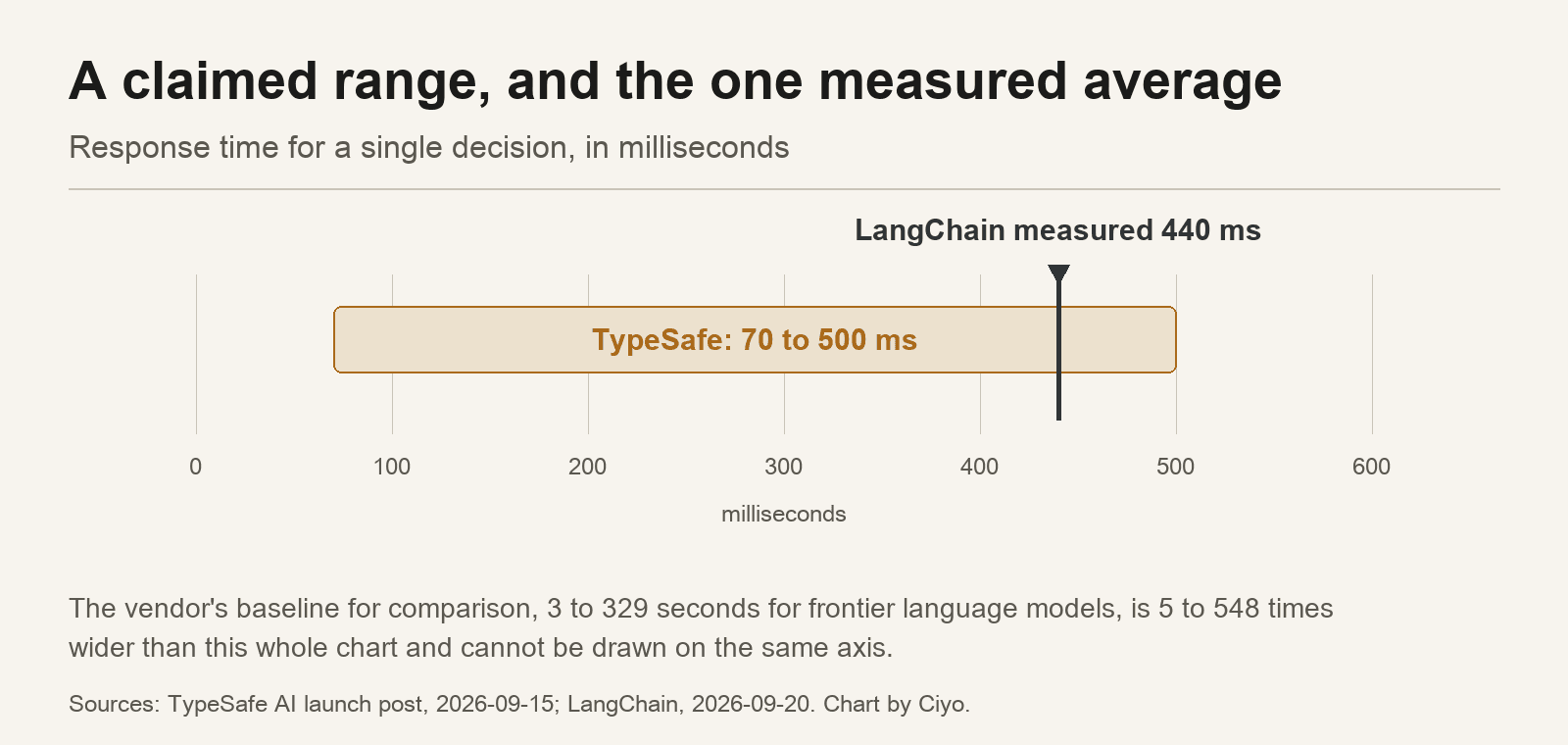
A claimed range, and the one measured average
LangChain's experiment of September 20 reports an average of 0.44 seconds per call. Put that on the same axis as the launch post's range and it lands inside it, near the slow end: 440 milliseconds against a claimed 70 to 500.
Both things are true at once, and that is the useful observation. The vendor's range is not contradicted. The headline multiplier is not reproduced either, because a multiplier is a ratio and the baseline does the work. Against a frontier model that takes three seconds, 440 milliseconds is roughly seven times faster, not two hundred.
What the same run cost
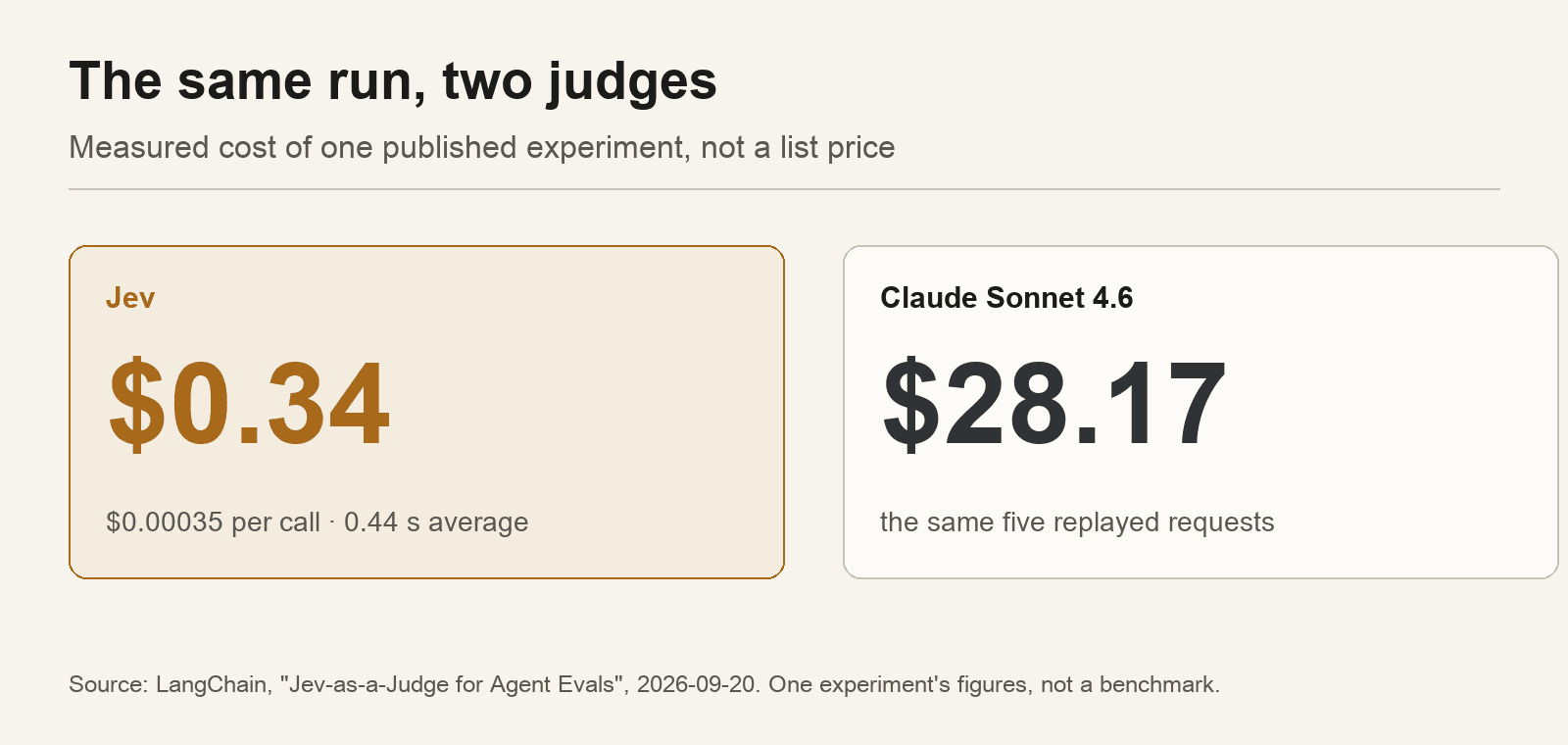
The cost comparison is less ambiguous. In LangChain's experiment a Jev judgement cost $0.00035, and the complete run of repeated judgements came to $0.34. The same run with Claude Sonnet 4.6 came to $28.17, a difference of about 83 times.
Eighty-three is not four hundred and forty-four. It is also more than enough to change what a team does: at a third of a dollar per evaluation pass, you stop choosing between coverage and budget and start running the judge on every trace instead of a sample.
Published 2026-09-20 by Daniel Shea and Seán Roche, with a public repository and pinned versions. LangChain ran a livestream with TypeSafe two days later.
Read the caveats with the numbers
LangChain wrote its own limitations down, which is the mark of a test worth reading. The experiment is built on five weather requests replayed through one agent. The variance result is described as observational, not as evidence that the training objective caused it. And they warn that low cost can amplify mistakes, because a consistently wrong evaluator produces bad feedback at scale.
They also pinned the versions and published the repository, so the run can be repeated. That is the difference between a benchmark and a boast, and it is rarer than it should be five days after a launch.
Why free output tokens matter more than the multiplier
A System One model returns a typed value, not a paragraph, so its output is tiny by construction. Charging nothing for it is less a discount than an admission that there is almost nothing to charge for. The meaningful number is the input price, which is where a long trace lands.
TechCrunch reached for the Jevons paradox to describe what follows, and the analogy fits the evaluation case exactly: when a judgement becomes cheap enough to stop counting, teams do not spend less. They judge far more, on more dimensions, more often. The budget moves from deciding whether to evaluate to deciding what to do with all the feedback.
How to check the next launch
Find the primary source and its date before repeating a number. Ask who ran the test and what relationship they have with the vendor. Look for the method: how many repetitions, against which baseline, on what task. Then ask whether the task in the test resembles the task you actually run, because a model can be excellent at scoring weather answers and untested at everything else.
Finally, check availability. Jev has no open weights, sits behind an early-access waitlist, and reaches most people through infrastructure such as Cloudflare's AI Gateway. A number you cannot act on is trivia.
Questions about the numbers
Is Jev really 40 to 200 times faster?
That is TypeSafe's figure for classification against frontier language models. The one measurement published outside the company is an average of 0.44 seconds per call, which sits inside the claimed 70 to 500 millisecond range, near its slow end.
What does one call cost?
TypeSafe lists $0.042 per million input tokens with free output. LangChain measured $0.00035 per call, and $0.34 for a run that cost $28.17 with Claude Sonnet 4.6.
Has anyone benchmarked it properly?
Not yet. There is one narrow experiment with a published repository and pinned versions, run by a company that hosted a livestream with the vendor two days later.
Keep reading
Ciyo writes about the models behind creative and agent tooling, and tests the ones it can run.