Models · For designers
Reading Every Comment, Not a Sample

The post does well. Two hundred replies arrive over a weekend. On Monday somebody scrolls for ten minutes, answers the four they happen to see, and closes the tab. Somewhere in the unread remainder is a customer asking whether you are open on the bank holiday, and a complaint about an order that will become a review.
Nobody chose that outcome. It is just what happens when reading everything costs an hour and reading some of it costs ten minutes. A model released on September 15, 2026 changes the price of the reading, which changes the choice. Ciyo cannot run Jev — it produces no image and no video and appears in neither of our model registries — but this is the job in a marketing week that most obviously fits it.
Why comments fit this shape of tool exactly
A comment is short, it is text, and what you need from it is a handful of yes-or-no facts rather than an essay. Those three properties are the whole specification.
This kind of model reads text only — TypeSafe's documentation says the input must be a string, a JSON object or an array of text values, and that images are not supported yet. For a comment thread that boundary costs you almost nothing, unlike almost every other creative job.
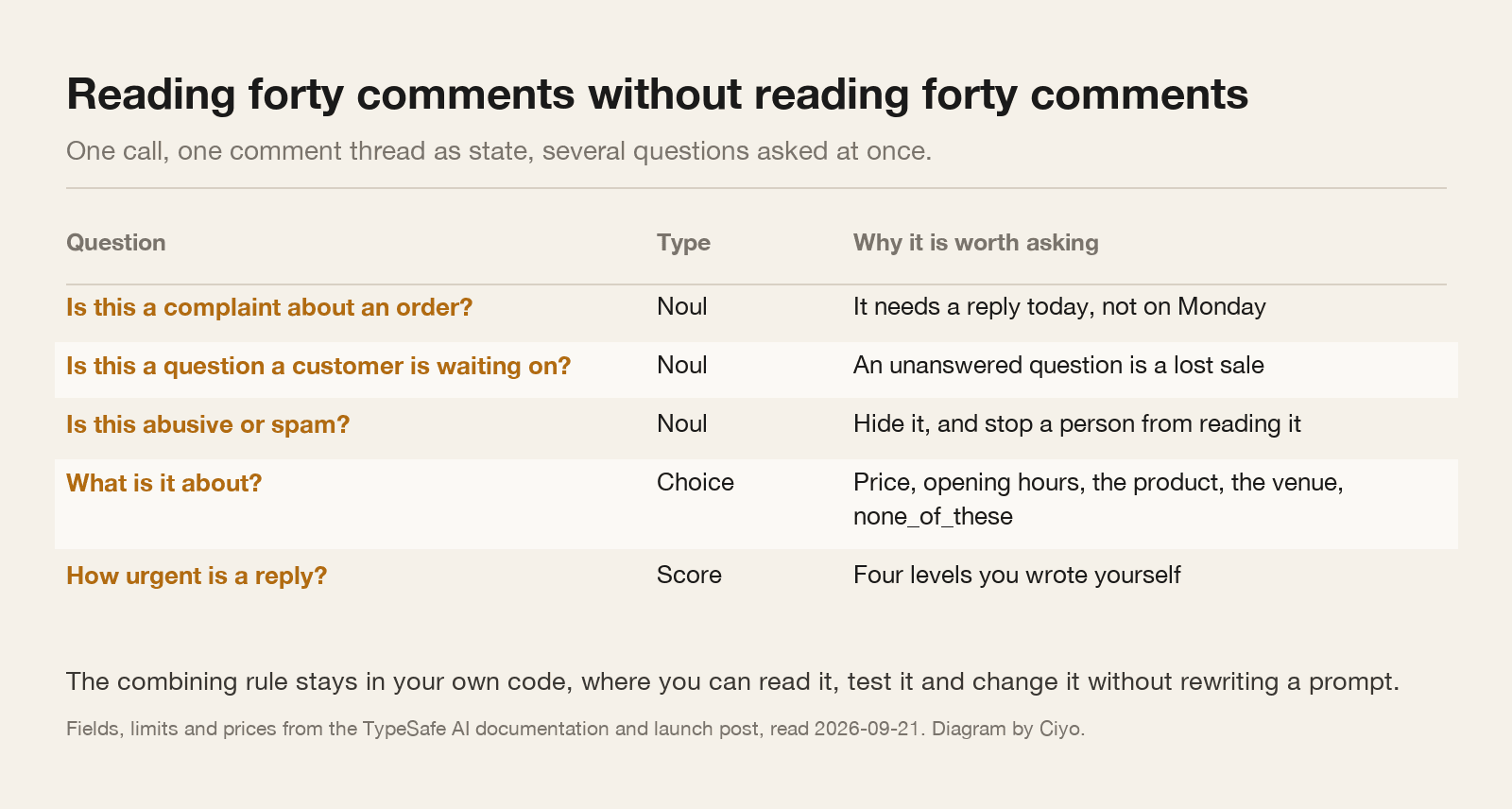
And the questions you want answered are already decided before you read: is this a complaint, is somebody waiting on an answer, is this abuse, what is it about, how urgent is it. You are not looking for insight. You are sorting.
The questions worth asking of every reply
Five narrow questions beat one broad one, and they are evaluated together against the same comment, so asking five costs little more than asking one.
What changes when checking everything is affordable
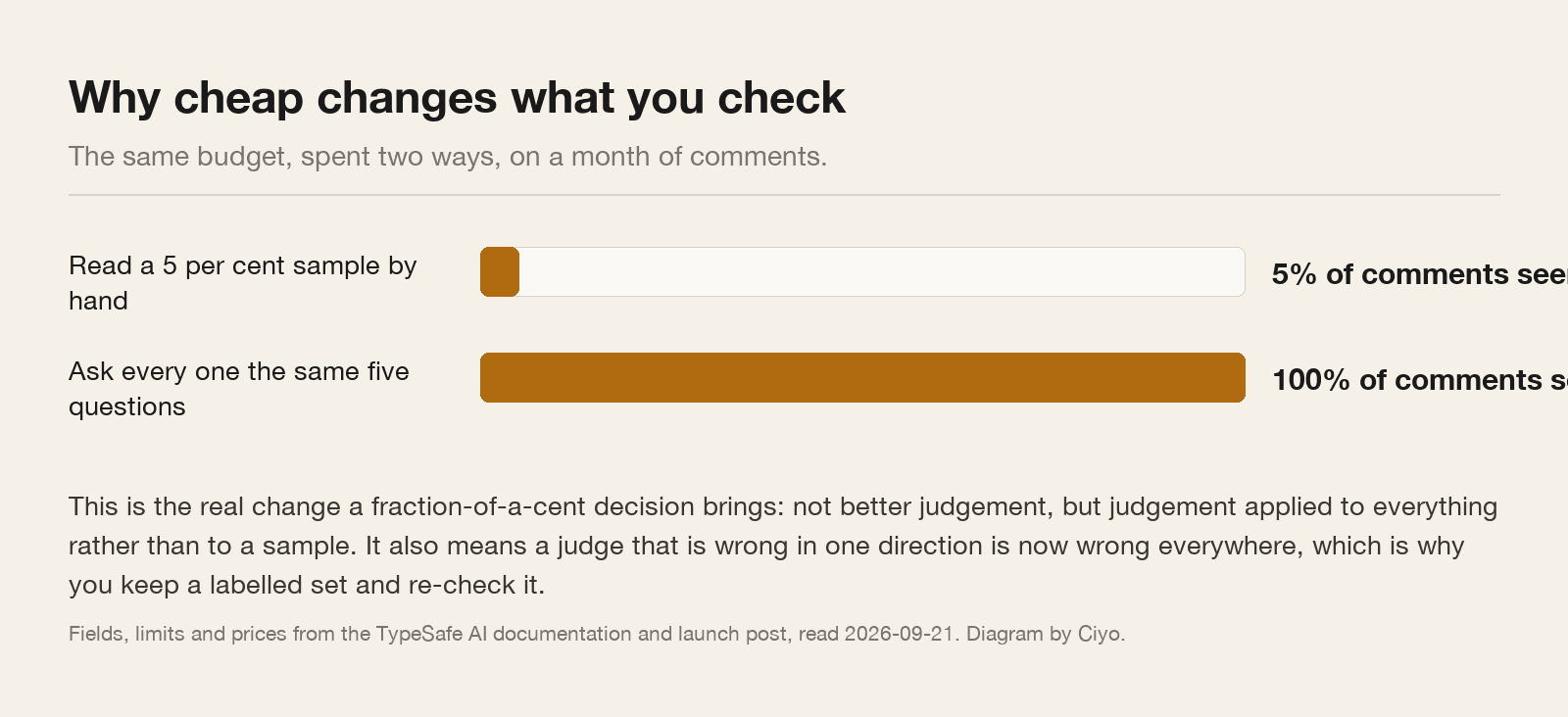
At a published $0.042 per million input tokens with output free, a comment costs a tiny fraction of a cent to ask five questions about. A month of replies for a small business costs less than a coffee.
The change that matters is not the money, it is which comments get seen. A five per cent sample read by a tired person on Monday is the status quo. Every comment sorted before anybody opens the tab is a different operation.
And the ordering changes too. Instead of reading newest-first, which is how platforms present replies and has nothing to do with importance, you open a queue where the complaints and the unanswered questions are at the top.
Do not let it reply to anybody
This is worth saying plainly, because it is the first thing people reach for and it is the wrong use.
A decision model cannot write. It returns a category, a score or a number, and nothing else. There is no sentence to send. If you want automated replies you are asking for a different kind of model, and you should think hard about whether you want them at all.
What this does is decide who deserves a human reply and in what order. That is a smaller promise and a much better one: the customer still hears from a person, and the person spends their time on the forty comments that needed them rather than on the hundred and sixty that did not.
| Bucket | What goes in it | Who handles it |
|---|---|---|
| Answer today | Complaints about an order, and questions somebody is waiting on | A person, first thing |
| Answer this week | General questions, opening hours, product curiosity | A person, when there is time |
| Hide | Abuse and spam | Automatic, above a high confidence |
| Acknowledge | Compliments and tagged friends | A like, or nothing, and that is fine |
| Somebody look at this | Anything the model was unsure about | A person, because the confidence was low |
The two rules that keep it honest
Declare an escape option on every choice. A pre-registered independent evaluation published on September 20, 2026 found that when no “none of these” option existed, none of thirty out-of-scope inputs were flagged: the model picked the nearest declared category and attached a confidence to it. A comment in another language, or a bot, or something none of your buckets anticipated, will land somewhere wrong and look settled.
And route on confidence, not just on the answer. Hiding a comment is destructive and irreversible in the customer's eyes, so it deserves a high bar; adding it to a queue does not. The published routing pattern puts anything below 0.6 in front of a person and reserves automatic action on expensive decisions for 0.85 and above.
Read what it hid. Once a week, ten minutes. A checker that is consistently wrong is now consistently wrong on everything, and the hidden pile is where that failure goes to be invisible.
Where to start
Take the last two hundred comments on your own account and sort them by hand into your buckets. It takes half an hour and it is the only benchmark that means anything.
Write the bucket definitions down while you do it. You will find edge cases immediately: is “this is expensive” a complaint or an opinion, and does a tagged friend with no words count as anything at all?
Then run the questions over the same two hundred and compare. If it agrees with you on the complaints and the unanswered questions, it is doing the job. If it disagrees, the usual cause is that your definitions were not as clear as you thought, which is useful to know before you automate anything.
Comment triage questions
Can it write the replies too?
No. A decision model produces a category, a score or a number and nothing else. It decides who needs a human reply and in what order; a person still writes it.
Can it read comments in other languages?
With lower accuracy. TypeSafe's documentation says English is the primary training language and that other languages, including CJK scripts, are accepted but currently less accurate.
Is it safe to auto-hide abuse?
Only above a high confidence, and only if somebody reviews what was hidden. Hiding is irreversible from the customer's point of view, so it deserves the same bar as any expensive action.
Does Ciyo do comment triage?
No. Ciyo is a canvas for making the work rather than a social inbox, and it does not run Jev. This is a job worth understanding, not a Ciyo feature.
Keep reading
Ciyo writes about the models behind creative and agent tooling, and tests the ones it can run.