Small business · Rights
Can You Sell What You Generate?
A shop owner makes a poster, likes it, and then stops: am I allowed to print this, put it in the window, and charge people money in front of it?
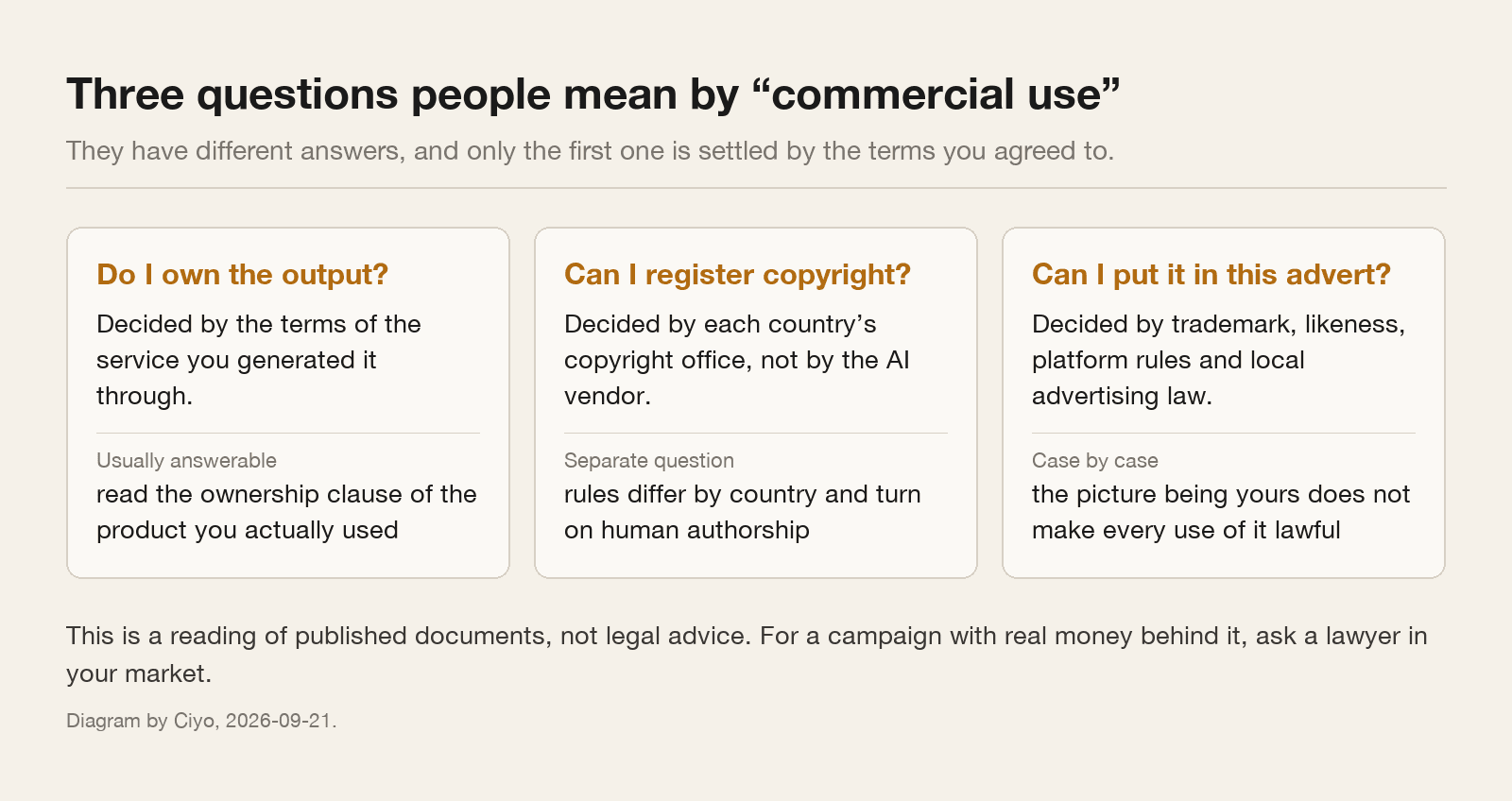
The question sounds like one question. It is three, and they have different answers from different places. This article reads the published documents and separates them. It is not legal advice, and for a campaign with real money behind it you want a lawyer in your own market — but you should not need a lawyer to understand what you already agreed to.
Three questions in one coat
Separate them before you go looking for answers, because each one is decided somewhere else.
Do I own the output? That is decided by the terms of the service you generated through. Can I register copyright in it? That is decided by a copyright office, and the rules differ by country. Can I put this specific picture in this specific advert? That is decided by trademark, likeness rights, platform policy and advertising law, and the picture being yours does not settle it.
What the ownership clause actually says
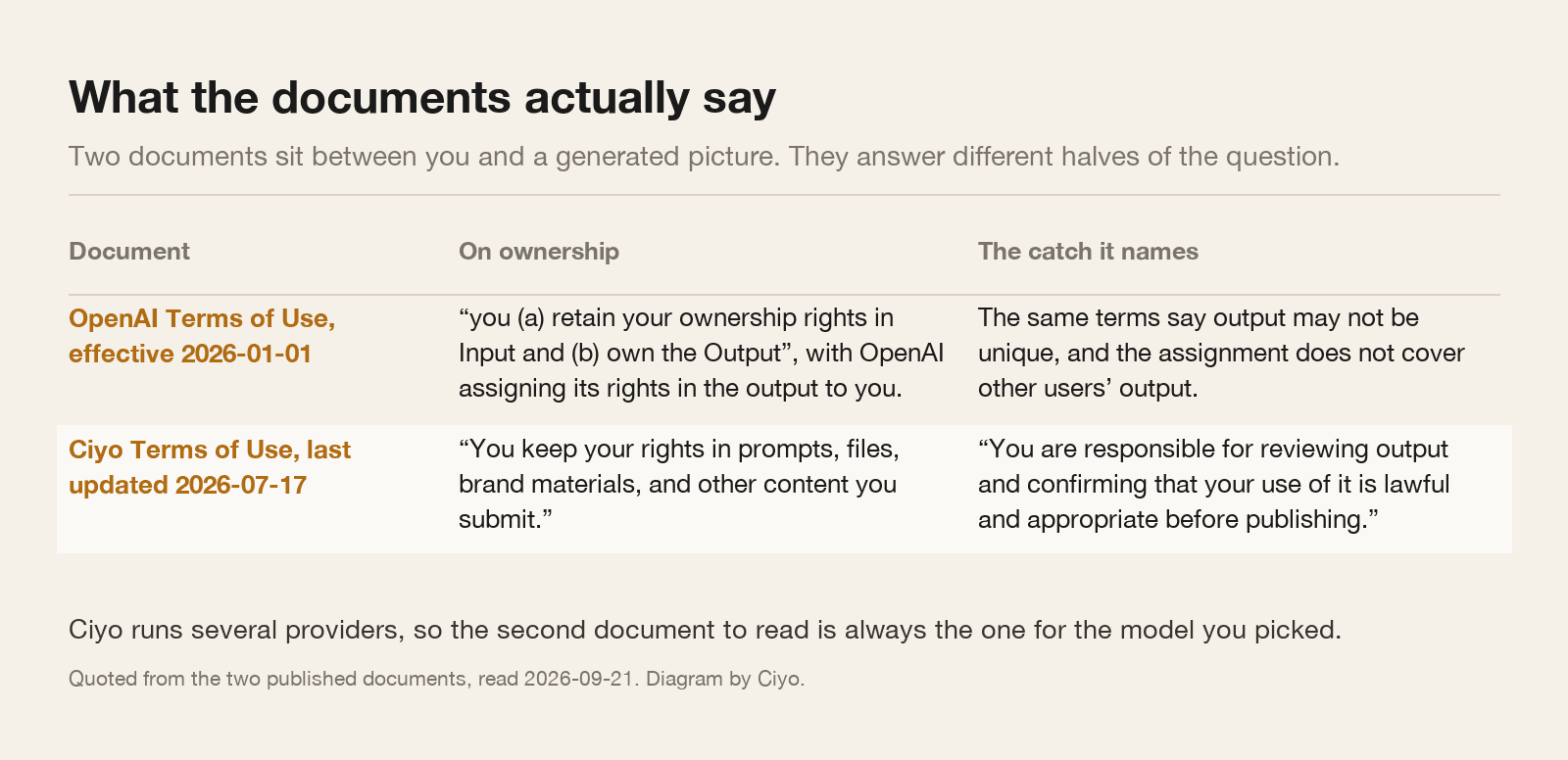
OpenAI's Terms of Use, effective January 1, 2026, are unusually direct about this. Under “Ownership of content” they say that as between you and OpenAI, and to the extent permitted by law, you retain your ownership rights in the input and own the output, and that OpenAI assigns to you all of its right, title and interest, if any, in the output.
Two qualifiers in that sentence are doing real work. “As between you and OpenAI” means the clause settles the question between those two parties and nobody else. “If any” acknowledges that OpenAI may have had no rights to assign in the first place, which is the copyright question in the next section.
The same terms add a warning people skip: output may not be unique, other users may receive similar output, and the assignment does not extend to other users' output. If two shops generate a similar poster, neither has a claim against the other on the strength of that clause.
The second document is the tool you used
Most people do not generate directly against a model vendor. They use a product, and the product's own terms are the ones they accepted.
Ciyo's Terms of Use, last updated July 17, 2026, say that you keep your rights in the prompts, files, brand materials and other content you submit, and that Ciyo's permission to process that content exists only to operate, secure and improve the service. They then hand the review back to you: output may be inaccurate, incomplete or similar to content generated for other users, and you are responsible for reviewing output and confirming that your use of it is lawful and appropriate before publishing or relying on it.
That last sentence is the one to take seriously. It is not a disclaimer to skim; it is the product telling you where its responsibility stops and yours starts. A tool that runs several model providers, as Ciyo does, also means the relevant vendor terms depend on which model you picked for that run.
Copyright registration is a separate door
“You own it” and “you can register a copyright in it” are different sentences. Ownership between you and a vendor is a contract. Copyright is granted by law, and several copyright offices have taken the position that purely machine-generated material does not qualify without meaningful human authorship, with the amount and kind of human contribution assessed case by case.
The practical consequence for a small business is usually mild. You can still print the poster, put it in the window and sell coffee in front of it. What you may not be able to do is stop somebody else from using a closely similar image, because the enforcement tool you would reach for is exactly the one that registration provides.
Rules differ by country, and this area moves. Check your own national copyright office rather than a summary, including this one.
Posted 2026-09-20, in a public argument about AI and copyright. The poster's point — that registrability turns on demonstrable human effort, that the copyright office decides, and that the rule is jurisdiction-specific — matches the distinction this article draws. The thread's wider claims about training-data litigation are the poster's own and are not relied on here.
The checks worth doing before a picture goes public
None of these are about AI. They are the checks any image needs, and generated images fail them in their own characteristic ways.
| Check | Why generated images fail it | What to do |
|---|---|---|
| Recognisable brands | A renderer will cheerfully invent a logo that resembles a real one | Look at cups, signage, packaging and clothing before publishing |
| Recognisable people | Faces can drift towards a real person, and likeness rights are separate from copyright | Avoid photoreal faces in adverts, or use a model release for a real one |
| Claims in the picture | Prices, dates and “award winning” text get rendered as confidently as anything else | Read every word in the image against what is actually true |
| Platform disclosure rules | Several platforms and advertising codes now require AI content to be labelled | Check the rules of the channel you are posting to |
The short version for a shop owner
Under the terms you agreed to, the picture is yours to use, including commercially, and the vendor has assigned you whatever rights it had. Your exclusivity is weaker than you might assume, because similar output can reach other people and registration may not be available.
So use it, print it, advertise with it — and do not build a brand identity on a single generated image you would be upset to see somewhere else. For the mark on your door, the sign and the packaging, the small extra cost of a human designer buys you something the terms cannot.
Commercial use questions
Is this legal advice?
No. It is a reading of two published documents and a description of how the questions differ. For anything with real money or real risk attached, ask a lawyer in your jurisdiction.
Do I own images I generate in Ciyo?
Ciyo's terms say you keep your rights in what you submit and make you responsible for confirming your use of the output is lawful before publishing. The model vendor's terms for the model you chose govern the output itself; OpenAI's, for example, assign their rights in the output to you.
Can somebody else generate the same image?
Something close, yes. The terms say plainly that output may not be unique and that the assignment does not extend to other users' output.
Do I have to say a picture was made with AI?
It depends on where you publish and what you claim. Several platforms and advertising codes require disclosure, and OpenAI's terms separately prohibit representing output as human-generated when it is not.
Make it, then check it
Generate the poster, run the four checks above, and keep a note of which model made it and when. That record is what makes the rights question answerable later.