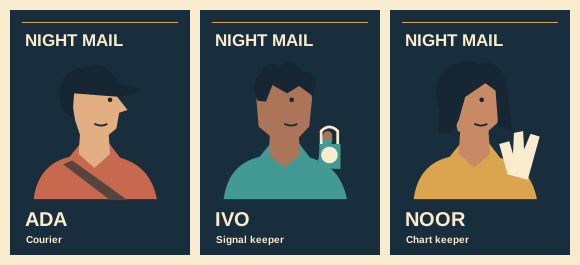
Cast portrait illustration
Match the eye line across three cast portraits
Different hairstyles make top-of-head alignment unreliable. Noor’s chart fan rises well above her forehead while Ada’s cap sits low. Align the faces first and give the costume details their own space.
Set a horizontal guide
Choose one working eye height for the three individual cards. Draw a temporary line through the master and place the centre of the visible eye on it for the first straight-on portrait.
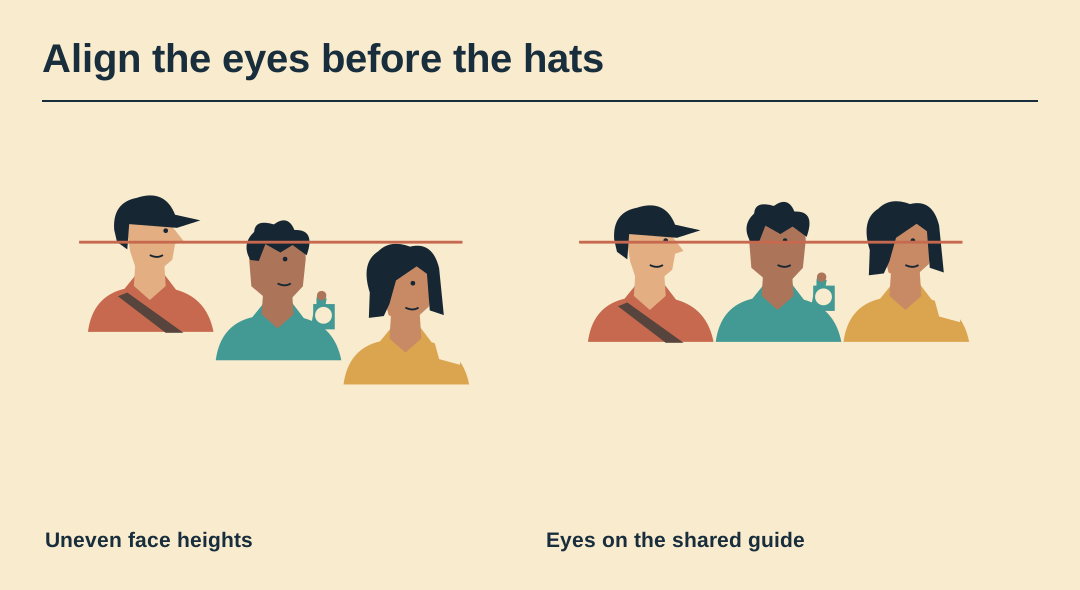
Use the face as the scale cue
Compare chin to brow distance in the three drawings. Resize proportionally. Fitting every portrait by the height of the accessory makes the wearer of the tallest hat appear smallest.
Handle a tilted pose
For a slight head tilt, use the midpoint between the eyes. Keep a natural tilt rather than straightening the actor’s expression. Compare the result with the upright portraits at a reduced size.
Give props clearance
When the face is aligned, inspect the top and sides of the projected costume. Adjust the portrait window or reconsider the pose if the chart fan collides with the show title.
View as a strip
Remove the guides and look across all three faces. If one appears to sink, inspect shoulder position and chin size before changing the eye line again.
Keep the guide invisible
Export a proof without construction marks. Verify that the red eye guide never appears in the deliverable and retain it only in the layered master.
Inspect the portrait artwork
Open the layered vector shapes and inspect how the face, costume and role prop separate at a smaller size.