GPT-6.1 Sol · Tested
GPT-6.1 Sol vs GPT-6 Astra: Is Sol Enough to Plan Your Campaign?

OpenAI released GPT-6.1 Sol on September 29, 2026 and says it “nearly matches GPT-6 Astra's intelligence on agentic coding, computer use, and professional work at one-fifth of Astra's standard input and output token prices.” Most early tests are about code. If you plan marketing campaigns, the question is simpler: will the cheaper model follow a brief as carefully as Astra?
On September 30, 2026 we gave both models the same launch brief for a fictional honey shop in ChatGPT Work, with nine rules that are easy to break. Both followed all nine. Then we made the key image from each model's prompt in Ciyo. Both images had the exact text we asked for.
What changed on September 29
GPT-6.1 Sol is an upgrade to GPT-6 Sol. In ChatGPT it is available to Plus, Pro, Business, Enterprise and Edu users in ChatGPT Work and Codex, and OpenAI says it is “not yet available in Chat”. In the API it is gpt-6.1-sol at $2 per million input tokens, $0.10 per million cached input tokens and $10 per million output tokens.
OpenAI still recommends Astra for the hardest work: its announcement says Astra “should be used for the most difficult scientific research tasks.” A campaign plan is not that. It is careful, rule-following writing, which is exactly where a cheaper model can be enough.
| Model | Input | Cached input | Output |
|---|---|---|---|
| GPT-6.1 Sol | $2 | $0.10 | $10 |
| GPT-6 Astra | $10 | Not compared here | $50 |
The brief: nine rules that are easy to break
Harbor & Hive is a fictional honey shop launching a new honey. A good planning brief gives only the facts you want used and makes the rules checkable: exact counts, aspect ratios, word limits, one exact line of on-image text, and things that must not appear. We wrote the scoring table before either model answered.
We sent the same message to GPT-6.1 Sol and to GPT-6 Astra in ChatGPT Work, each in a new chat at the same “High” reasoning setting.
You are planning a small launch for Harbor & Hive, a honey shop at 22 Pier Lane. Product: Ember Spice honey, 250 g jar, $14, launches Saturday October 10. Audience: local Instagram followers aged 25-45. Give me exactly: (1) three image prompts for GPT Image 2.5, one 4:5 feed post, one 9:16 story, one 1:1 product shot; each prompt under 80 words; only the feed post may contain text, and that text must be exactly "Ember Spice - Oct 10"; (2) one 8-second video shot for Seedance 2.5 as a single prompt, starting from the 1:1 product shot; (3) three Instagram captions under 30 words each; (4) a 5-item checklist for reviewing the images before posting. Rules: no health or medical claims, no discount, do not invent any fact I did not give you. End with a line listing every fact you used.The scores: nine out of nine for both
Both answers had the right number of prompts, captions and checklist items, the right ratios, the exact feed text, no invented facts, no health claims and no discount. The image prompts were 52 to 60 words and the captions 20 to 23 words, well inside the limits.
The differences were small but real. Sol put the shop's name into its image prompts, which an image model might try to print on the jar. Astra kept the name out of the image prompts, but one of its captions says “this Saturday”, which is only true in launch week. Astra's checklist added a useful item: compare the jar in the picture with the real product before posting.
| Check | GPT-6.1 Sol | GPT-6 Astra |
|---|---|---|
| 3 prompts, 1 video shot, 3 captions, 5 checks | Yes | Yes |
| Ratios on the right prompts | Yes | Yes |
| Image prompts under 80 words | 59, 52, 54 | 60, 57, 57 |
| Captions under 30 words | 20, 21, 20 | 21, 23, 23 |
| Exact feed text, text on the feed only | Yes | Yes |
| No invented facts, no health claim, no discount | Yes | Yes |
| Video starts from the 1:1 shot | Yes | Yes |
| Fact line at the end | Yes | Yes |
| Worth fixing | Shop name inside image prompts | “this Saturday” in one caption |
| Time shown in ChatGPT | Worked for 36 s | 13 s, then about 23 s more |
Then make the images in Ciyo
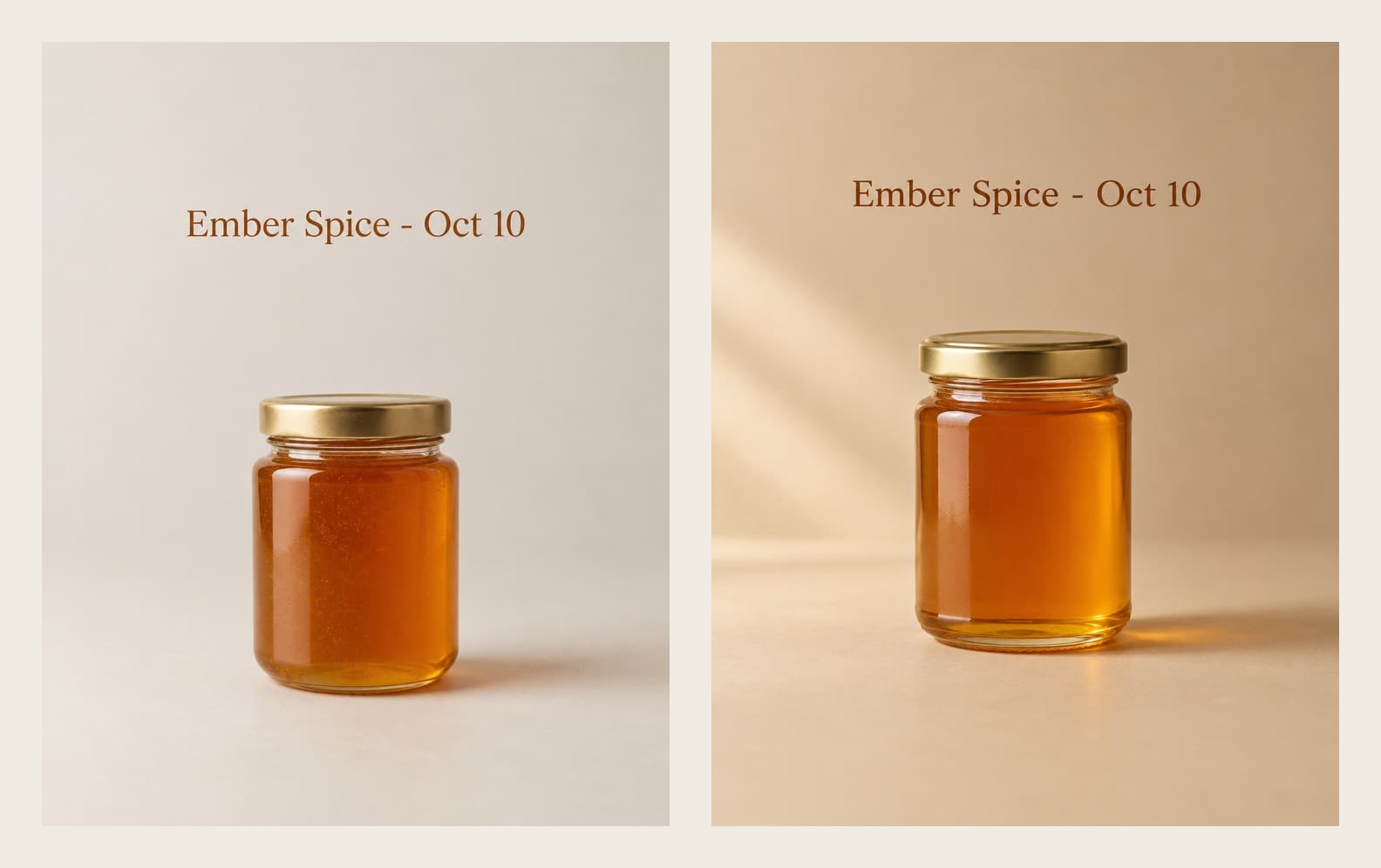
A plan is only as good as the pictures it produces, so we took each model's 4:5 feed prompt, word for word, to a new Ciyo board and asked the Ciyo Agent to generate both with GPT Image 2.5 Flare at 1K and check the text letter by letter. The two images cost 4 credits.
The agent could not open the new images in its viewer that day, so it ran text recognition on the files instead and said so. Both read exactly “Ember Spice - Oct 10”, at 93 to 97% confidence. In the Sol image the text reader also picked up faint marks on the jar, which were not letters when enlarged. The agent's verdict: “On text alone neither prompt wins, but Astra's image is slightly cleaner.”
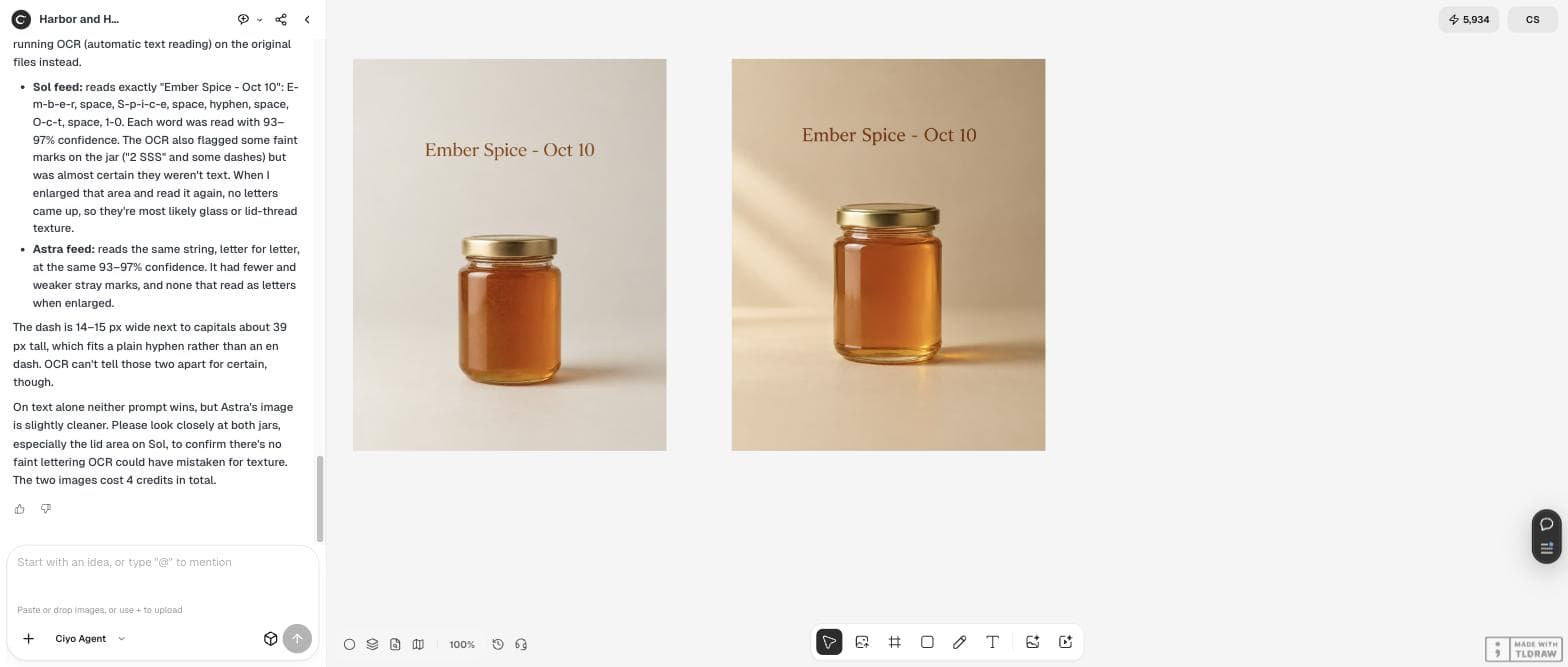
I'm comparing two planning models for a honey launch. Generate these two 4:5 feed prompts exactly as written, one image each, GPT Image 2.5 Flare, 1K. Label them "Sol feed" and "Astra feed". Then check the text in each image letter by letter against "Ember Spice - Oct 10" and tell me which one is usable. [followed by both prompts, word for word]The two feed posts
Side by side, both are usable launch posts: a plain jar, the exact line of text, warm light. Astra's prompt asked for a warm background and side light, and its picture has more mood. Sol's prompt asked for a neutral background, and its picture is plainer. That difference comes from the wording of the prompts, which you can change in either model.
Which model to use for campaign planning
For a brief like this, with clear facts and checkable rules, GPT-6.1 Sol did the job as well as Astra in our test, at a fifth of Astra's API price. Keep Astra for work where the plan needs more judgement: a new brand, conflicting goals, or a long research brief. In both cases, read the output against your rules; the small slips in our test were the kind a checklist catches.
In Ciyo the agent menu offers the Ciyo Agent and GPT-6 Astra; GPT-6.1 Sol is not one of the choices. You can plan in ChatGPT Work or Codex with Sol and bring the prompts to a Ciyo board, as we did, to generate and check the pictures.
Posted 2026-09-29. The poster tested models on two code repositories with 105 planted bugs and reported GPT-6 Astra finding 45 for $33 and GPT-6.1 Sol 44 for $6.56, calling it a single run (“n=1”). It is a coding test, not creative work, and their own test; it points the same way as ours: close results at a much lower price.
Next steps for your launch
Turn the approved plan into pictures and a short video, and keep the brief's rules in front of whoever reviews them.
GPT-6.1 Sol for creative planning
Is GPT-6.1 Sol good enough for marketing briefs?
In our test, yes. It followed all nine rules of a launch brief, the same as GPT-6 Astra, on September 30, 2026. Check the output against your own rules either way.
Can GPT-6.1 Sol make images?
It writes text and prompts; the pictures come from an image model. We generated both models' prompts with GPT Image 2.5 in Ciyo, and both images had the exact text we asked for.
Where can I use GPT-6.1 Sol?
OpenAI lists ChatGPT Work and Codex for Plus, Pro, Business, Enterprise and Edu users, and the API as gpt-6.1-sol. It says Sol is not yet available in Chat.
Does Ciyo run GPT-6.1 Sol?
No. On September 30, 2026 the Ciyo agent menu offered the Ciyo Agent and GPT-6 Astra. You can bring prompts written with Sol to a Ciyo board to make and check the images.
Turn your campaign plan into pictures
Paste your prompts on a Ciyo board, generate them with GPT Image 2.5, and let the Ciyo Agent check the text before you post.