Video · Tested
How We Made a Product Video with Claude Code from One Prompt
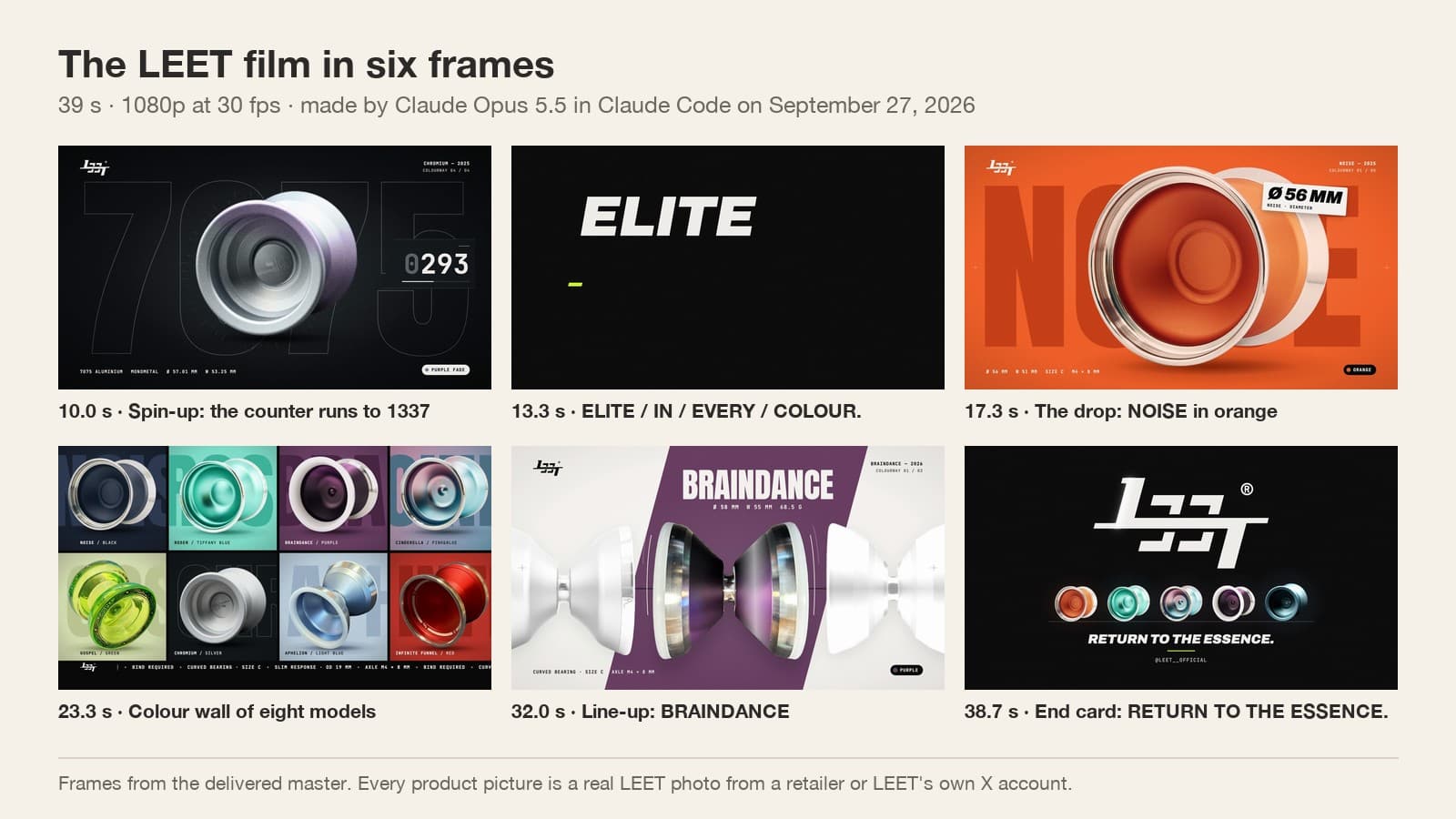
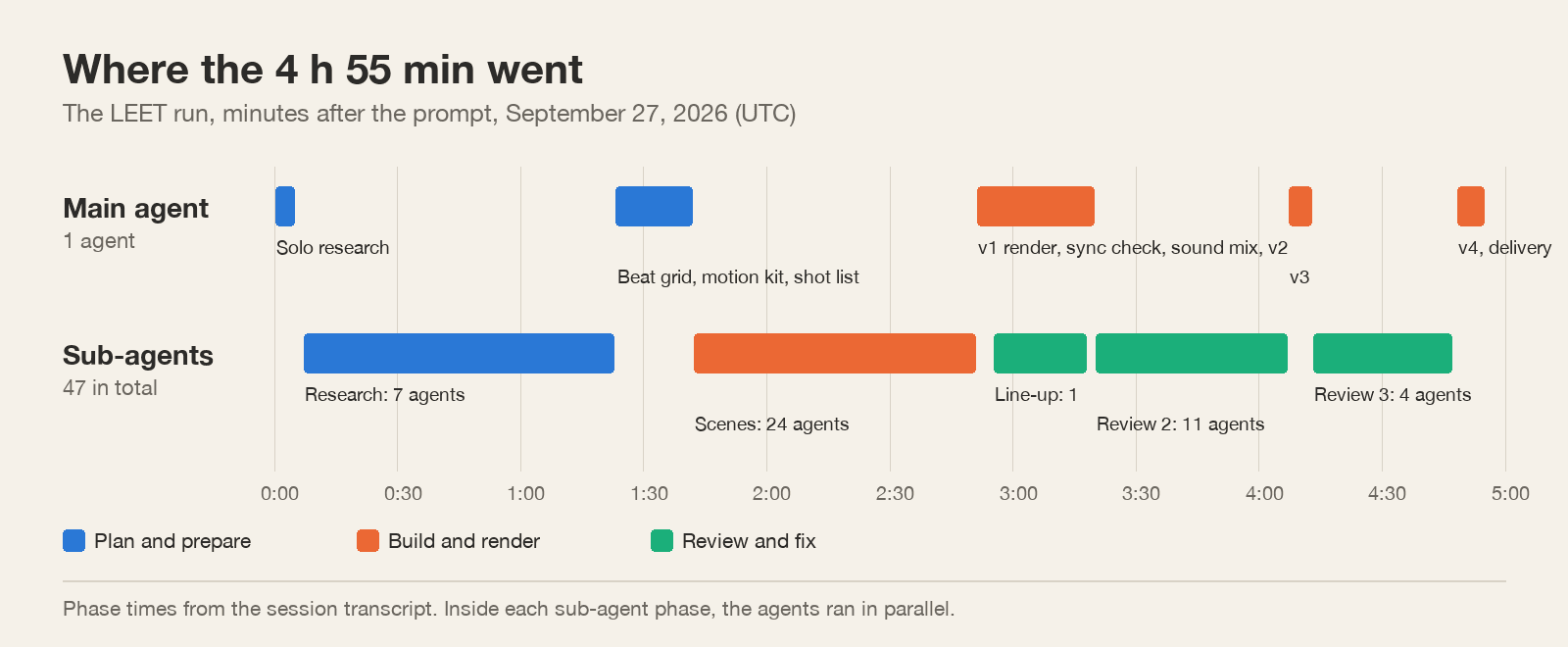
On September 27, 2026 we gave Claude Code one short prompt: make a professional promo film for LEET, a yo-yo brand, with real product assets and motion that follows the music. Claude Opus 5.5 then worked on its own for 4 hours 55 minutes and handed back a finished 39-second film with music, where every cut and colour change lands on the beat.
This article shows how the agent made it, why clean product assets decide the result, and what one prompt really took: 47 sub-agents, three review rounds and about $248 of Opus 5.5 tokens at list price. Ciyo does not run Claude Opus 5.5. The film was made in Claude Code; Ciyo is where you make and prepare the product images an agent like this works from.
The prompt, word for word
The prompt had three short lines. It named the product and told the agent to look it up. Nobody sent a second creative instruction; the only later messages, after delivery, were questions about where the music came from.
The prompt is short because it sets standards, not steps: real assets, music, motion that follows the music, and a professional result. Claude Code turned those four standards into its own production plan.
1. Use actual product screenshot/logo/assets, the product is Leet yoyo, you can search by google my yoyo product
2. Must have music and motion must match the music

Do it like a real professional production video, not like a demo or prototype.
Step 1: make the product stills in Ciyo
The first line of the prompt, use actual product assets, decides how the film looks. A video agent can move, light and cut images; it cannot invent a believable product. Give it matching stills in every colourway and it can build the shot the LEET film is made of: the yo-yo stays still and only its colour changes on each kick.
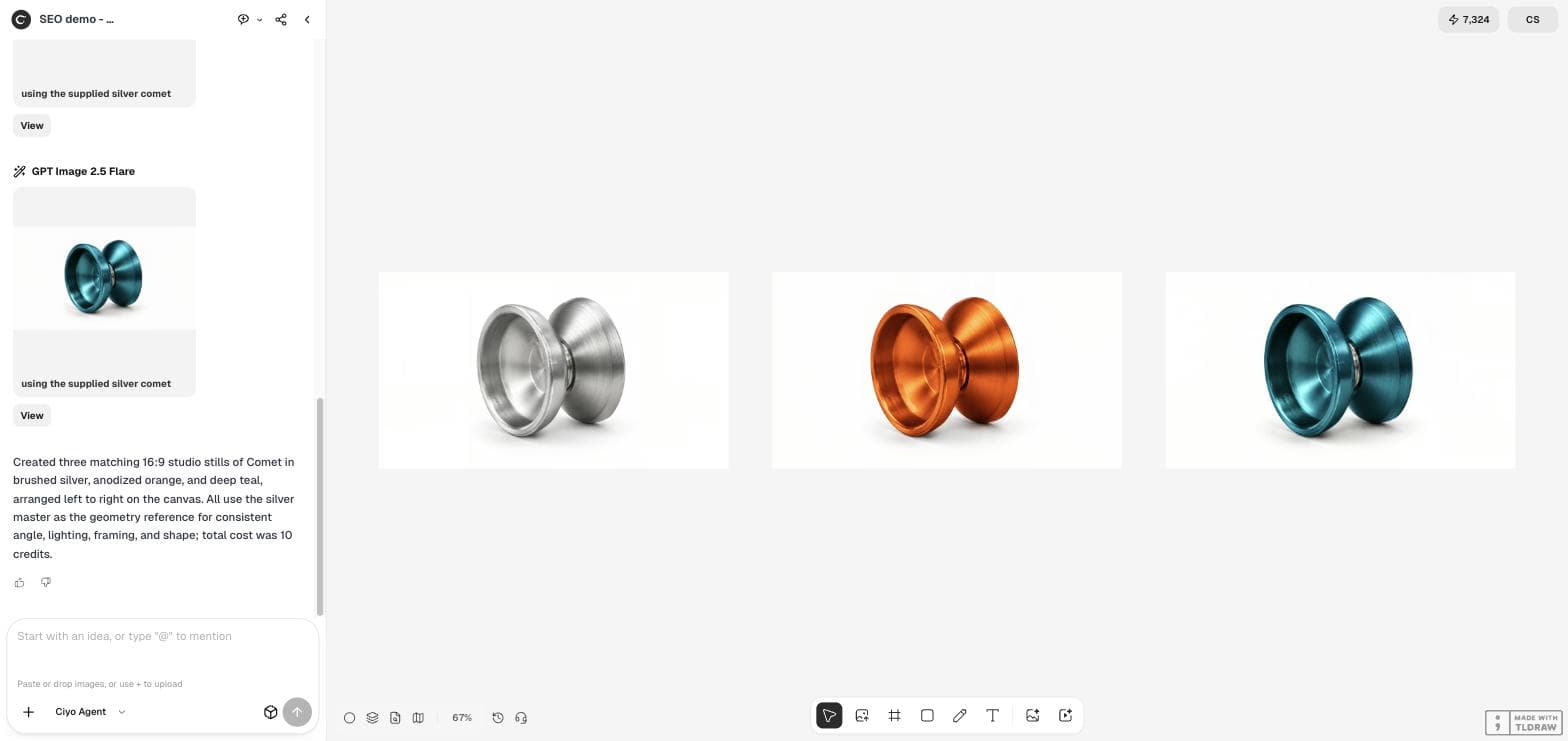
If you have no studio photos yet, make them in Ciyo. For this article we used a fictional product, Comet, a metal yo-yo from "Halcyon Spin", and asked the Ciyo Agent for three matching studio photos. It made a silver master shot first, then used it as the reference for the orange and teal versions, so the shape, angle and light match. The three 2560 × 1440 images cost 10 credits with GPT Image 2.5 Flare.
Product stills for a launch video. Comet is a metal yo-yo from Halcyon Spin, a small yo-yo brand. Make three matching studio photos of Comet: one in brushed silver, one in orange, one in teal. Same three-quarter angle, same soft studio light, plain white background, no text. The shape must be identical in all three, so only the colour changes.Posted 2026-09-26. The author says his own one-prompt Opus 5.5 video "looked mid" and lists what the better ones had in common. One point matches our experience: give Opus your logo, colours and screenshots of your real product, or it guesses them. He also recommends rendering with HyperFrames or Remotion. The post does not mention Ciyo.
Step 2: cut them out and export them
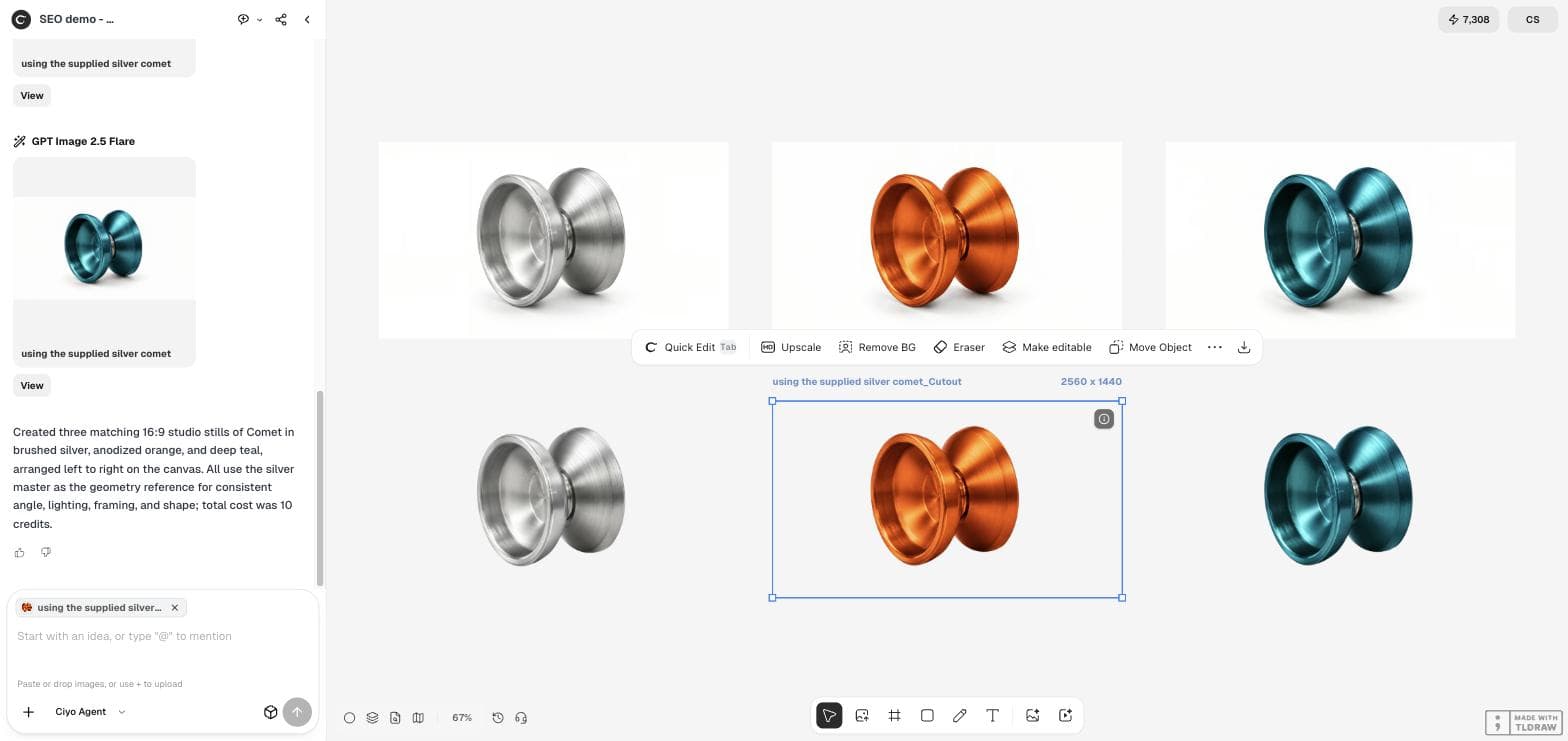
Select a still and press Remove BG in the image toolbar. Ciyo places a transparent copy beside the original; each cut-out cost 2 credits, and all three came back as 2560 × 1440 PNGs with transparent backgrounds. The complete set, three stills and three cut-outs, cost 16 credits.
Download them with the toolbar's download button and put them in one folder with your logo and a short text file of the facts you want on screen: model names, sizes, your tagline. Name the files by model and colour, for example comet-teal-cutout.png, so the agent never has to guess which file is which.
The LEET run shows why this step pays off. It had no prepared assets, so one agent downloaded 102 photos from three retailers and LEET's X account and cut out 85 of them with a local background-removal model. It took 75 minutes, the slowest job of the whole research phase, and the retailers still own those photos.
What the agent did with one prompt
Claude Code did not answer with a video. It planned a production, ran it with teams of sub-agents that each had one job, and checked their work before it moved on. Over the run, the agents made 3,314 tool calls.
Research, 75 minutes: seven agents worked in parallel. One studied the brand and found its tagline, "Aim to return yo-yo to the essence". One rebuilt the logo as a vector that overlaps the original mark by 99.5%. One cut out the photos, one chose the music, and three wrote rival creative concepts, which the main agent blended into one: "Elite in every colour".
Preparation, 20 minutes: the main agent measured the beat grid, placed every colourway of a model on one shared canvas so a colour swap changes nothing else, wrote a motion kit and a frame-by-frame shot list, and limited the on-screen text to facts it had verified on retailer pages and LEET's X account.
Build, 69 minutes: eight agents built the eight scenes in parallel, eight art directors reviewed them, and eight fixers applied the notes. Then came three review rounds and four renders; a full render of the film took about one minute.
How the music was chosen and how the motion follows it
Claude cannot hear, and it did not compose anything. It chose, cut and mixed existing music by measurement.
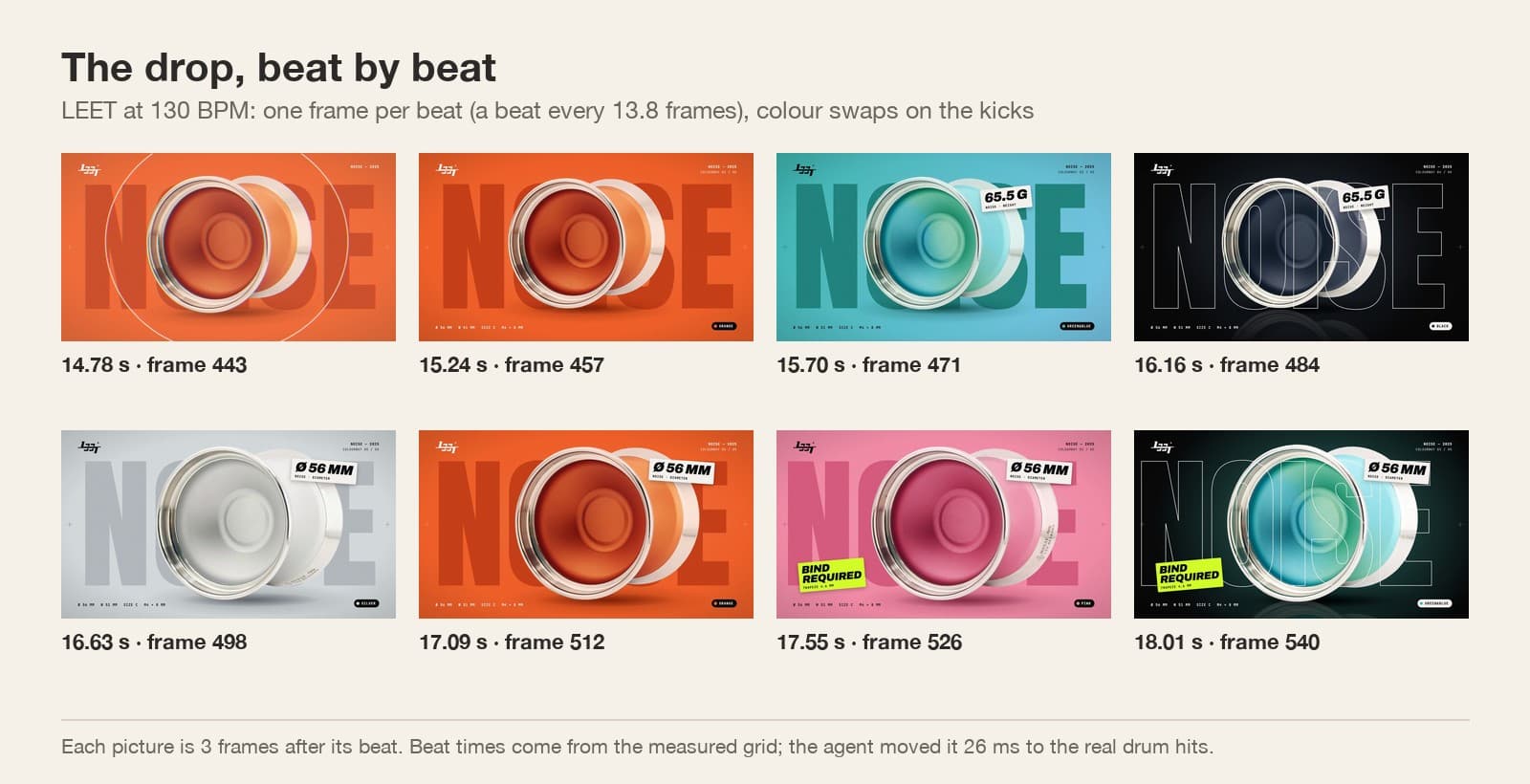
An agent read the Mixkit licence, downloaded 30 free tracks and measured their tempo, how steady the beat is and how much louder the drop is. "Night Terrors" by Arulo won with a +14.2 dB step into the drop. The main agent cut a 39-second edit from whole bars of the song, measured the real drum hits, found its scout's beat grid 26 ms late, and locked everything to exactly 130 BPM. It then placed 76 sound-effect cues from 31 Mixkit effects on musical positions: ticks on digits, whooshes on cuts, a metal ring on the chrome yo-yo.
Every animation is timed in music, not seconds. Each scene asks for a frame with fAt(bar, beat), so a cut or a colour swap lands on its frame because the code has no other way to say when.
The review rounds made it look professional
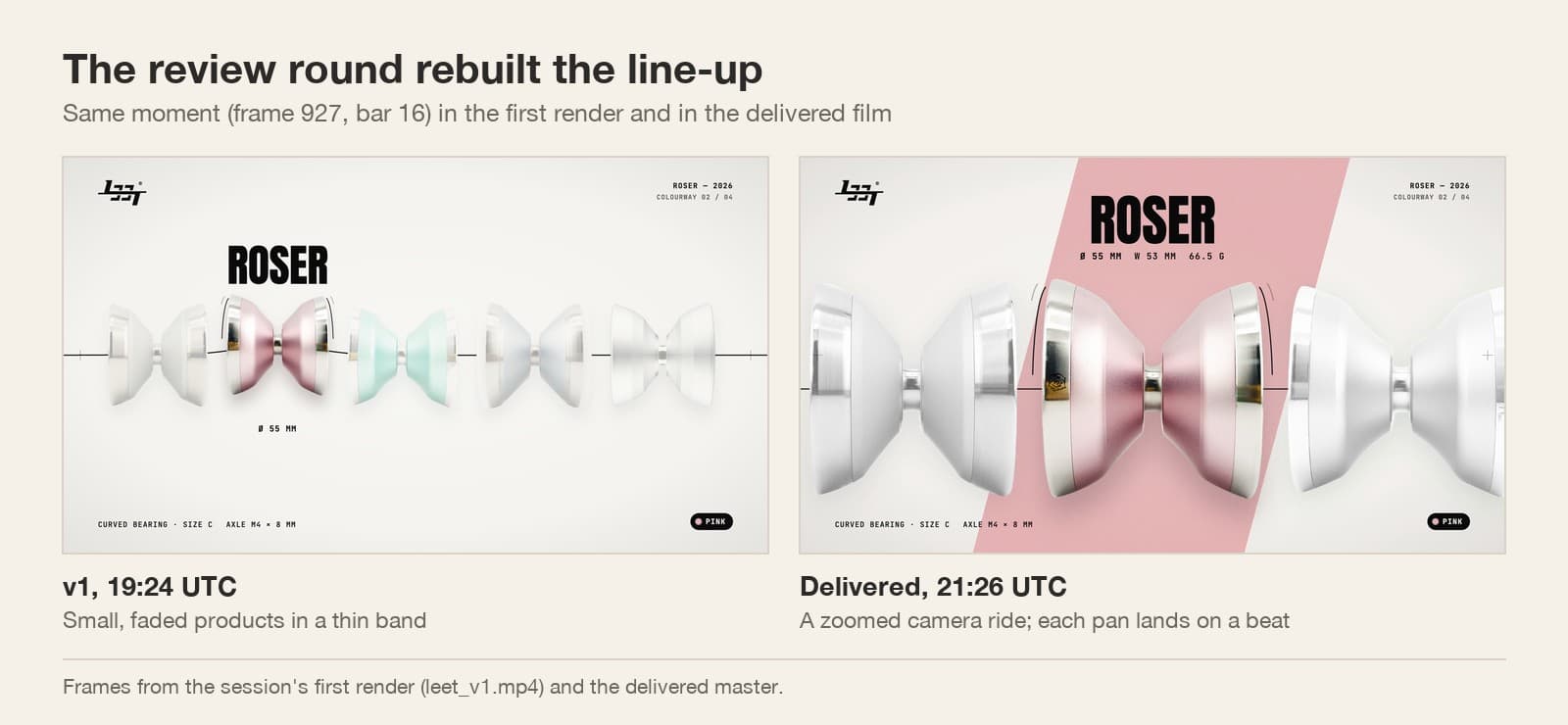
The first render was not good enough, and the agent said so itself. Looking at one contact sheet per beat, it judged the line-up the weakest part: tiny, faded products in a thin band across an empty page. It sent a separate agent to redesign it as a zoomed camera ride.
Critics that review but do not edit looked at art direction, sync, brand and copy, and technical quality. The first round found 10 blocking issues across the eight scenes, the second found 47 issues in the whole film, and the third found a flicker the agent had caused itself: the film grain loaded through CSS and was missing on some frames. In the delivered film, 39 of 40 visual events land on the beat or within one frame of it; the other is a planned black frame before the drop. The mix is at −14 LUFS, the usual loudness for web video.
What one prompt really cost
The token counts come from the session log. We priced them at Anthropic's list price for Claude Opus 5.5 at standard speed: $4 per million input tokens, $20 per million output tokens, $0.20 per million cache reads, and $5 or $8 per million cache writes (5-minute or 1-hour). A Claude subscription is billed differently, so read the dollar figure as a list-price estimate, not an invoice.
Most of the cost is cache reads: each sub-agent re-reads its growing context at every step. Fewer agents and fewer review rounds cost less, and look less finished.
| Item | LEET film |
|---|---|
| Film | 39 s, 1920 × 1080, 30 fps |
| Prompt to finished file | 4 h 55 min |
| Sub-agents | 47 |
| Output tokens | 3.84 million |
| Cache reads | 517 million |
| Opus 5.5 at list price | about $248 |
| Music | Mixkit free licence, $0 |
| Sound effects | 31 Mixkit effects, 76 cues, $0 |
| Files delivered | 139 MB master, 28 MB web version |
Copy this workflow
1. Make or collect one still per colourway in Ciyo and cut each one out.
2. Put them in a folder with your logo (an SVG if you have one) and a facts.txt with the names, sizes and lines you want on screen.
3. Open Claude Code in that folder and send a prompt like the one below.
4. When the file arrives, watch it once with the sound on; the agent cannot hear it.
Then check the rights. Photos taken by your retailers belong to them. Mixkit's free music licence covers online video, social posts and web ads, but not TV, radio, games or CDs, and the track is not exclusive to you. Remotion, the video library the agent used, is free for individuals and companies with up to three employees; larger companies need a company licence.
Make a professional product promo video for [brand], not a demo or prototype.
1. Use only the real assets in this folder: the product stills and cut-outs, the logo, and facts.txt. Put only facts from facts.txt on screen.
2. It must have music, and the motion must match the music. Use music I may use in online ads, and tell me its licence.
3. 16:9 at 1080p, about 30 seconds.
Deliver a master file and a web version under 30 MB, and list what I must check before I publish.Product videos with Claude Code
Can Claude make a marketing video from one prompt?
Yes, in Claude Code with Claude Opus 5.5. Our run on September 27, 2026 started from one three-line prompt and delivered a finished 39-second film with music after 4 h 55 min.
Did Claude make the music?
No. The agent downloaded 30 free tracks from Mixkit, chose one by measurement, cut it and mixed it with sound effects. Claude cannot listen, so play the mix before you publish.
How much did the video cost?
At Anthropic's list prices, about $248 of Claude Opus 5.5 tokens. The music and sound effects were free under Mixkit's free licences.
What renders the video?
Code. The agent wrote the film in Remotion, a React video library, rendered it frame by frame and encoded it with ffmpeg.
Can I do this inside Ciyo?
Ciyo does not run Claude Opus 5.5. Use Ciyo to make and prepare the product stills and cut-outs, then give that folder to Claude Code.
Start with the product assets
Make your product stills in Ciyo, cut them out and download them, then give Claude Code a clean folder to work from.